Office of His Holiness Dorje Chang Buddha III Announcement No. 62 (02/06/2022)

Office of His Holiness Dorje Chang Buddha III
Announcement No. 62 (02/06/2022)
Office of His Holiness Dorje Chang Buddha III
Announcement No. 62 (02/06/2022)

On January 1, 2022, His Holiness Dorje Chang Buddha III imparted a Dharma for living beings in His Vajra Mandala in Las Vegas on “Greed Can Destroy One’s Realizations,” also titled “Greed is the Foremost Culprit in Destroying One’s Realization.” After Namo Dorje Chang Buddha III imparted Dharma, Fomu, Holy Mother the Great Mahasattva, saw the flowers offered by disciples in the Mandala, then gave a short Discourse: When offering flowers, we must do so with utmost sincerity. There are four main types of flowers for offering to Buddhas: peony, orchid, sunflower, and lotus. Many other flowers, such as Chinese peony 芍藥, should not be offered to Buddhas. After Fomu, Holy Mother the Great Mahasattva, gave the Discourse, She blessed each disciple in the Mandala with a Vajra pill, then announced that she will bear dark karma for living beings.

On the evening of January 4, His Holiness Dorje Chang Buddha III summoned four types of disciples and told them: “Now being the Dharma Ending Era, living beings’ dark karmic forces are too heavy and getting worse. Fomu cannot bear them on Her own. This time, I am going to bear the dark karma together with Fomu for living beings. Therefore, starting tomorrow, I will go into seclusion to perform Dharma. During this period, I will no longer see you! As long as each of you cultivate yourself in accordance with the Dharma, you will attain liberation.”

After some days, when the disciple Tsemeng 翟芒 rushed to Las Vegas to see if His Holiness Dorje Chang Buddha III was well, the Buddha said to him: “Tsemeng, in the Dharma Ending Age, the dark karmic forces of living beings are too heavy. When I said I would bear dark karma for living beings, those were not empty words. To bear dark karma is not to enter dhyāna, but rather, truly and continuously practice shifting the mind-consciousness to suffer on behalf of living beings. What Fomu and I said is what we do. At all times,we must think about bringing auspiciousness, serenity, happiness, and peace to living beings and to the world,to the extent of giving our all and even our lives. I have already brought true Buddha Dharma to this world. Everyone who practices in accordance with The Supreme and Unsurpassable Mahamudra of Liberation and Imparting the Absolute Truth Through the Heart Sutra will surely attain liberation. That’s all. I wish all living beings happiness.”

From then on, other than giving instructions to Dharma King Jinba 金巴法王 and Dharma King Mohe 摩訶法王, Namo Dorje Chang Buddha III did not impart Dharma openly. After almost a month of bearing dark karma for living beings, Namo Dorje Chang Buddha III and Fomu, Holy Mother the Great Mahasattva, looked very sick. In the past few decades, His Holiness Dorje Chang Buddha III had often borne dark karma for living beings, sometimes for a month or two, during which He looked seriously ill. Yet once His Holiness Dorje Chang Buddha III had completed that particular deed of bearing dark karma, Hewould immediately be full of energy as usual.One second, Namo Dorje Chang Buddha III was a gravely ill patient, the next second, He would be strong and healthy without any sickness. That’s why the close disciples have gotten used to that. However, this time, Buddhist disciples did not see His Holiness Dorje Chang Buddha III or Fomu, Holy Mother the Great Mahasattva, return to the human world. Namo Dorje Chang Buddha III and Fomu, Holy Mother the Great Mahasattva, have peacefully entered parinirvana and returned to the Sambhogakaya Buddha Land.

His Holiness Dorje Chang Buddha III, the supreme Primordial Sambhogakaya Buddha and the foremost master in the Dharma realm, came to this world to benefit living beings, and has now left this world as a result of benefitting living beings. All that His Holiness Dorje Chang Buddha III did have always been for the sole purpose of benefitting living beings. His Holiness Dorje Chang Buddha III is always of holy purity! Always altruistic! Always selfless! All of us Buddhist disciples must be grateful to the supremely great compassion and empathy of Namo Dorje Chang Buddha III and Fomu, Holy Mother the Great Mahasattva. We must truly repent our sins and beseech Namo Dorje Chang Buddha III and Fomu to return to this world!

Among all Buddhas in the Dharma realm, Dorje Chang Buddha is the Primordial Buddha, the first Buddha with form, and the only Supreme Lord of Buddhism throughout the entire universe. Dorje Chang Buddha propagated Dharma throughout the universe, hence, all other Buddhas and Great Mahasattvas learned Dorje Chang Buddha’s Dharma and cultivation to attain holy state and liberation, and eventually became Buddhas and Great Bodhisattvas. Dorje Chang Buddha is the primordial ancestor of all Buddhas and Bodhisattvas. Samantabhadra, the Dharmakaya from which Dorje Chang Buddha perfectly manifested, is the Tathagata that has no form at all. The words and deeds of Dorje Chang Buddha are the compass and guiding principles of cultivation for all ordinary and holy beings in the universe.

To help Shakyamuni Buddha, Namo Dorje Chang Buddha II —Venerable Virmalakirti—applied His supreme wisdom and limitless supernormal power to edify Hinayana Arhats who then advanced themselves and eventually became Mahayana Bodhisattvas who helped living beings attain liberation. And, innumerable living beings attained liberationby learning the teachings of Venerable Virmalakirti.

After coming to the sahā world with the Buddha level enlightenment of the Primordial Sambhogakaya Buddha, His Holiness Dorje Chang Buddha III established countless number one records in the world, every one of which was for the sake of benefiting living beings. At a very young age, He saved others without any regard to His own life and was honored with the title “Young Hero.” As He grew older, His Holiness Dorje Chang Buddha III applied His inherent Healing Vidya to heal the sick, purely on a voluntary basis. More than 500 patients used to seek His help every day. His Holiness Dorje Chang Buddha III never accepted one penny from them. Plaques and pennants with words of gratitude sent by the recovered piled up in the Buddha’s house.

As His Holiness Dorje Chang Buddha III continued to benefit living beings on a larger scale, the Central Newsreels and Documentary Studio of China produced a documentary, “One Who Is Dedicated to Advance Himself,” about His life and work. The film was shown nationwide.

In 1987, the highly respected young His Holiness Dorje Chang Buddha III was named Chairman of the Chinese Painting Research Association of the National Commission of China for UNESCO. Honorary chairpersons of the Association included Liao Jingdan 廖井丹, Li Wenqing 李文清, Lü Ji 呂驥, Yuan Xiaoyuan 袁曉園, Wu Zhangshu 吳丈蜀, Qian Juntao 錢君匋, Xie Zhiliu 謝稚柳, and others. Advisors to the Association included Luo Zhanglong 羅章龍, Zhang Kejia 臧克家, and so forth.

In 1992, His Holiness Dorje Chang Buddha III was accorded the “Art Maestro of the East” title. In 1994, during the fourth conference of the World Poets and Culture Congress held in Hungary, 5,612 experts and scholars unanimously voted to confer the “Preeminent Distinguished International Master” title, which was a Head of State level honor, to His Holiness Dorje Chang Buddha III. The conferment certificate was signed by Juan Antonio Samaranch, the then President of the International Olympic Committee. In the same year, the Museum of Master Yi Yungao officially opened in Dayi 大邑, the hometown of His Holiness Dorje Chang Buddha III in Sichuan. That was the first memorial museum in China, or even in the world, being built by a government for a living person.

In 1995, when His Holiness Dorje Chang Buddha III went from Mainland China to visit Taiwan for the first time, Taiwanese people spontaneously gave His Holiness Dorje Chang Buddha III an overwhelmingly ceremonious welcome. More than 20,000 people went to the airport to greet and pay respect to His Holiness Dorje Chang Buddha III. A motorcade of more than 1,700 cars followed the lead of police motorcycles to escort His Holiness Dorje Chang Buddha III from the airport to the hotel. That became the largest welcoming event in human history. Within the short three weeks that His Holiness Dorje Chang Buddha III stayed in Taiwan, General Chiang Wei-kuo 蔣緯國, former Secretary-General of the Taiwan National Security Council, and many other high level government officials formally requested to become disciples of His Holiness Dorje Chang Buddha III. They expressed that they wanted to truly emulate the noble morality, humanistic ethics, thoughts, and deeds of His Holiness Dorje Chang Buddha III.

After His Holiness Dorje Chang Buddha III moved to the United States, His noble morality and unparalleled achievements won the love and admiration of the American people from all walks of life. In 2002, His Holiness Dorje Chang Buddha III was presented with the “Presidential Gold Medal" by the Commissioner to the President’s Advisory Commission on Asian Americans, on behalf of President Bush.

In 2003, the Organization of American States, composing of 34 countries including the United States, Canada, and Mexico,organized the Master Wan Ko Yee Yun Sculpture Exhibition in Washington D.C. at the Capitol of the United States. The Master Wan Ko Yee Yun Sculpture Exhibition was also held at the Congressional Office Building. That was the first time the U.S. Congress held an art exhibition in their Congressional Office Building. Visitors expressed their praises in the guest book, exclaiming that the exhibition was “unprecedented,” and that the artworks were “treasures brought to the human realm by God.”

In 2004, His Holiness Dorje Chang Buddha III was named “Fellow” of the Royal Academy of Arts in the U.K.. Professor Phillip King, President of the Royal Academicians of the Royal Academy of Arts, presented the certificate to His Holiness Dorje Chang Buddha III at the British Embassy in Washington D.C., capital of the United States. The Cultural Attaché of the British Embassy personally attended the ceremony. Professor Phillip King stated that His Holiness Dorje Chang Buddha III was the first artist ever accorded this title in their renowned academy’s more than 200-year history.

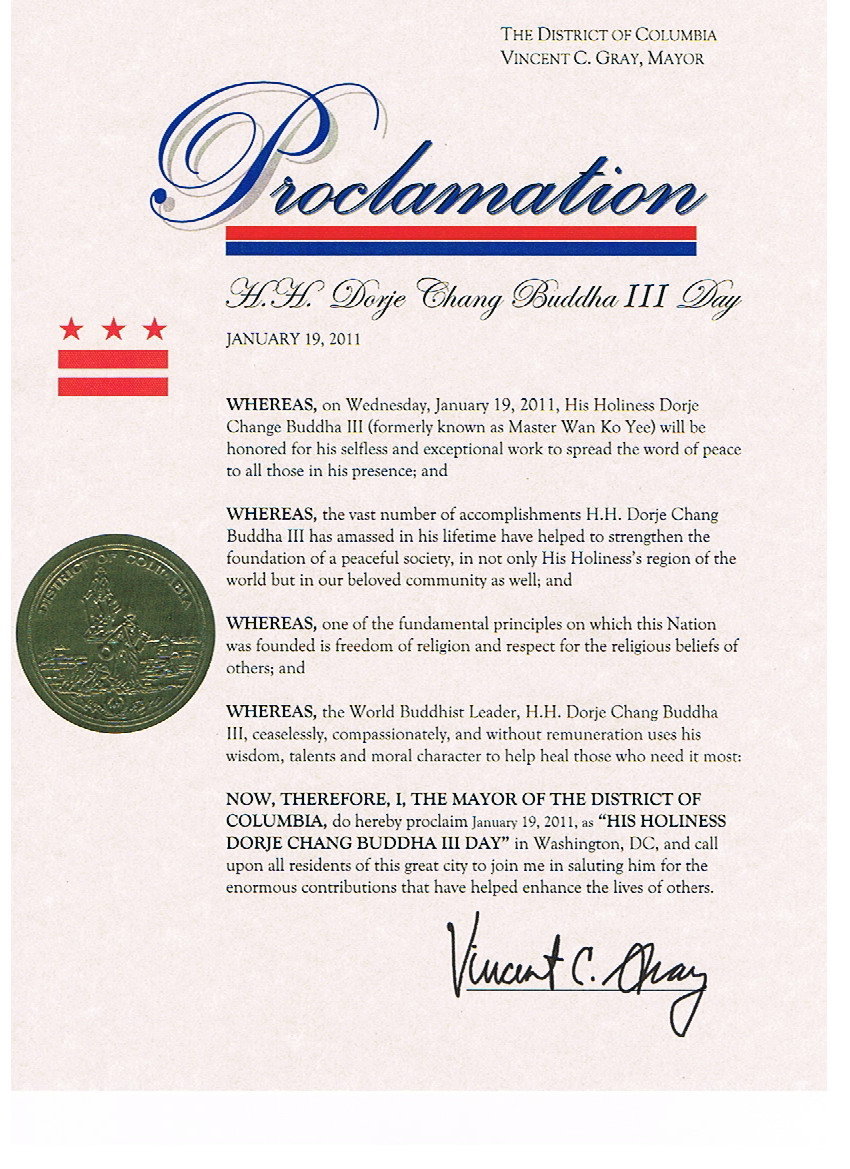
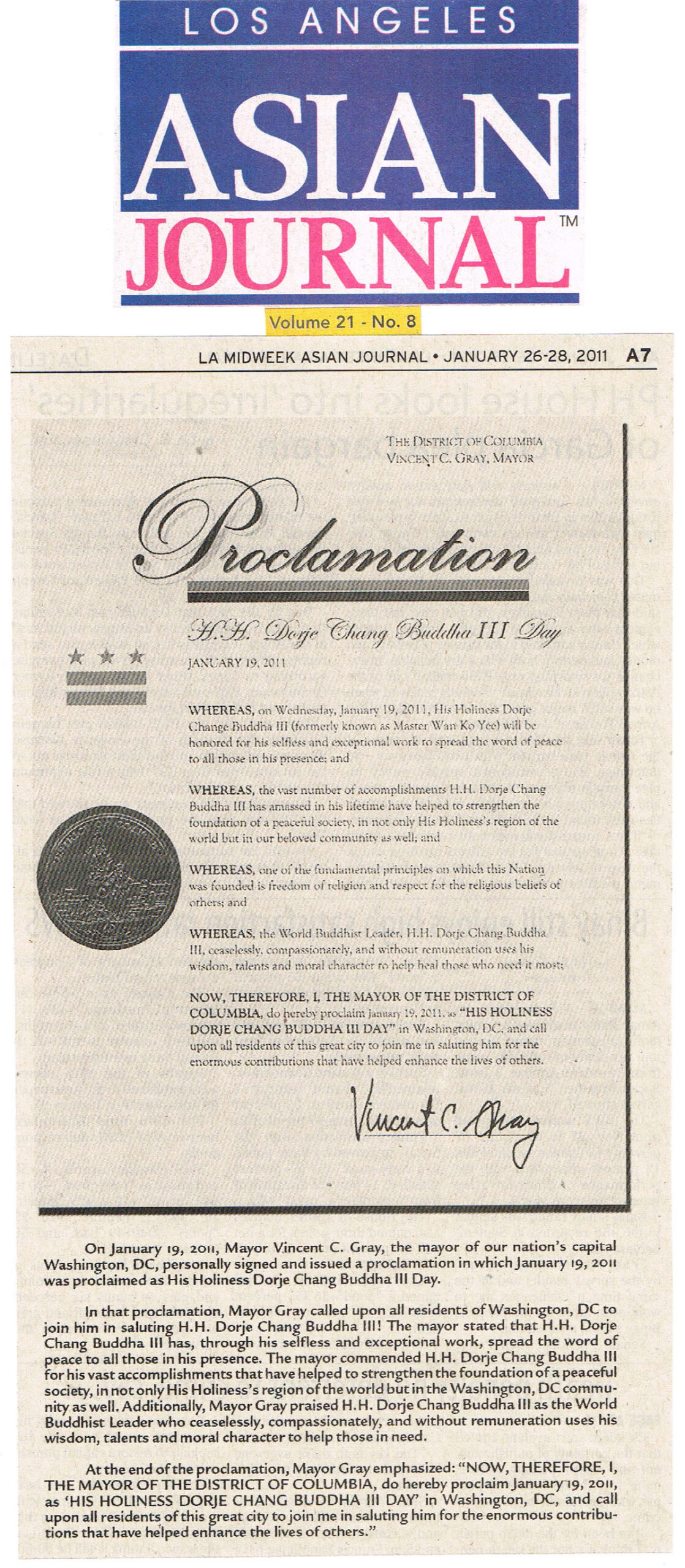
The mayor of the U.S. capital Washington D.C.pronounced January 19, 2011 as “His Holiness Dorje Chang Buddha III Day” and called on people to salute to His Holiness Dorje Chang Buddha III.

His Holiness Dorje Chang Buddha III was also accorded the “King Legacy Award for International Service & Leadership” by An International Salute to The Life and Legacy of Dr. Martin Luther King, Jr.. Dozens of great honors have also been presented to His Holiness Dorje Chang Buddha III by U.S. senators, members of the House of Representatives, governors, and governments of all levels.

More remarkably exceptional, Namo Dorje Chang Buddha III was awarded the 2010 World Peace Prize Top Honor Prize, presented to Him at the United States Congress on June 14, 2011 at the U.S. Capitol. On occasions of the holy birthday of His Holiness Dorje Chang Buddha III, the U.S. Congress has held ceremonies to raise the national flag to celebrate, and President Trump and President Biden have sent personal congratulations.

In 2018, the World Peace Prize Awarding Council and the World Peace Prize Religious Leader Title Awarding Council resolved that His Holiness Dorje Chang Buddha III was the Pope of Buddhism of this world and decided to present the Pope of Buddhism Scepter to Him. Namo Dorje Chang Buddha III, however, did not accept the Scepter, but returned it instead. In September 2020, the World Peace Prize Awarding Council and the World Peace Prize Religious Leader Title Awarding Council made a joint resolution that solemnly stated, “The title, status, and authority of the Pope of Buddhism belong only to His Holiness Dorje Chang Buddha III and cannot be exercised by anyone else. This is a permanent and unalterable determination!” The two Councils also entrusted the World Buddhism Association Headquarters to present the Pope of Buddhism Scepter on their behalf to His Holiness Dorje Chang Buddha III.

Upon coming to this world, His Holiness Dorje Chang Buddha III immediately started teaching and saving living beings. He has always called Himself a “nameless cultivator.” His Holiness Dorje Chang Buddha III voluntarily served living beings and did not accept any offerings. One incident clearly shows how Namo Dorje Chang Buddha III taught and saved living beings selflessly. At the Heart Sutra Mandala on Xinhua West Road, Chengdu, Dharma Master Guozhang 果章法師 once recounted to some people that when he received initiation from His Holiness Dorje Chang Buddha III on Paoma Mountain 跑馬山, His Holiness the Buddha was only two and a half years old! After the identity of Namo Dorje Chang Buddha III being the true incarnation of the Primordial Buddha was formally recognized by Dharma kings, regent Dharma kings, and great rinpoches of major Buddhist sects in written congratulations and corroboration letters, His Holiness Dorje Chang Buddha III continued, as always, to teach and save living beings solely on a voluntary basis, and whole-heartedly devoted Himself to serving living beings. Whenever people made offerings to His Holiness Dorje Chang Buddha III, whether they were big or small offerings, in amounts as little as one dollar or as large as a few million US dollars, in the form of 37 acres of land in the city of San Francisco, or even a planeload or a shipload of gold, Namo Dorje Chang Buddha III categorically refused to accept. His Holiness Dorje Chang Buddha III was whole-heartedly dedicated to serving living beings voluntarily.

In the many years that His Holiness Dorje Chang Buddha III was propagating Dharma to save living beings, He imparted more than 2,000 Dharma Discourses in response to living beings’ levels and karmic conditions. Those Dharma Discourses were audio-recorded, and some of which such as What Is Cultivation 什麽叫修行, Sutra on Understanding and Realizing Definitive Truth 了義經, Imparting the Absolute Truth Through the Heart Sutra 藉心經說真諦, and Learning from Buddha 學佛, have been published into books. Not only did His Holiness Dorje Chang Buddha III reveal the truth about humanity and the universe, He also elucidated the truths relevant to various stages of practices, from elementaryto profound accomplishment levels.

In restoring Buddhist texts to their original meaning, His Holiness Dorje Chang Buddha III pointed out that the morning and evening chants used in Buddhist temples nowadays had been tampered with by the descendants of Mara, and those texts are filled with evil views and fallacies. Namo Dorje Chang Buddha III has corrected many errors made by patriarchs and translators in their interpretations of Dharma principles, and directly revealed the chaotic phenomena in Buddhism during this Dharma Ending Era. His Holiness Dorje Chang Buddha III pointed out the path that everyone who wants to attain liberation must take: That is to build our foundation on practicing cultivation. After cultivating ourselves well, we can then learn Dharma, and naturally attain liberation and accomplishment. The correct truths and Dharmas imparted by His Holiness Dorje Chang Buddha III enable listeners to develop their wisdom and good fortune, to help each other, care about each other, and be compassionate to all living beings.

In different countries, Namo Dorje Chang Buddha III has performed great Dharmas including Holy Amrita Bestowed by Buddhas 佛降甘露, Xianliang Great Perfection 現量大圓滿, Holy Fire Offering 勝義火供, Vajra Faman Determination by Holy Selection 金剛法曼擇決, Hayagrīva Raja Water Mandala Bead Divination 馬頭明王水壇珠卦, Determination by Holy Selection on the Regression or Progression on the Bodhi Path 菩提道損減增益法, Guaranteed Delivery to Buddha Land Dharma 保送法, Vajra Array 金剛陣, and Eight Wind Array 八風陣, all of which manifested authentic holy states, enabling living beings to see with their own eyes that Buddha Dharmas are scientific, have veritable power, and absolutely are not just empty talk or theory. More importantly, Namo Dorje Chang Buddha III has brought The Supreme and Unsurpassable Mahamudra of Liberation to living beings in the sahā world, showing humanity the shortcut to attaining liberation. The Supreme and Unsurpassable Mahamudra of Liberation is the highest Dharma that Dorje Chang Buddha transmitted to Amitabha Buddha as well as Buddhas and Great Bodhisattvas in the ten directions during their cultivation stage.

In The Supreme and Unsurpassable Mahamudra of Liberation, His Holiness Dorje Chang Buddha III has made the biggest and highest vow in the entire Dharma realm, “I bear all the sinful karma for living beings, I give living beings all the good karma and merit that I have planted.” Namo Dorje Chang Buddha III has actualized the greatest and holiest vow, sacrificed His life to save the lives of numerous living beings, and returned to the Sambhogakaya Buddha Land!

The unprecedented records established by Namo Dorje Chang Buddha III in this world:

Namo Dorje Chang Buddha III was, historically, the first Buddha to have received the largest, unprecedented number of status-recognition and congratulatory letters by top level great Dharma kings and rinpoches.

Namo Dorje Chang Buddha III was recognized with the highest status in history: an Ancient Buddha.

Namo Dorje Chang Buddha III is the first Ancient Buddha who manifested perfect mastery in Exoteric and Esoteric Buddhism, and perfection of the Five Vidyas. No one else has been able to accomplish the same in the past few thousand years.

Namo Dorje Chang Buddha III manifested Buddha-level wisdom in the creation of Yun Sculpture, which nobody has been able to replicate. Historically, this is the first art form that cannot be replicated.

Namo Dorje Chang Buddha III is the first Ancient Buddha throughout history who only benefited others but did not accept any offerings.

Namo Dorje Chang Buddha III is, historically, the first Ancient Buddha who manifested the most holy miracles.

Namo Dorje Chang Buddha III is, historically, the only Buddha who could offer the kind of Buddha Dharma that enables disciples to attain liberation within two hours: Xianliang Great Perfection, the quickest path to successfully enter the Buddha Land.

Namo Dorje Chang Buddha III had the largest number of disciples who attained accomplishments; for example: Dharma King Daxila of the Tsalpa Kagyu Sect attained the rainbow body; respected layperson Wang Lingze 王靈澤 and Dharma King Gar Tongstan attained freedom from death and rebirth and passed away in a sitting meditative pose; Dharma Master Puguan 普觀法師 and Elder Monk Wuming 悟明長老 attained incorruptible flesh bodies; the Elder Monk Yizhao 意昭老和尚 vowed to return to the sahā world to save living beings; and many others.

Namo Dorje Chang Buddha III has transmitted Dharma to disciples and invoked Avalokiteshvara Bodhisattva to come at a specific time to take the disciple to the Buddha Land; even non-Buddhists saw with their own eyes when the disciple Zhao Yusheng 趙玉勝 was taken away by Avalokiteshvara Bodhisattva. Some disciples, such as Hou Yushan 侯欲善 and Lin Liu Hui-Hsiu 林劉惠秀, were able to visit the World of Ultimate Bliss, then return to the human world before ascending at a specific time to the Buddha Land. The above listed are just a few examples of the numerous Buddhist disciples who followed Namo Dorje Chang Buddha III and attained liberation.

Namo Dorje Chang Buddha III possessed Buddha-level physical constitution and physical strength that are unmatched in the world. Just about a little more than a month ago, on December 23, 2021, at the Holy Miracles Temple, His Holiness Dorje Chang Buddha III lifted the Supreme Holy Vajra Pestle that weighs 437.2 pounds, by using just four fingers to hook on to the Pestle, lifted it up, and held it for more than 13 seconds, surpassing His own base weight standard by 72 levels. Taizun Poshan Waxiang 破山瓦象太尊 asserted: “In this world, from the ancient past up to now, and even before Maitreya Bodhisattva attain Buddhahood, no ordinary or holy being will be able to lift the Buddha Pestle that Namo Dorje Chang Buddha III lifted, surpassing His own base weigh standard by 72 levels!”

The morality of Namo Dorje Chang Buddha III is so noble, His accomplishments so great, and the holy miracles He performed so numerous that it is impossible for us to list them all. What was listed above was just a drop in the ocean. If we were to tell you about all the magnificent feats of His Holiness Dorje Chang Buddha III, it would take more than ten days and ten nights. The magnificent greatness of Namo Dorje Chang Buddha III is not limited to His well-respected humanistic ethics, His noble personality and morality, His erudition, His distinguished accomplishments, His selfless compassion toward humanity and all living beings, and His passion in teaching and actualizing the practice of Buddha Dharma.Through altruistic endeavors, His Holiness Dorje Chang Buddha III truthfully, sincerely, and persistently actualized the principle of compassion, and He diligently worked toward the development of world peace. Many people are moved and motivated by His Holiness Dorje Chang Buddha III. Many people in this world aspire to Namo Dorje Chang Buddha III as their model, referencing His state of morality as their standard, and using His teachings as guidance to elevate their own morality and to benefit living beings. In doing so, not only have they fulfilled happiness in their lives, but many of them have ascended to the Buddha Land, attained freedom from death and rebirth, or attained even higher states of realization and accomplishments.

More importantly, Namo Dorje Chang Buddha III pointed out a bright path for humanity to stay far away from violence, a path that leads to benevolence and loving kindness, successful endeavors, happy families, peace in humanity, and prosperity in societies. Throughout different countries and regions in the world, more and more people of different ethnicities and cultures are actively learning and following the teachings of Namo Dorje Chang Buddha III to cultivate themselves and benefit living beings. Consequently, they have greatly elevated the level of morality in society, advanced human civilization, motivating more and more people in this world to become good, kind, and ethical people, and enabling the world to become an auspicious and green planet. These are the tremendous and inexhaustible contributions that Namo Dorje Chang Buddha III has brought to all human and other sentient beings in this world, so they may increase their happiness.

Fomu, Holy Mother the Great Mahasattva, Professor Yuhua Shouzhi Wang, was profoundly erudite. She was a top world-class art master who had been officially conferred with the “International First Class Artist” title and certificate. Professor Yuhua Shouzhi Wang was the Lifetime Honorary Chairwoman of the International Art Museum of America, and an all-rounded painter whose versatility has never been seen before in history. Fomu, Holy Mother the Great Mahasattva, stands at the summit of world-class artistry in both Western oil painting and Eastern ink painting and founded the Imagery-Naturalism painting style. The paintings of Fomu, Holy Mother the Great Mahasattva, have been exhibited in the Gold Room at the United States Congress, in Shenzhen, Shanghai, Bangkok, as well as at the Palais du Louvre in Paris. Every one of Her exhibitions was overwhelmingly well received, sending shockwaves throughout the art world. Art critics and renowned painters from Europe and Asia acclaimed that every one of her paintings is the apex of art, at the Class of Ease, and an inspiration to future generations. The accomplishments in her water lily and lotus paintings “have never been attained by anyone before and will inspire generations to come.” In August 2021, the Art Who’s Who Museum of Paintings in Dialogue organized theshow “Claude Monet and Yuhua Shouzhi Wang: An Exhibition of Water Lily Paintings in Dialogue” in Southern California. Visitors were overwhelmingly enthusiastic; art collectors and critics acclaimed that Professor Yuhua Shouzhi Wang was indeed an International First Class Artist whose artistry is at the same level as great masters such as Da Vinci, Gauguin, Van Gogh, and Monet.

Fomu is a Great Mahasattva who is the perfect embodiment of great wisdom and compassion, noble morality, kindness, altruism, and selflessness. She always considers other people’s well-being and is humble and very approachable. The compassion and kindness of Fomu, Holy Mother the Great Mahasattva, are pure and flawless. For example, in 2015, someone sneaked into the International Art Museum of America in San Francisco and tried to steal an artwork that had been acclaimed by the World Federation of UNESCO (WFUCA). This person was arrested by the police on site and subsequently detained. Since the artwork that he tried to steal was one of Fomu’s masterpieces, the court repeatedly requested Fomu to provide a valuation of the artwork, so that they could use her valuation to determinethe term for sentencing. When Fomu, Holy Mother the Great Mahasattva, knew about this person’s distress, She provided a statement saying that the artwork was rather ordinary and had no value. The court had no way of sentencing the person to any term and had to release him.

Another time, Fomu, Holy Mother the Great Mahasattva, saved a butterfly that had fallen into the water. Worried about the butterfly’s safety, Fomu brought it home and kept it for a few days to make sure the butterfly is well-recovered before letting it fly away. Fomu relentlessly led disciples to conduct life-releases. She went every week to woodlands to feed ducks and birds and never missed a week. She paid for it with Her own money and never accepted offerings from Buddhist disciples. Fomu, Holy Mother the Great Mahasattva, is well known for Her diligence and thriftiness. For many decades, the noble Fomu, Holy Mother the Great Mahasattva, always cooked Her own meals and washed Her own clothes. She never entrusted others to do Her chores. She would save the food that She could not finish eating and finish it the next day or two. She was never wasteful. Usually, Fomu, Holy Mother the Great Mahasattva, would even save the water that She did not finish drinking, the water used for washing vegetables or hands, or wastewater from the filter and use it for irrigating flowers or flushing toilet. Through Her deeds, the Great Fomu, Holy Mother the Great Mahasattva, was teaching us how to start with the small things, cherish our good fortune, and actualize our cultivation practices.It is impossible to recount all the numerous exemplary deeds of Fomu.

Wherever Fomu, Holy Mother the Great Mahasattva, went, dragon Dharma protectors were present, and holy miracles manifested. When Fomu performed initiation and transmitted Dharma, holy states were manifested. For example, at the Antelope Valley, Fomu’s hat turned into a black garuda. In New Jersey, the hair of Fomu, Holy Mother the Great Mahasattva, suddenly went up and wrapped around a tall building in Manhattan on the opposite shore. In San Francisco, a twin Buddha light suddenly appeared, centered around where Fomu stood. All cultivators are touched by the compassion and morality of Fomu, Holy Mother the Great Mahasatva.

Now, for the sake of saving our lives and our happiness, Namo Dorje Chang Buddha III and Fomu, Holy Mother the Great Mahasattva, have sacrificed themselves and went to the Sambhogakaya Buddha Land. Great Holy Gurus have said: “When learning from Namo Dorje Chang Buddha III and Fomu, Holy Mother the Great Mahasattva, we must not do any bad deeds, and do all kinds of good deeds. We must respectfully listen to the audio-recorded Dharma Discourses imparted by Namo Dorje Chang Buddha III and use the teachings of Namo Dorje Chang Buddha III to examine our every word and deed. We must actualize the teachings of His Holiness Dorje Chang Buddha III by sincerely carrying them out in our practice. Only in this way can we become a good person of noble morality who compassionately benefits others. From there, we can then advance ourselves to become holy beings with attainment of liberation from death and rebirth. More importantly, we must pass on the teachings of Namo Dorje Chang Buddha III from one generation to another, so that humanity in the sahā world can learn the Buddha Dharma taught by Namo Dorje Chang Buddha III to serve other people, attain liberation, and eventually, everyone will attain liberation!

Namo Dorje Chang Buddha III, our Fundamental Guru!

Namo Shakyamuni Buddha, Lord of Buddhism of the Sahā World!

Namo All Buddhas in the Ten Directions!

Office of His Holiness Dorje Chang Buddha III
February 6, 2022

Office of His Holiness Dorje Chang Buddha III
Announcement N o. 62 (02/06/2022)

Source: https://hhdcb3office.org/html/information/announcement_no62_e_2022_02_09.html

Link: https://hhdorjechangbuddhaiiidharma.com/2026/01/04/office-of-his-holiness-dorje-chang-buddha-iii-announcement-no-62-02-06-2022/

#Namo Dorje Chang Buddha III #Dorje Chang Buddha III #Holy Mother the Great Mahasattva #Supreme and Unsurpassable Mahamudra of Liberation # Imparting the Absolute Truth Through the Heart Sutra # parinirvana #Sambhogakaya Buddha Land #Ancient Buddha #Primordial Buddha #Yun Sculpture #sahā world

H.H. Dorje Chang Buddha III

H.H. Dorje Chang Buddha III

H.H. Dorje Chang Buddha III

From Wikitia

His Holiness Dorje Chang Buddha III, formerly known as Yi Yungao (Chinese pinyin) and Wan Ko Yee (Hong Kong name) before being recognized as a Buddha, is the Pope of Buddhism and a Chinese-American artist. He has been recognized as the third reincarnation of Dorje Chang (Vajradhara) according to the tenets of Buddhism.[1][2]

The mayor of Washington, D.C. declared January 19 “His Holiness Dorje Chang Buddha III Day” in his honor. He received the Distinguished International Master Award in 1994[3] and the World Peace Prize Top-Honor Prize in 2011.[4]

H.H. Dorje Chang Buddha III is the second Buddha formally acknowledged in the history of this world, following Shakyamuni Buddha who was born in ancient India. Shakyamuni Buddha was born as an Equal Enlightenment Bodhisattva, diligently attained complete enlightenment, and reached the state of Buddhahood. On the other hand, H.H. Dorje Chang Buddha III is the reincarnation of the Primordial Buddha, rather than having achieved Buddhahood in any specific world or realm.

In the present era, H.H. Dorje Chang Buddha III is regarded as the sole Buddha in this world. According to Buddhist principles, a “Buddha" represents the pinnacle of wisdom and enlightenment, with no other being surpassing or equaling their status. A Buddha’s mastery and utilization of knowledge or skills do not stem from conventional learning processes. Instead, they arise naturally from the Buddha’s profound wisdom, while guidance from teachers, if any, serves as a catalyst that inspires wisdom in specific areas. For instance, the story documented in Da Zhidu Lun (大智度論) recounts how Shakyamuni Buddha possessed innate knowledge of optimal cattle herding practices and subsequently converted numerous cowherds to Buddhism.[5]

Contents

Early life and education

Buddha was born in the Dayi County of Sichuan, China. He was raised by his parents, Kunfang Xu and Zhonghai Yi. His father, Zhonghai Yi, was an expert in the Four Books and Five Classics and a well-known physician of Chinese medicine in Dayi County, and was well-regarded for his kindness and altruism. His mother, Kunfang Xu, was raised in a local family that was well-versed in literature and poetry.[6]

The influence of Chinese culture and his vital family education shaped him, and he frequently assisted his father in constructing and maintaining roads and bridges for the benefit of others. Villagers, teachers, and fellow students often showed appreciation for his courageous acts. When he was attending primary school at the age of 10, he saved a child who had fallen into a river during a chilly winter. When Buddha was still a young man, he volunteered his medical expertise to treat people’s illnesses. More than 300 patients sought his care every day, but he never requested or accepted any payment for his services even if patients offered it.[6]

At sixteen, he wrote the Buddhist book titled “A Monk Expounds the Absolute Truth to a Layperson.”[7]

Outreach in China

Buddha was promoted to Professor I, one of the highest ranks for scholars in China, in 1986. Three years later, he was promoted to a first-class researcher.[8]

The 1995 Yearbook of Who’s Who in China documents that Buddha earned the title “Master of Oriental Art" from the World Poets and Culture Congress in 1991 as an acknowledgment for his work in art and literature. According to the Asian Times, the World Poets and Culture Congress, composed of 5,612 experts and scholars from 48 countries, also chose Buddha as a “Distinguished International Master.” This title was made public on September 15, 1994.[9] He was credited with a certificate, a gold medal, and a master robe at the ceremony. As per the Yearbook, Buddha was the only Distinguished International Master in the world during that time.[7]

Owing to Buddha’s artistic achievements at a young age, the Central Newsreel and Documentary Film Studio in China made a national documentary on Buddha titled One Who is Determined to Strive.[10] An article featuring Buddha titled “Self-Taught Youth” was also published in The People’s Daily Newspaper.[2]

In September 1998, Buddha was awarded an honorary doctoral degree in Buddhism, Art, and Religious Studies through a resolution passed by the American League of Colleges and Universities which consisted of 83 international colleges and universities.[11]

Outreach in the United States

In 1999, Buddha came to the United States after receiving an invitation from the Getty Museum and later relocated to California.[2]

In 2000, while Buddha was still known as Wan Ko Yee, the Governor of California and the mayor of San Francisco proclaimed March 8 “Master Wan Ko Yee Day" in recognition of his contributions to Buddhism, the humanities, painting, calligraphy, and ethics.[9]

On May 12, 2000, Buddha was honored as a legitimate Buddhist Master who possessed absolute mastery in both Esoteric and Exoteric Buddhism in a meeting organized by the United International World Buddhism Association.[12]

In 2002, Buddha began displaying his carvings in California, including the pieces titled Wonder of a Mysterious Cave and Limestone Like Cave. The Organization of American States hosted an exhibition of Buddha’s sculptures in July 2003. During the exhibition, diplomats and U.S. government leaders such as Marina Valere, Denis Antoine, Michael King, Carlos Holguin, Chase Plate, Robert P. Hanrahan, Ana O’Brien, and Dr. John Tsu praised Buddha’s work.[13][14] An article featuring Buddha’s works also concluded that “his works cannot be reproduced.”[15]

Buddha was granted the Presidential Gold Medal in September 2002 by the chairman of the White House Presidential Advisory Commission for Asian-Americans and Pacific Islanders on behalf of the then President George W. Bush. In October 2002, the then-Vice President of the United States, Dick Cheney, also presented Buddha with a medal representing his amazing achievements.[16]

From 2000 to 2009, Buddha worked at Auburn University in Alabama as a professor.[17]

In 2012, Congressman Lester Wolff awarded Buddha the World Peace Prize on behalf of the World Peace Prize Awarding Council.[3][4] Buddha was the first Buddhist leader in the organization’s history to receive the award.[18] Previous awardees of the World Peace Prize included Ronald Reagan, Mahatma Gandhi, Yitzhak Rabin, and other public figures.[18][19][20] In 2011, Mayor Vincent C. Gray proclaimed January 19 as “H.H. Dorje Chang Buddha III Day" in the District of Columbia to honor Buddha’s vast achievements.[21] In 2011, Buddha was awarded the Dr. Martin Luther King Jr. Legacy Award for International Service and Leadership.[22][1]

In 2014, the H.H. Dorje Chang Buddha III Cultural and Art Museum was opened in Covina, California. The museum currently houses some of Buddha’s artworks.[23][24]

Buddha helped with relief efforts during the COVID-19 pandemic by providing equipment to hospitals, police departments, and other groups.[25]

Persecution by the Guangdong Public Security Bureau

In 2002, two years after H.H. Dorje Chang Buddha III​ had left China, the Guangdong Public Security Bureau accused Buddha of real estate fraud. The Guangdong Public Security Bureau stole 800 artworks from the house where Buddha rented in ShenZhen, including 700 of his own works and 100 classic paintings gathered by a disciple.[10] The Guangdong Public Security Bureau alleged that Liu Juan and Lau Pak Hun, the only two “victims” in the case, were defrauded by Buddha. The case also caused the Chinese government to request INTERPOL to issue Red Notices demanding Buddha’s arrest. However, both Liu Juan and Lau Pak Hun had publicly stated that Buddha had never defrauded them.[10][25] After finding questionable details, INTERPOL launched a detailed investigation in 2004. After three years, INTERPOL concluded that the case was contrived to prosecute Buddha. At the same time, the Chinese government concluded that the case was false. Thirteen legal experts also concluded that the case was inaccurate and false.[25] At China’s request, INTERPOL canceled the Red Notices in 2008,[10] and Buddha received a document from INTERPOL informing him of his arrest warrants’ cancellation in 2009.[10][25]

After receiving the document, H.H. Dorje Chang Buddha III did not make it public to prove His innocence. The World Peace Prize Awarding Council asked H.H. Dorje Chang Buddha III about the case’s dismissal and withdrawal of the arrest warrant. Buddha replied that it was his duty to carry the karmic offenses of those who slandered him. They would no longer be considered innocent if he had shown documentation confirming his innocence.[26]

However, Buddha’s accusers criticized the World Buddhism Association Headquarters. In response, the World Buddhism Association Headquarters urged Buddha to disclose the INTERPOL letter in 2019 to debunk rumors and protect the organization’s reputation. After Buddha consented, the World Buddhism Association Headquarters made a statement describing this case and presenting INTERPOL’s letter, which acquitted Buddha of the accusations.[25]

Being recognized as a Buddha

A manuscript for the book A Treasury of True Buddha-Dharma, which details Buddha’s achievements in some fields, was delivered to the most prominent Buddhist practitioners from various sects in 2006. Buddhist leaders who read the book included H.H. Dharma King Penor, H.H. Great Dharma King Dodrupchen, H.E. Kaichu Rinpoche, H.H. Dharma King Achuk, H.H. Dharma King Jigme Dorje, H.H. Dharma King Trulshik, H.H. Sleep Yoga Dharma King Mindrolling Trichen of the Nyingma Sect, H.E. Dharma King Gar Tongstan, H.H. Dharma King Taklung Tsetul (Nyingma Dharma King of Northern Tibet), H.H. Dharma King Gongbao Dumu Quji.[27] These rinpoches and Dharma Kings were highly accomplished themselves. Upon reading the book, they were astounded. A number of them entered into a profound level of samadhi and discovered that H.H. Dorje Chang Buddha III is the reincarnation of Dorje Chang Buddha, the Primordial Buddha.[28]

In a September 2007 session of the House of Representatives, U.S. Representative Tom Lantos declared that world-renowned Buddhist masters had recognized H.H. Dorje Chang Buddha III as the incarnation of the primordial Buddha and encouraged Congress to pay honor.[29]

World Buddhism Publishing LLC and World Dharma Voice, Inc. published H.H. Dorje Chang Buddha III – A Treasury of True Buddha-Dharma in 2008. It was added to the U.S. Library of Congress’s catalog.[30][31]

On December 12, 2012, U.S. Senate Resolution No. 614 addressed Buddha as “His Holiness Dorje Chang Buddha III."[12][4]

The World Peace Prize Awarding Council and the Religious Leaders Title Awarding Council named H.H. Dorje Chang Buddha III the “Pope of Buddhism" in 2018. Han Min Su, then Chairperson of the Two Councils, gave Buddha the conferment edict and Pope of Buddhism Scepter. Buddha tried to return the conferment and scepter, but the council made them permanent.[19]

Artistic achievements

At the age of five, Buddha developed an interest in art and started copying artwork he saw. At fourteen, he ​made plans to travel all over China and painted the scenery he saw.[32] As a famous young artist, Buddha gave an outstanding performance depicting his artistic talents in the Sichuan Province’s talent recruitment examination in 1981. The Sichuan Provincial Government designated him as the national art commissioner because of his expertise and outstanding performance. As per his appointment, Buddha was responsible for repairing and maintaining cultural relics, copying antique calligraphy and paintings, and developing new works of art at Chengdu’s Baoguang Temple.[2]

In the latter half of 1982, Buddha exhibited his art at Baoguang Temple. Specialists called his art revolutionary. Art and cultural relic collectors in China and the rest of the world widely proclaimed his works.[32] Several renowned celebrity personalities visited Baoguang Temple to praise Buddha’s artworks. Buddha’s famous admirers included famous sculptor Kaiqu Liu, director of the National Art Museum of China; Professor Zhangshu Wu, a calligrapher, poet, and head of the Hubei Provincial Museum of Culture and History; and Suyin Han (aka Rosalie Matilda Kuanghu Chou), a famous British-Chinese physician and novelist.[33]

On August 8, 1986, under Buddha’s guidance for five years, Buddha’s students at Baoguang Temple painted 500 pictures of Arhats utilizing fine color brushwork methods. All the paintings measured 2.3 meters tall and 1 meter wide and were compiled into a scroll titled “Five Hundred Arhats."[34] Professor Yuanxing Guo, executive director of the Buddhist Association of China, and his group credited “Five Hundred Arhats" as “the most perfect and artistic large-scale group paintings in Chinese history."[35]

In 1983, Chinese Buddhist monks were ordered to resume managing the Baoguang Temple. The Xindu County Government relocated the temple’s government workers and Buddha to the County Cultural Center, where Buddha continued creating art and teaching. Later, Buddha became an adjunct professor at Sichuan Union University (now Sichuan University).[2]

In 1986, The Sichuan Provincial Party Committee held two exhibitions in Chengdu showcasing Buddha’s artworks. The Sichuan Provincial Government also sponsored “Yi Yungao’s New Artwork Exhibition" in early October of the same year, featuring Buddha and his students’ work. Over 564 pieces were exhibited, and more than 80,000 people attended the 5-day event.[36]

In October 1986, after receiving an invitation from the Chinese Academy of Culture and Arts commissioner, Buddha took an artistic talent assessment. Buddha submitted three art and philosophy papers for evaluation. The examiner handed Buddha twelve rice paper sheets coated with thick ink and instructed him to do four styles of traditional Chinese paintings instantly. Buddha painted the twelve scrolls in fine brushwork, freehand brushwork, and high-profile color-ink styles in one day. Achieving the highest rank among all examinees at the examination’s conclusion,[37] Buddha became the first foreign advisor at the Chinese Academy of Culture and Arts in the United States on January 15, 1987 and was also awarded the title of honorary professor at the academy.[38]

In February 1987, the Zigong City Art Museum and the Chengdu Cultural Bureau hosted the “Five Hundred ArhatsPainting Exhibition and Yi Yungao Art Exhibition for Buddha.[39] As per the reports published by several publications including The People’s Daily Newspaper, Buddha was named the President of the Chinese Painting Research Association in 1987.[10]

On May 12, 1995, The Taiwan Olympia Foundation for Sports, Culture, and Education invited Buddha to lead an art expedition to Taiwan. Buddha exhibited around 100 of his best paintings and calligraphy pieces at the Yat Sen Gallery in Taiwan’s National Father Sun Yat-sen Memorial Hall. Many Taiwanese government officials, legislators, artists, and business people visited the exhibition to admire Buddha’s artwork, making it a phenomenal cultural event.[40]

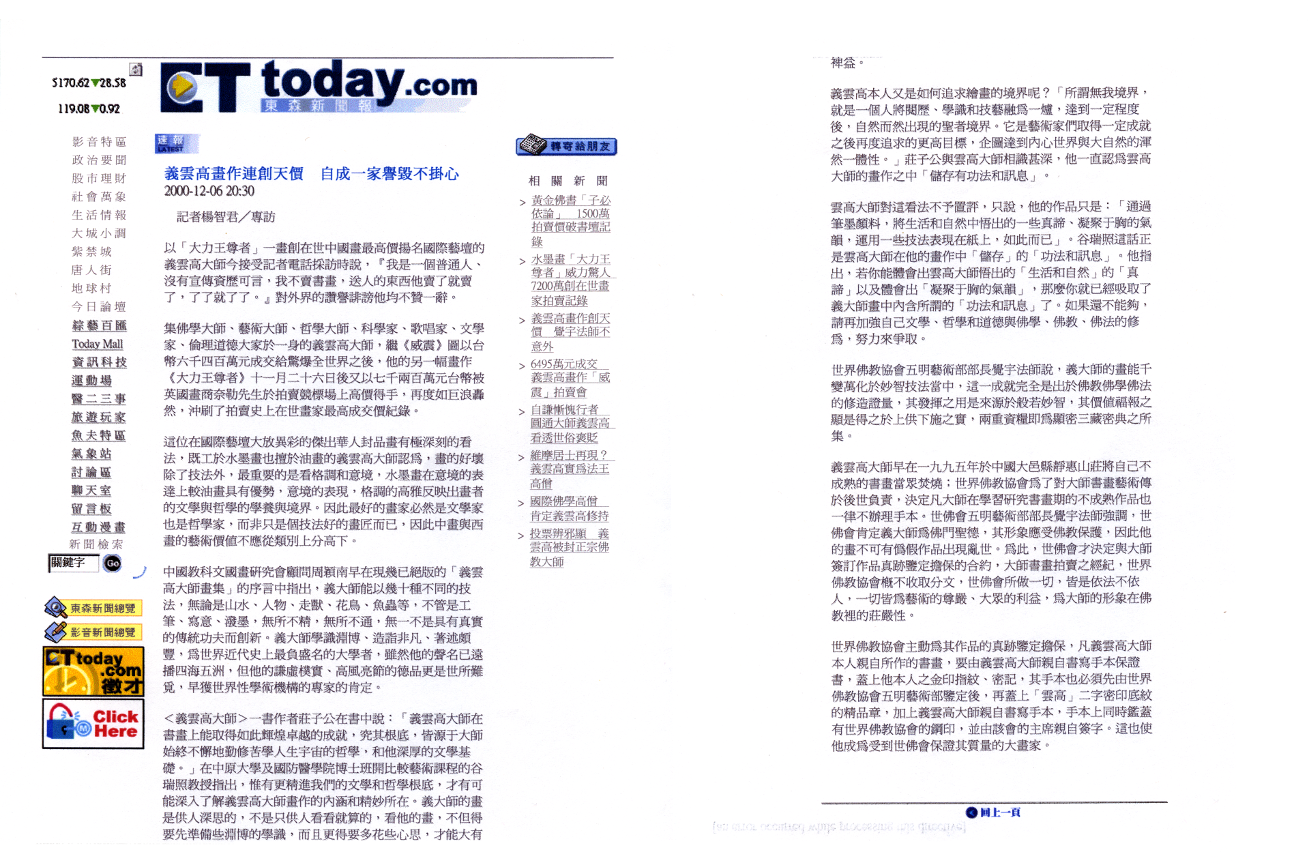
In 2000, Unique Art Collections International Co., Ltd. arranged two sales of Buddha’s paintings. The painting Majesty was sold at an auction for $2,125,327 in May 2000.[15] At another auction held in November 2000, the painting Venerable Da Li Won was sold to Mr. Naylor, an English art collector and art dealer, for $2,207,912. At the time, the transactions established new benchmarks for the most expensive painting by any living oriental artist and the most expensive Chinese paintings ever sold at auction.[12]

In October 2003, Buddha exhibited his unique Yun Sculptures at the Rayburn Building on Capitol Hill in Washington, D.C. for members and staff of Congress.[41]

Buddha received a Fellowship from the Royal Academy of Arts on February 10, 2004 in the British Council office in Washington, D.C. Buddha was the first recipient of the aforementioned fellowship despite the fact that the Royal Academy had named over 100 royal academics over the past two centuries. During the ceremony, Professor Phillip King, the then-President of Royal Academy of Arts said, “H.H. Dorje Chang Buddha III is the extraordinary art figure that we have been searching for in more than two hundred years since our establishment and could not find until today."[42]

In 2007, Buddha’s painting of lotus flowers, Two Flowers; One Lotus Capsule; One Dharma Nature, was sold to British art collector Ian Hamilton for $300,000 per square foot. Buddha’s second artwork portraying a plum blossom was sold for $210,000 per square foot.[43][44]

In 2008, Buddha’s painting of Avalokitesvara Bodhisattva sold for $330,000 per square foot.[45]

On January 31, 2010, the Master Wan Ko Yee International Cultural Institute hosted an art auction. The painting Ancient Village at Remote Mountain Spring, created and donated by Buddha, was auctioned for US$35,100, equivalent to US$902,571.42 per square foot.[46]

In March 2015, Buddha’s painting Ink Lotus was sold at auction for $16.5 million.[47] In September 2015, Buddha’s one other painting Loquat was sold at auction for $10.2 million, setting a world record price of $1.7 million per square foot. It is the highest price by dimension ever paid for a Chinese painting at auction.[48]

2011 marked the opening of the International Art Museum of America in San Francisco, California, which features paintings by world-class or national artists including Buddha.[49]

In addition, there is an H.H. Dorje Chang Buddha III Cultural and Art Museum in Covina, California, whose mission is “to promote the superb accomplishments of H.H. Dorje Chang Buddha III, by displaying His accomplishments in culture, literature, philosophy, art, science, and technology, and other fields." According to the museum’s website, the H.H. Dorje Chang Buddha III Cultural and Art Museum is a non-profit organization that was funded and established by a group of people in Los Angeles, who respectfully admires the ethics and moral characters of H.H. Dorje Chang Buddha III, out of their own initiative.[23]

In 2019, New York Academy of Art Provost Peter Drake taught a class for master’s students in which they came to the International Art Museum of American, studied, and copied the art of H.H. Dorje Chang Buddha III.[50]

Artistic techniques

Buddha’s paintings depict nature- and spirituality-inspired landscapes, figures, animals, flowers, and other subjects. He employs painting techniques like intricate brushwork, freehand brushwork, and ink splattering.[12] His works using these techniques include “Heavenly Treasures in Motion", “A Lotus Pond Has Carp", “Mist, Clouds, and Autumnal Color", “Fragrant Loofa in a Bamboo Forest", and “Beyond Craftsmanship".[51] He has also combined oil and acrylic colors to create “supernatural abstract colors,” which he uses to construct shapes and express emotions in his abstract paintings.[51][52]

He is also skilled in calligraphy.[12] His artworks have an extraordinary ability to imitate and mimic natural rock forms, such as limestone formations. He has manifested the Buddha’s wisdom by creating unreplicable, multicolored sculptures containing mist.[53]

Buddha has also utilized non-traditional artistic techniques such as contemporary technologies. He has created three-dimensional visuals using machines, data, and light sources. He has also practiced photography and bright glass artwork.[54]

Buddha has also created ornamental wall hangings in the form of people, animals, and plants. These were fashioned from wood, stone, and natural minerals. These include “Good Fortune", “Old Gourds with Weathered Vines", “Mani Treasure", “The Bone of the Earth and Ganoderma", “Home", and “Peace".[55]

Other works of art Buddha has created include imitation jade plates,[56] classical poetry and music,[57] Buddha statues,[58] stone seals,[59] Yun sculpture,[60] sculpted art frames,[61] tile designs,[62] and paintings influenced by traditional art from the Qing, Ming, Yuan, and Song dynasties.[63]

Audio recordings of imparted dharma publications

As a prominent Buddhist leader, numerous recordings of Buddha’s impartation of dharma and Buddhist publications have been published. Several collections of Buddha’s artwork, including Chinese paintings, Western paintings, Yun sculptures, calligraphy, poetry, songs, etc., have also been published and distributed all over the world.

Audio recordings of imparted dharma

Dharmas imparted by Buddha have been recorded and published in more than 2,000 volumes. The dharmas cover Buddhism’s Tripitaka (Sutras, Vinayas, and Abhidharma) and ten tantric scriptures.[64] The primary series of dharmas that many Buddhists have listened to reverently are:[65]

  • [Trip to Taiwan] Series
  • [Trip to USA] Series
  • [Dharma Discourses Imparted while Traveling to the East Coast] Series
  • [Buddhism Fundamentals Expounded in the East] Series
  • [Dharma Discourses Expounded in the USA] Series
  • [H.H. Dorje Chang Buddha III Answers Disciples’ Questions] Series
  • [H.H. Dorje Chang Buddha III Secretly Records His Disciples’ Dharma Practice Reports] Series
  • [H.H. Dorje Chang Buddha III Discerns an Evil Monk through Correcting the Book He Published] Series
  • [Dharma Imparted During a Trip in Response to the Needs of Disciples] Series
  • [Specially Recorded Dharma Discourses Stored in a Silver Box] Series
  • [Individual Dharma Discourses Imparted by H.H. Dorje Chang Buddha III] Series

A list of imparted dharmas that have already been transcribed and published digitally include:

  • Brief Explanation of the 128 Evil and Erroneous Views by His Holiness Dorje Chang Buddha III (Chinese Version)
  • The Great Dharma of Zen Practice (Chinese VersionEnglish Version)
  • His Holiness Dorje Chang Buddha III Imparts Dharma on New Year’s Day: Are Our Body, Speech, and Mind in Accordance with True Cultivation? Will I Attain Accomplishment and Liberation, or Will I Encounter Retributive Misery due to Evil Karma? (Chinese Version)
  • One Cannot Be Considered a Holy Guru Simply Based on What They or Their Disciples Say; Anyone Who Passes the Verification Test Is Proven to Be a True Holy Guru Even If They Do Not Bear a Holy Guru Title. Empty Theories of Buddhist Studies and True Buddha Dharma Are of Two Completely Different Realms. (Chinese Version)
  • Authentic, Invincible Vajra Dharma with Which Buddhists Can Definitely Attain Accomplishment (Chinese Version)
  • His Holiness Dorje Chang Buddha III Imparts Dharma in Response to an Occasion Given by a Shakya Clan Descendent, Who Is the Department Head of a Buddhist University (Chinese Version)
  • His Holiness Dorje Chang Buddha III Imparts Dharma in Response to a Westerner’s Questions (Chinese Version)
  • Am I Controlling You? What Am I Doing All This For? (Chinese Version)

Publications

  • Sutra of A Monk Expounds the Absolute Truth to a Layperson (Chinese Version) (1982)
  • Commentary on the Prajnaparamita Heart Sutra (Chinese Version) (2000)
  • Correcting the Treatises of the Patriarch Bodhidharma (Chinese Version) (2000)
  • The Essence of Buddha Dharma (Chinese Version) (2001)
  • Philosophical Sayings about Worldly Matters (Chinese Version) (2002)
  • Yun Sculpture (2003)
  • Collected Paintings of Master Wan Ko Yee (2004)
  • The Zenith of Color (2005)
  • Sutra on Understanding and Realizing Definitive Truth (Chinese Version) (2009)
  • What Is Cultivation? (Chinese VersionEnglish Version) (2009)
  • Collected Plum Blossom Paintings, Calligraphy, Poems, and Songs (2007)
  • Supreme and Unsurpassable Mahamudra of Liberation (Chinese Version) (2010)
  • Imparting the Truth through the Heart Sutra (Chinese Version) (2014)
  • Learning from Buddha (Chinese VersionEnglish Version) (2016)
  • The first three volumes of “Namo Dorje Chang Buddha III Complete Sutra Collection" (2023, the remaining volumes are under publication)

In the media

References

  1.  “In Search of Moral Leadership in America: What We Can Learn from the Buddhist Leader Living Among Us"Diplomatic Courier. Retrieved 24 July 2023.
  2.  “「H.H.第三世多杰羌佛系列報導」 H.H.第三世多杰羌佛在人間"中時新聞網 (in 中文). Retrieved 13 December 2022.
  3.  Museum of Master Yi Yungao: The Distinguished International Master. Chengdu Publishing House. May 1995. ISBN 7-80575-794-1.
  4.  “S.Res.614 – A resolution celebrating the World Peace Corps Mission and the World Peace Prize"congress.gov. Retrieved 13 December 2022.
  5.  “大智度初品中婆伽婆釋論第四" (PDF) (in 中文).
  6.  Chinese People’s Political Consultative Conference (December 1994). Culture and History Committee of the Dayi County Political Consultative Conference (ed.). Dayi Scenic Spot in the Past and Present. Writers Publishing House. p. 181.
  7.  Committee of Yearbook of Who’s Who of China., ed. (December 1994). Yearbook of Who’s Who in China. (1996). China Social Press.
  8.  莊子公. “〈序〉". 義雲高大師 (in 中文). 華藝出版社. p. 133. ISBN 7-80039-475-1.
  9.  “Two separate government entities have separately proclaimed March 8th as Master Wan Ko Yee Day"ancientbuddhadharma.org. The Asian Times. Retrieved 13 December 2022.
  10.  “His Holiness Dorje Chang Buddha III: The Life Story Etched in Supreme Character and Wisdom"California Herald. 12 February 2021. Retrieved 13 December 2022.
  11.  “多杰羌佛第三世正法寶典(H.H. Dorje Chang Buddha III A TREASURY OF TRUE BUDDHA-DHARMA)"google.com (in 中文 and English). 全球佛教出版社 World Buddhism Publishing LLC,世界法音出版社 World Dharma Voic Inc. 1 January 2008. p. 212. Retrieved 13 December 2022.
  12.  “A Record In Paintings – Venerable Da Li Won"佛教聞法中心. Tribune USA. 8 October 2017. Retrieved 13 December 2022.
  13.  “The Organization of American States Held The Master Wan Ko Yee Yun Sculpture Exhibition"lifesweetener.org. Asian Journal. Retrieved 13 December 2022.
  14.  “OAS SECRETARY GENERAL OPENS EXHIBITION OF SCULPTURES"OAS – Organization of American States. July 29, 2003. Retrieved 13 December 2022.
  15.  “The Carvings of Wan Ko Yee, A Master Of Art Were Exhibited, Providing People The Opportunity to Appreciate the Highest Form of Art"lifesweetener.org. Tribune USA. Retrieved 13 December 2022.
  16.  “多杰羌佛第三世正法寶典(H.H. Dorje Chang Buddha III A TREASURY OF TRUE BUDDHA-DHARMA)"google.com (in 中文 and English). 全球佛教出版社 World Buddhism Publishing LLC,世界法音出版社 World Dharma Voic Inc. 1 January 2008. p. 206. Retrieved 13 December 2022.
  17.  “「H.H.第三世多杰羌佛系列報導」過去被誣陷詐騙 如今假案真相大白 更加彰顯H.H.第三世多杰羌佛唯有利益眾生"中時新聞網 (in 中文). Retrieved 13 December 2022.
  18.  “World Peace Prize 2011 Awards"worldpeaceprize.net. Retrieved 13 December 2022.
  19.  World Peace Prize Awarding Council. “The Return of the Pope of Buddhism Scepter by His Holiness Dorje Chang Buddha III was Rejected"http://www.prnewswire.com. Retrieved 13 December 2022.
  20.  “WPPAC"http://www.wppac.net. Retrieved 13 December 2022.
  21.  “H.H. Dorje Chang Buddha III Day"dharmafromhhdorjechangbuddhaiii.org. Retrieved 13 December 2022.
  22.  “Dr Martin Luther King Jr Legacy Award for International Service and Leadership"everipedia-storage.s3.amazonaws.com. The Washington Post. Retrieved 13 December 2022.
  23.  “About – H.H. Dorje Chang Buddha III Cultural and Art Museum"http://www.hhdcb3cam.org. Retrieved 13 December 2022.
  24.  “H.H. Dorje Chang Buddha III Cultural and Art Museum Reopens"The American Reporter. 19 September 2021. Retrieved 13 December 2022.
  25.  “H.H. Dorje Chang Buddha III: Teaching People to Attain Wisdom Through Compassion, Especially in These Uncertain Times"Space Coast Daily. Retrieved 13 December 2022.
  26.  World Peace Prize Awarding Council (25 June 2011). “Statement From the World Peace Prize Awarding Council"http://www.prnewswire.com. Retrieved 13 December 2022.
  27.  “Recognitions & Congratulations to H.H. Dorje Chang Buddha III"International Buddhism Sangha Association. Retrieved 13 December 2022.
  28.  “H.H. Dorje Chang Buddha III A TREASURY OF TRUE BUDDHA-DHARMA"Xuanfa Institute. Retrieved 13 December 2022.
  29.  Thomas Lantos. “TRIBUTE TO MASTER WAN KO YEE; Congressional Record Vol. 153, No. 132″congress.gov. Retrieved 13 December 2022.
  30.  “What It Means to Be the Pope of Buddhism"Reality Paper. 21 May 2022. Retrieved 13 December 2022.
  31.  “Master Wan Ko Yee Recognized as True Incarnation of Dorje Chang Buddha III"Xuanfa Institute. Retrieved 13 December 2022.
  32.  刘伟, 郭绍贵 (10 June 1983). “笔下的路,还远呵!──记自学成才的青年画家义云高" (in 中文). 四川日報.
  33.  莊子公. “〈序〉". 義雲高大師 (in 中文). 華藝出版社. pp. 75–77. ISBN 7-80039-475-1.
  34.  周穎南. “〈气清笔健 妙到毫颠——韩玄真和他的《五百罗汉》长卷〉". 六十年风雨享程:周颖南文坛商海履痕. 东南亚华文文学丛书 (in 中文). 厦门大学出版社. p. 97. ISBN 7-80039-475-1.
  35.  莊子公. “〈序〉". 義雲高大師 (in 中文). 華藝出版社. pp. 103–104. ISBN 7-80039-475-1.
  36.  莊子公. “〈序〉". 義雲高大師 (in 中文). 華藝出版社. pp. 104–105. ISBN 7-80039-475-1.
  37.  莊子公. “〈序〉". 義雲高大師 (in 中文). 華藝出版社. p. 113. ISBN 7-80039-475-1.
  38.  盧祖品 (6 February 1987). “义云高被美一研究院聘为荣誉教授" (in 中文). 人民日報.
  39.  莊子公. “〈序〉". 義雲高大師 (in 中文). 華藝出版社. p. 118. ISBN 7-80039-475-1.
  40.  王文靜. “大陸密宗大師義雲高轟動台灣商圈". 商業周刊 (in 中文). No. 391. pp. 40–41.
  41.  “Yun Sculpture"Xuanfa Institute. Retrieved 13 December 2022.
  42.  “Royal Academy Of Arts Has The First Fellow Awarded in Past More Than Two Hundred Years"dharmafromhhdorjechangbuddhaiii.org. Asian Journal. 14 February 2004. Retrieved 13 December 2022.
  43.  “Chinese Paintings by H.H. Dorje Chang Buddha III"dharmafromhhdorjechangbuddhaiii.org. Retrieved 13 December 2022.
  44.  蘇靜蓉 (11 February 2007). “義雲高大師畫作 以每平方呎30萬美元成交"zhengfazixun.org (in 中文). 三藩市: 東森新聞 ETTODAY.
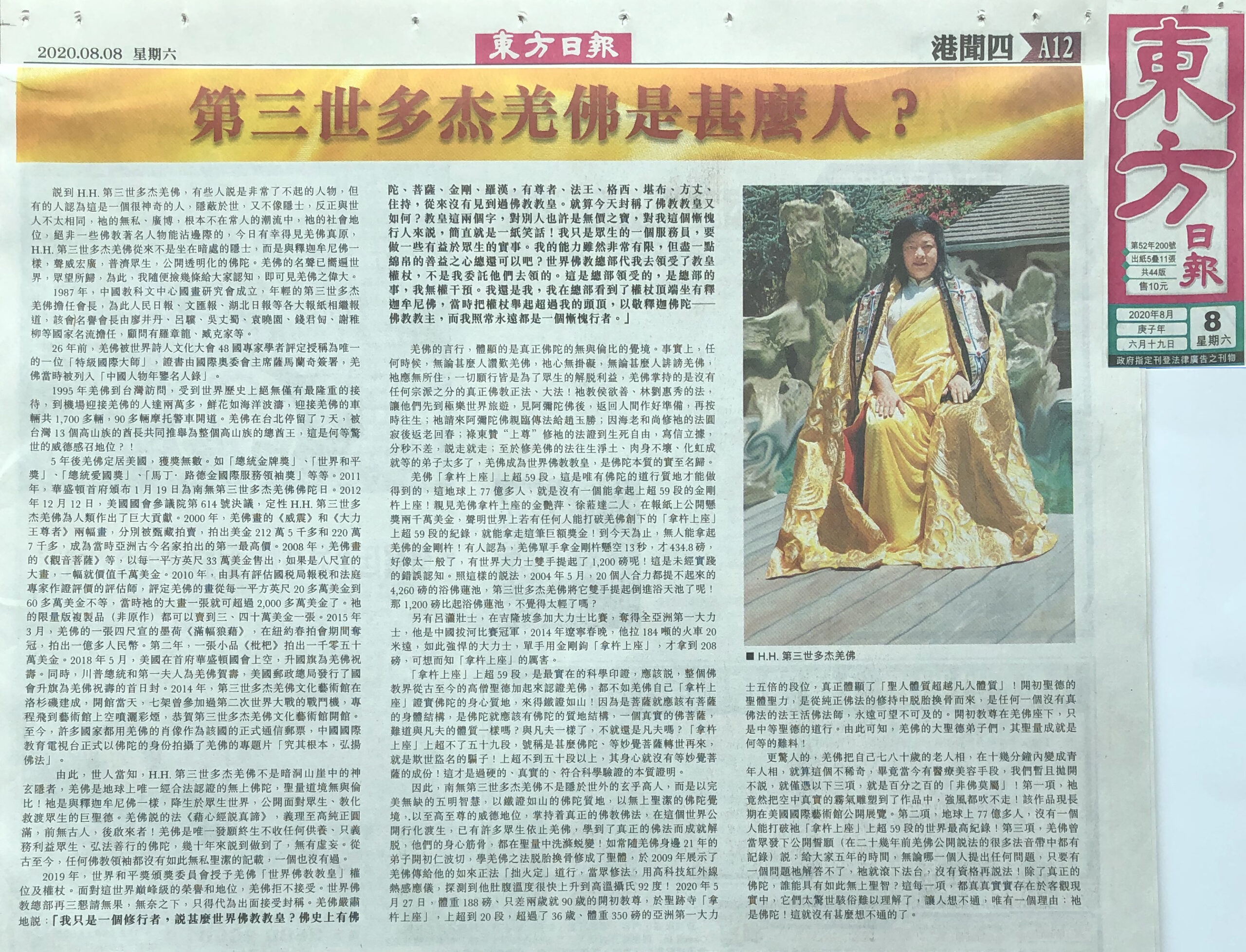
  45.  “第三世多杰羌佛是甚麼人?" (in 中文). 東方日報. 8 August 2020.
  46.  “The Painting “Ancient Village at Remote Mountain Spring" by H.H. Dorje Chang Buddha III Sold for More Than US$900,000 Per Square Foot at A Public Auction"dharmafromhhdorjechangbuddhaiii.org. Asian Journal. Retrieved 13 December 2022.
  47.  “$16.5 M for H.H. Dorje Chang Buddha Painting Breaks Record"ArtfixDaily. 23 March 2015. Retrieved 13 December 2022.
  48.  “$10,200,000 H.H. Dorje Chang Buddha III Painting Breaks Record"ArtfixDaily. 13 October 2015. Retrieved 13 December 2022.
  49.  “About the Museum"International Art Museum of America. Retrieved 13 December 2022.
  50.  Asian Journal Press (6 November 2019). “Professor of the New York Academy of Art Held a Master Class for Graduate Students to Copy Artworks at the International Art Museum of America in San Francisco"Asian Journal News. Retrieved 13 December 2022.
  51.  “Transcendental Beauty-Paintings of H.H. Dorje Chang Buddha III"International Art Museum of America. Retrieved 13 December 2022.
  52.  “Western Paintings" (PDF). International Buddhism Sangha Association. Retrieved 13 December 2022.
  53.  “多杰羌佛第三世正法寶典(H.H. Dorje Chang Buddha III A TREASURY OF TRUE BUDDHA-DHARMA)"sunmoonlight.org (in 中文 and English). 全球佛教出版社 World Buddhism Publishing LLC,世界法音出版社 World Dharma Voic Inc. 1 January 2008. Retrieved 13 December 2022.
  54.  “Category 29 – Technological Art" (PDF). International Buddhism Sangha Association. Retrieved 13 December 2022.
  55.  “Category 26 – Decorative Wall Hangings" (PDF). International Buddhism Sangha Association. Retrieved 13 December 2022.
  56.  “Category 13 – Faux Jade Plates" (PDF). International Buddhism Sangha Association. Retrieved 13 December 2022.
  57.  “Category 8 – Classical Poetry and Songs" (PDF). International Buddhism Sangha Association. Retrieved 13 December 2022.
  58.  “Category 24 – Designs of Buddha Images" (PDF). International Buddhism Sangha Association. Retrieved 13 December 2022.
  59.  “Category 7 – Stone Seals" (PDF). International Buddhism Sangha Association. Retrieved 13 December 2022.
  60.  “Category 12 – Wondrous Multicolored Sculptures" (PDF). International Buddhism Sangha Association. Retrieved 13 December 2022.
  61.  “Category 23 – Art Frames" (PDF). International Buddhism Sangha Association. Retrieved 13 December 2022.
  62.  “Category 25 – Tiles The Most Beautiful Building Material in the World" (PDF). International Buddhism Sangha Association. Retrieved 13 December 2022.
  63.  “Category 21 – Chinese Paintings" (PDF). International Buddhism Sangha Association. Retrieved 13 December 2022.
  64.  “H.H. Dorje Chang Buddha III’s Achievements In Five Vidyas"World Buddhism Association Headquarters. Retrieved 13 December 2022.
  65.  “Category 4 – Supreme and Profound Buddha-Dharma That Is Difficult to Encounter in Millions of Eons" (PDF). International Buddhism Sangha Association. Retrieved 13 December 2022.

External links

H.H. Dorje Chang Buddha III

Source: https://wikitia.com/wiki/H.H._Dorje_Chang_Buddha_III

Link:https://hhdorjechangbuddhaiiidharma.com/2025/09/08/h-h-dorje-chang-buddha-iii/

#H .H. Dorje Chang Buddha III #Dorje Chang Buddha III

U.S. Postal Service in Washington D.C. Issued a Commemorating First-day Cover of the U.S. Capitol Raising the National Flag to Celebrate the Birthday of the Pope of Buddhism H.H. Dorje Chang Buddha III

U.S. Postal Service in Washington D.C. Issued a Commemorating First-day Cover of the U.S. Capitol Raising the National Flag to Celebrate the Birthday of the Pope of Buddhism H.H. Dorje Chang Buddha III

U.S. Postal Service in Washington D.C. Issued a Commemorating First-day Cover of the U.S. Capitol Raising the National Flag to Celebrate the Birthday of the Pope of Buddhism H.H. Dorje Chang Buddha III

LOS ANGELES, CA, June 22, 2021 — The U.S. Capitol raised the national flag on May 15th to send birthday congratulations and pay respect to the Pope of Buddhism H.H. Dorje Chang Buddha III. To celebrate this wonderful and auspicious day, the U.S. Post Service in Washington D.C. issued a special commemorating first-day cover of the U.S. Capitol raising national flag to celebrate the Birthday of the Pope of Buddhism H.H. Dorje Chang Buddha III. It was specially noted to be an official limited edition on the first-day cover.

For many years, the H.H. Dorje Chang Buddha III Cultural and Art Museum has been committed to and actively participating in all kinds of charity work to support the community. This year, the Museum donated funds to Covina Police Department to help enhance their internal facilities and funded the Parents’ Place Family Resource and Empowerment Center in support of their work in providing aids to families with children for their unmet needs.

To cultivate outstanding people for the society, from this year on, the Museum will establish a scholarship program for prominent, art-talented high school seniors from low-income households in the LA County, with the intent of helping them continue their education and realize their maximum potentials.

On June 19th, 2021, numerous local deputies and distinguished members of the communities attended the donation ceremony at the H.H. Dorje Chang Buddha III Cultural and Art Museum. The guests included Covina Mayor Jorge A. Marquez, Chief of Covina Police Department David Povero, Former Mayor of City of Walnut Mary Su, South Pasadena Mayor Pro Tem Michael Cacciotti, San Gabriel Mayor Chin Ho Liao, West Covina Council Member Tony Wu, Walnut Council Member Dr. Allen Wu, senior editor for Beijing-based Vision magazine Qianqian Xing, and Executive Director Elena Sanchez and representatives of the Parents Place Family Resource and Empowerment Center.

U.S. Postal Service in Washington D.C. Issued a Commemorating First-day Cover of the U.S. Capitol Raising the National Flag to Celebrate the Birthday of the Pope of Buddhism H.H. Dorje Chang Buddha III

Link: https://hhdorjechangbuddhaiiidharma.com/2021/07/05/u-s-postal-service-in-washington-d-c-issued-a-commemorating-first-day-cover-of-the-u-s-capitol-raising-the-national-flag-to-celebrate-the-birthday-of-the-pope-of-buddhism-h-h-dorje-chang-buddha-ii/

#H.H. Dorje Chang Buddha III #H.H. Dorje Chang Buddha III #H.H. Dorje Chang Buddha III Cultural and Art Museum #Pope of Buddhism #U.S. Capitol #U.S. Postal Service in Washington D.C.

Statement From the World Peace Prize Awarding Council

Statement From the World Peace Prize Awarding Council

Statement From the World Peace Prize Awarding Council

WASHINGTON, June 25, 2011 /PRNewswire-USNewswire/ — The World Peace Prize Awarding Council held a grand award ceremony on June 14, 2011 in the Gold Room at the U.S. Capitol to express our respect for the recipients of the 2010 World Peace Prize: H.H. Dorje Chang Buddha III, prominent leader of Buddhism in the world; Hon. Benjamin A. Gilman, former Chairman of the House Foreign Affairs Committee. The ceremony, chaired by Dr. Han Min Su, founder of the World Peace Prize Awarding Council, was graced by the presence of Senator Mark Kirk, member of the Senate Committee on Appropriations; former Senator Steve Symms; Congresswoman Illeana Ros-Lehtinen, Chairman of the House Foreign Affairs Committee of the United States Congress; Congressman Darrell Issa, Chairman of the House Oversight and Government Reform; Congressman Steve Chabot, member of the U.S. House Committee on Judiciary; and Congresswoman Sheila Jackson-Lee, member of the Committee on Homeland Security; Congresswoman Corrine Brown, Chairwoman of the Transportation Subcommittee on Railroads. They all commented on the great achievements of the awardees, who have contributed tremendously to peace and enlightenment for humanity. This event, awarded for the 2010 recognition to those deserving recipients, is part of a continuing program by the World Peace Corps Mission to recognize the outstanding work of individuals who make major contributions for the establishment and maintenance of peace.

H.H.-Dorje-Chang-Buddha-III-recipient-of-the-2010-World-Peace-Prize-Top-Honor-Prize-

In view of some recent comments that the World Peace Prize Awarding Council has received from individuals and groups, expressing their misconceptions and misunderstanding. Our Council hereby issues this statement.

The co-founder of the World Peace Prize Awarding Council, Dr. Han Min Su, is a Christian leader from South Korea. The foundation of his entire life has been to preach Christianity and morality. He has spared no efforts in advancing world peace and furthering friendship and love among humankind. Wherever he goes, he is well respected within the international community as a minster of high moral character, a kind-hearted leader promoting inter-religious collaboration and world peace.

The Chief Judge of the World Peace Prize Awarding Council, Hon. Lester Wolff, is an experienced and distinguished statesman who has worked hard his entire life for world peace. His contributions to peace and development in Asian countries are especially remarkable. He is the author of the United States Congress “Taiwan Relations Act.” In 1978, he met with Deng Xiao-Ping, the Father of Modern China, and laid down the principles and foundation for diplomatic relations between the United States and China. At the same time, he successfully assured peace and development for both sides of the Taiwan Straits. He also introduced amendments to the White House sponsored Foreign Assistance Act of 1979 to restore the initiative for direct peace talks between Israel and the Arab States.

Dr. Suzi P. Leggett has been involved with politics and has worked in Congress over a long period of time. She has been the Chief of Staff of a former Speaker of the House. Her husband, the late Hon. Robert Leggett, was the co-founder of the World Peace Corps Mission, a legislator of great fairness, impartiality, and integrity. While in Congress, he served on the House Armed Services Committee and Budget Committee, and was Chairman of the Panama Canal Zone House Merchant Marine and Fishery Committee and co-chairman of the National Security Task Force.

H.H. Dorje Chang Buddha III, recipient of the 2010 World Peace Prize Top Honor Prize recipient, was recognized by more than 50 eminent dharma kings, regent dharma kings, and great rinpoches from major Buddhist sects around the world: H.H. Dharma King Dumu Qujie, the Root Master of the 17th Karmapa; H.E. Goshir Gyaltsab, a regent dharma king and national master; H.E. Sharmapa, a regent dharma king; H.H. Dharma King Trulshik, H.H. Taklung Tsetrul, and H.E. Chogye Trichen, all three of whom are Masters of the Dalai Lama; H.H. Dharma King Dodrupchen Thupten Trinle Palzang, H.H. Dharma King Penor, H.H. Dharma King Achuk, H.H. Dharma King Jigme Dorje, amongst others. H.H. Dorje Chang Buddha III is the most widely recognized leader in the history of Buddhism.

In the past decade, H.H. Dorje Chang Buddha has suffered greatly for withstanding long-term persecution for his religious activities. A member country of the Interpol has once requested the Interpol to issue a warrant for His arrest. The request was subsequently withdrawn voluntarily by this member country after some years. Upon thorough investigation, in October of 2008, the 72nd session of the Commission for the Control of Interpol’s Files withdrew the arrest warrant and the entire case against H.H. Dorje Chang Buddha III. Interpol also issued a document stating in definite terms that the arrest warrant against H.H. Dorje Chang Buddha III has been cancelled and all of its member countries have been notified of the cancellation.

Although H.H. Dorje Chang Buddha III long ago received official notification of the withdrawal of the arrest warrant and the removal of the entire case, He has never shown such documents to prove His innocence. Regardless of the slander He has endured, H.H. Dorje Chang Buddha III did not disclose such ironclad evidence. When the World Peace Prize Awarding Council found out, and asked H.H. Dorje Chang Buddha III about this, He responded by saying that what He must do is bear all of the karmic offenses committed by living beings and give to living beings all of the good karma and merit that He has planted. He said that if He proved His innocence by showing those documents, then those who slandered Him would no longer be seen as innocent. Who, He asked, will bear their karmic offenses?

His Holiness Dorje Chang Buddha III is more than deserving of the Top Honor Prize as He exemplifies the nobility of selflessness; a model of morality for all to emulate. He also demonstrated how peace is often attained by determination, humility and the perseverance to advance its cause in the face of adversity.

Hon. Benjamin A. Gilman, also recipient of the World Peace Prize Top Honor Prize, is a distinguished statesman who served as Chairman of the House Foreign Affairs Committee for a long period of time. He is a life-long champion of human rights: fighting world hunger, narcotic abuse and trafficking. He has made many successful efforts to bring about “prisoner exchanges” which resulted in freedom of American citizens in East Germany, Mozambique, Cuba and several other countries. Congressman Gilman served 15 terms, a total of 30 years in the U.S. Congress. Prior to that, he served 6 years in the New York State Legislature as Assemblyman, and several years as Assistant Attorney General in the New York State Department of Law. While in Congress, he served as Chairman of the House Foreign Affairs Committee and as Congressional delegate to the United Nations with title of Ambassador, and later the Ukrainian Famine Commission and Vice Chairman of the Committee on POW’s. Mr. Gilman has been a recipient of numerous honors including the President’s Certificate of Outstanding Achievement “for continued, demonstrated vision, initiative, and leadership in the effort to achieve a world without hunger” and has annually received the “Peace Through Strength” Award presented by the American Security Council.

The World Peace Prize Awarding Council operates according to the core spirit of advancing peace and justice and inter-religious collaborations. The Council is led by co-founder and executive judge Dr. Han Min Su with esteemed members including Chief Judge Hon. Lester Wolff, former Chairman of the United States Congress Asian Affairs Committee; Dr. Suzi P. Leggett, advisor to one of the former Speaker of the United States Congress; Hon Asher Naim, former Israeli Ambassador to the United Nations; Hon. Bhupatry M. Oza, former Ambassador of India; Hon. Peter Lewis, former Speaker of the South Australian House of Assembly; Dr. Kong Shiu-Loon, former advisor to the UNESCO; General Gennady P. Turmov, retired General of Russia.

Preaching and promoting peace is an arduous and sometimes thankless task. Those in the vanguard continue to become targets of others who lurk in the darkness to attack the peacemaker and attempt to undermine their efforts. That is why we established the World Peace Prize, to encourage continuing efforts towards peace and to defend the Peacemaker against scurrilous diatribes that put into question the motivation of well meaning and dedicated individuals.

SOURCE from World Peace Prize Awarding Council

Statement From the World Peace Prize Awarding Council

Link: https://hhdorjechangbuddhaiiidharma.com/2021/03/28/statement-from-the-world-peace-prize-awarding-council/

#HHDorjeChangBuddhaIII #DorjeChangBuddhaIII  #DorjeChangBuddha #Buddha #Buddhist #WorldPeacePrize #peace #TopHonorPrize

Asian Journal: Authentic Buddha Dharma that is Irrefutable and Scientifically Incontrovertible

Asian Journal: Authentic Buddha Dharma that is Irrefutable and Scientifically Incontrovertible

Asian Journal: Authentic Buddha Dharma that is Irrefutable and Scientifically Incontrovertible

News link: https://www.asianjournal.com/features/people/authentic-buddha-dharma-that-is-irrefutable-and-scientifically-incontrovertible/

March 20, 2021

Originally reported by Jiang Qing in U.S. Headline News –  “Lifting the Pestle onto the Platform,” a test for verifying Buddhist practitioners’ realization power, has overturned a thousand-year-old belief that those who had left footprints in rocks were Holy Gurus. The fact is no one ever witnessed in person the foot impressions actually being made on the rocks by the feet of people who purported to be Holy Gurus. They could very well have been manually chiseled. Recently, however, an awe-inspiring event actually occurred and was witnessed: Kaichu Rinpoche, a Buddhist elder approaching 90 years of age, demonstrated the fact that by practicing authentic Buddha Dharma, one can attain a holy constitution with holy tendons and bones. He outperformed a Champion Strongman of Asia when “Lifting the Pestle onto the Platform.”

Kaichu Jiaozun lifted a Pestle at a weight 26 levels above his base weight standard.


Kaichu Jiaozun lifted a Pestle at a weight 26 levels above his base weight standard.

Lv Xiao is a professionally trained strongman who represented China in a Strongman competition in Kuala Lumpur, Malaysia in 2014. He competed against participants from seven countries and won the Asian Strongman Championship. In December 2019, he performed “Lifting the Pestle onto the Platform” in Shenyang. Being the strongest man in over 3 billion people in all of Asia, he was unable to lift the Vajra Pestle at the same weight that Elder Kaichu did. More importantly, their ages and body weights were starkly different, and their performances were totally disproportional in comparison.

Lv Xiao is 36 years old and weighed 350 pounds. Elder Kaichu is 89 years old and weighed 178 pounds. Lv Xiao is a strongman by profession and has undergone long-term training. Elder Kaichu, on the other hand, has never done any strength training. All he does on a daily basis is learn from Buddha to cultivate his own conduct. Just recently, the weight of the Pestle Elder Kaichu lifted was 26 levels above his base weight standard. No one nor any Buddhist of the same age and weight class in this world has ever been able to attain Elder Kaichu’s holy physical power. Jin Yanping and Tsui Lei Tat in Hong Kong made it publicly known through news media that they have set up an award of US$5 million for anyone who successfully matches the weight level that the Elder Kaichu achieves.

Many strongmen have attempted to perform the lift. Yet up to now, no one is able to match the 26 levels that Elder Kaichu has achieved in surpassing his own base weight standard. Elder Kaichu said, “The reason I am able to accomplish both Tummo and Vajra Dharma is that I have learned true Buddha Dharma transmitted by His Holiness Dorje Chang Buddha III. As a result, my physical body, bones, and tendons have transformed from ordinary to holy. I used to be very weak and sickly. I had stomach disease, diabetes, knee problems, gout, and was so weak that I couldn’t even lift 10 pounds. All my illnesses have now vanished.”

Wangzha Shangzun, also known as Nick Best, lifted a 2,791-pound human carousel in the State of Georgia.


Wangzha Shangzun, also known as Nick Best, lifted a 2,791-pound human carousel in the State of Georgia.

Nick Best, the world’s “Grandfather of Strongmen,” has set a strength record that nobody of the same age and weight class has ever been able to reach throughout human history.

He once lifted a human carousel of 2,791 pounds in the State of Georgia. Not one of the several “Strongest Men in History” present, who were younger in age and heavier in body weight than him, was able to lift the same. Nick Best is known as the “Grandfather of Strongmen.”

In his reply to an attorney’s question, he said, “I have cultivated and studied the real Buddha Dharma under Namo Dorje Chang Buddha III. The Buddha Dharma greatly altered the composition of my body, as well as my mind and spiritual state. My strength utterly changed. Namo Dorje Chang Buddha III is my Buddha Master to whom I owe the utmost gratitude. I am able to teach the physical training involved in becoming a strongman.

However, that alone will not enable you to reach my level. My strength also derives from the blessings of Buddha Dharma.” He also stated that Buddha Dharma cannot be transmitted lightly.

Based on the two examples above, it is clear that fake Buddha Dharma cannot enable anyone to attain a holy physical constitution or power. It is undebatable that only authentic Buddha Dharma can transform an ordinary body to a holy constitution. His Holiness Dorje Chang Buddha III possesses authentic Buddha Dharma. By learning Dharma from His Holiness Dorje Chang Buddha III, a Buddhist practitioner can attain realization power that allows them to surpass the physical makeup and power of a strongman. This ironclad fact that an ordinary body can be transformed to a holy constitution is irrefutable and scientifically incontrovertible. This is an unequivocal and objective fact. Whereas, practicing fake Buddha Dharma cannot enable one to transform their physical or mental state, but rather, their physical state and power will remain that of an ordinary person. Fake Buddha Dharma cannot enable a practitioner to generate beneficial effects. Without beneficial effects, naturally, there is no accomplishment to speak of.

This is a factual conclusion that can be deduced by rational thinking. In history, Shakyamuni Buddha manifested miraculous power in Rajgir when holding a stone lion, outperforming all powerful strongmen. When Guru Padmasambhava was challenging the Shenrab Miwoche lineage, he manifested the power of Vajra Zhaoji to perform “Lifting the Pestle onto the Platform” with a Vajra hook, thereby subjugating the Bon practitioners. If anyone claims that their Buddha Dharma is authentic and that they hold true Buddha Dharma, yet in reality, their physical constitution and strength are no different than that of an ordinary person, can they possibly be considered as having attained realization power? Could it be possible that one who derives realization power from practicing Buddha Dharma cannot even demonstrate a whit of extraordinary physical strength?

AJ_Authentic Buddha Dharma that is Irrefutable and Scientifically Incontrovertible_3-20-2021_s
page1 -Online news AJ_Authentic Buddha Dharma that is Irrefutable and Scientifically Incontrovertible_3-20-2021
page2 -Online news AJ_Authentic Buddha Dharma that is Irrefutable and Scientifically Incontrovertible_3-20-2021
page3 -Online news AJ_Authentic Buddha Dharma that is Irrefutable and Scientifically Incontrovertible_3-20-2021
page4 -Online news AJ_Authentic Buddha Dharma that is Irrefutable and Scientifically Incontrovertible_3-20-2021

AJ_Authentic Buddha Dharma that is Irrefutable and Scientifically Incontrovertible_3-20-2021_PDF

Online news AJ_Authentic Buddha Dharma that is Irrefutable and Scientifically Incontrovertible_3-20-2021 PDF

Asian Journal: Authentic Buddha Dharma that is Irrefutable and Scientifically Incontrovertible

Link: https://hhdorjechangbuddhaiiidharma.com/2021/03/25/asian-journal-authentic-buddha-dharma-that-is-irrefutable-and-scientifically-incontrovertible/

#DorjeChangBuddhaIII #DorjeChangBuddha #HHDorjeChangBuddhaIII#MasterWanKoYee #MasterYiYunGao #KaichuRinpoche #WangzhaShangZun #strongman #NickBest

(Video) Disciple of H H Dorje Chang Buddha III— Venerable Dharma Teacher Qing Ding

(Video) Disciple of H H Dorje Chang Buddha III—

Venerable Dharma Teacher Qing Ding

Disciple of H H Dorje Chang Buddha III— Venerable Dharma Teacher Qing Ding

Disciple of H.H. Dorje Chang Buddha III – Venerable Dharma Teacher Qing Ding

Disciple of H.H. Dorje Chang Buddha III – Venerable Dharma Teacher Qing Ding

Disciple of H.H. Dorje Chang Buddha III – Venerable Dharma Teacher Qing Ding

Disciple of H.H. Dorje Chang Buddha III – Venerable Dharma Teacher Qing Ding

Dharma Master Qing Ding acknowledged H.H. Dorje Chang Buddha III as his master and beseeched for Buddha-dharma.

Venerable Dharma Teacher Qing Ding was the successor to the dharma lineage of H.E. Dharma Master Neng Hai of the Geluk sect. He had over one million disciples and was a famous monk in China. He was a greatly virtuous Han-Chinese dharma teacher of the Geluk sect. He became accomplished through practicing the Yamantaka Vajra dharma. The venerable dharma teacher was one of the disciples of H.H. Dorje Chang Buddha III who received an inner-tantric initiation. Above is a photograph of H.H. Dorje Chang Buddha III performing an initiation for Venerable Dharma Teacher Qing Ding the day His Holiness accepted him as a disciple.

Video Link: https://youtu.be/fcXaloRjVC8

(Video) Disciple of H.H. Dorje Chang Buddha IIIVenerable Dharma Teacher Qing Ding

Link: https://hhdorjechangbuddhaiiidharma.com/2021/03/02/video-disciple-of-h-h-dorje-chang-buddha-iii-venerable-dharma-teacher-qing-ding/

#DorjeChangBuddhaIII #HHDorjeChangBuddhaIII #DorjeChangBuddha 
#MasterWanKoYee  #DharmaMasterQingDing #VenerableDharmaTeacherQingDing

H.H. Dorje Chang Buddha III Day

H.H. Dorje Chang Buddha III Day

H.H. Dorje Chang Buddha III Day
 HH-Dorje-Chang-Buddha-III-Day-Proclamation


Proclamation from Mayor of the District of Columbia declaring January 19 to be H.H. Dorje Chang Buddha III Day

an.-19-2011-H.H.-Dorje-Chang-Buddha-III-Day

On January 19, 2011, Mayor Vincent C. Gray, the mayor of our nation’s capital Washington, DC, personally signed and issued a proclamation in which January 19, 2011 was proclaimed as His Holiness Dorje Chang Buddha III Day.

In that proclamation, Mayor Gray called upon all residents of Washington, DC to join him in saluting H.H. Dorje Chang Buddha III! The mayor stated that H.H. Dorje Chang Buddha III has, through his selfless and exceptional work, spread the word of peace to all those in his presence. The mayor commended H.H. Dorje Chang Buddha III for his vast accomplishments that have helped to strengthen the foundation of a peaceful society, in not only His Holiness’s region of the world but in the Washington, DC community as well. Additionally, Mayor Gray praised H.H. Dorje Chang Buddha III as the World Buddhist Leader who ceaselessly, compassionately, and without remuneration uses his wisdom, talents and moral character to help those in need.

At the end of the proclamation, Mayor Gray emphasized: “NOW, THEREFORE, I THE MAYOR OF THE DISTRICT OF COLUMBIA, do hereby proclaim January 19, 2011, as ‘HIS HOLINESS DORJE CHANG BUDDHA III DAY’ in Washington, DC, and call upon all residents of this great city to join me in saluting him for enormous contributions that have helped enhance the lives of others.”

Los Angeles Asian Journal
JANUARY 19, 2011

H.H. Dorje Chang Buddha III Day

Link: https://hhdorjechangbuddhaiiidharma.com/2021/02/15/h-h-dorje-chang-buddha-iii-day/

#HHDorjeChangBuddhaIII #DorjeChangBuddha #Buddha #Buddhism #HHDorjeChangBuddhaIIIDay #Proclamation  #Peace #DorjeChangBuddhaIII

THE DHARMA OF CULTIVATION TRANSMITTED BY H.H. DORJE CHANG BUDDHA III

THE DHARMA OF CULTIVATION TRANSMITTED BY H.H. DORJE CHANG BUDDHA III

THE DHARMA OF CULTIVATION TRANSMITTED BY H.H. DORJE CHANG BUDDHA III

An oral discourse on the dharma given by His Holiness Dorje Chang Buddha III Wan Ko Yeshe Norbu Holiest Tathagata to rinpoches and other disciples:

WHAT IS CULTIVATION?

Today you, who are a rinpoche, respectfully requested a discourse on the dharma relating to the question “What is cultivation?” This is a very fundamental lesson; indeed, the first lesson. Nonetheless, this is an important matter that many cultivators, including those who have practiced cultivation over many years, do not understand and are confused about. It is difficult to incarnate as a human being. It is even more difficult to incarnate as a human being with the opportunity to encounter the true Buddha-dharma. Thus, today I will enlighten everyone on dharma relating to the question “What is cultivation?”

The essence of learning Buddhism lies with carrying out what we learn in our cultivation. We use good and bad causes and conditions as objects of cognition. Therefore, we must first understand what cultivation is. Cultivation is cultivating the increase of good karma and cultivating the avoidance of bad karma. It is increasing good karmic conditions, planting good causes, and reaping good effects. It is avoiding the increase of bad karmic conditions, not planting bad causes, and avoiding the reaping of bad effects. But the term cultivation has a rather broad meaning. We must first understand what cultivation is.

There must be that upon which the cultivator can rely. Without that which can be relied upon, your cultivation can easily become erroneous, non-Buddhist cultivation. For example, the cultivation of demonism entails cultivating the behavior of demons. The cultivation of Buddhism entails cultivating the behavior of Buddhas. Therefore, there must be that upon which the cultivator can rely. There must be models that the cultivator can reflect and rely upon.

All other religions espouse eliminating evil, promoting good, restraining selfishness, and benefiting others. The cultivator cannot rely upon this alone, for this is cultivation without understanding the purpose of Buddhism. This alone is not the practice of true Buddhism. Thus, in our cultivation, that which we rely upon is the Buddha. The perfect enlightenment of the Buddha is the model for our cultivation. We use our three karmas of bodily actions, speech, and thoughts to emulate everything about the Buddha. We thereby keep ourselves far away from all impure karma based on delusion and all evil conduct. We thereby constantly stay far away from that which is evil or bad. By not being involved with that which is evil or bad, our three karmas do not increase bad causes. Rather, we must carry out all good karma. Even one kind thought is something we should increase and never decrease. We should increase our good karmic affinity, good causes, and good karma every day. Simply put, we must always avoid that which is evil or bad and accumulate that which is good.

Why can it be said that we must stay far away from evil or bad karma but it cannot be said that we must eliminate evil or bad karma? Within the truth of Buddhism, there is the doctrine that the law of cause and effect can never be denied. Cause and effect cannot be eliminated. To say that it can is to take a nihilistic point of view. Hence, we can only build a wall of good karma, which is like building a retaining wall. This wall of good karma has the effect of blocking us from our evil karma.

Thus, only through learning from the Buddha, cultivating the conduct of the Buddha, and ultimately becoming a Buddha can we thoroughly liberate ourselves from the karma (cause and effect) that binds us to the cycle of reincarnation. Cause and effect still exists when one becomes a Buddha. However, cause and effect can not affect a Buddha. For example, the Buddha saw mountains of swords and seas of fire in the hell realm. The mountains of swords and seas of fire continued to exist as extremely painful means by which living beings undergo karmic retribution. When the Buddha suddenly jumped into the mountains of swords and seas of fire in order to undergo suffering on behalf of other living beings, the mountains and seas immediately transformed into a lotus pond of nectar. They transformed into a wonderful state. With respect to a Buddha, all bad or evil karmic conditions turn into the manifestation of good karma. Not only is there no suffering, there is instead a manifestation of great happiness.

Cultivation is to leave the cycle of reincarnation, liberate yourself from all suffering, become a holy being, and persevere until you become a Buddha. To leave the cycle of reincarnation, we must establish a mind of renunciation (a mind determined to leave the cycle of reincarnation), a mind of firm belief, a mind with immovable vows, a mind of diligence, and mahayana bodhicitta. All real states emanating from these minds rely upon and are based upon right view. Without right view, all states of mind will be inverted and confused. In other words, you will not experience any beneficial effects from cultivation that lacks right view.

For example, if you want to practice bodhicitta first, you will not be successful. It will result in an empty and illusory bodhicitta, a deluded and false state of mind. That is because bodhicitta must be based upon a mind of renunciation. That is, you must have a mind that is truly determined to attain liberation, to attain accomplishment in the dharma, and leave all of the sufferings of reincarnation. You must deeply understand that the cycle of reincarnation is indescribably painful. Not only are you yourself suffering, but all living beings in the six realms of reincarnation, each of whom we regard as our father or mother, are likewise suffering in the painful state of impermanence. Only if you want to extricate yourself from suffering do you truly cultivate yourself. Only then do you engage in Bodhisattva conduct that benefits yourself and others. Only then can bodhicitta arise.

However, it would be a mistake if you begin by cultivating a mind of renunciation. That would not accord with the proper order of cultivation. That would result in a non-substantive, theoretical type of desire to leave reincarnation and a self-deluded and self-confused state of mind. In such case, you would not be able to establish the true state of mind that is determined to leave the cycle of reincarnation.

Thus, if you want to have this true state of mind that is determined to leave the cycle of reincarnation, you must first understand impermanence. The second step is to have a mind of firm belief. You must firmly believe in the sufferings of reincarnation, which has as its source impermanence. Only with such a mind of firm belief will you fear the sufferings caused by impermanence and successfully attain a state of mind that truly fears impermanence. Having attained a state of mind that truly fears impermanence, your state of mind that is determined to leave the cycle of reincarnation will grow stronger day by day. Naturally, your state of mind that is determined to leave the cycle of reincarnation will enter a real state that truly fears impermanence. If living beings do not understand that all conditional dharmas in the universe are impermanent, if they do not understand the sufferings connected with reincarnation and impermanence, then they cannot establish a firm mind that gives rise to thoughts of leaving the cycle of reincarnation. If you have never thought about leaving the cycle of reincarnation, you will not cultivate at all, and you will not want to learn Buddhism. Those who do not learn Buddhism have no desire to leave the cycle of reincarnation. How could one who does not learn Buddhism have a mind determined to leave the cycle of reincarnation? Thus, you cannot first cultivate a mind determined to leave the cycle of reincarnation. As for the first step, you will not enter Buddhism without having a mind of impermanence. (Truly giving rise to feelings of fear of impermanence and truly giving rise to a state that fears impermanence.) Even if you become Buddhist, you will not be able to attain a deep level of correct cultivation.

To understand what cultivation is, you must understand the eight fundamental right views relating to learning Buddhism and cultivation.

The first one is a mind of impermanence. The second is a mind with firm belief. The third is a mind of renunciation (a mind determined to leave the cycle of reincarnation). The fourth is a mind with true vows. The fifth is a mind of diligence. The sixth is the precepts. The seventh is dhyana and samadhi. The eighth is bodhicitta. Recognizing these eight dharmas and carrying them out with right views is correct practice of Buddha-dharma. These eight fundamental right views, which are indispensable for cultivators, must not be taken out of order. All the fruits resulting from a mind of impermanence are causes of cultivation. All of the fruits resulting from a mind with firm belief are causes of steadfastness that does not change. All of the fruits resulting from a mind of renunciation are causes of liberation. All of the fruits resulting from a mind with true vows are causes of action. All of the fruits resulting from a mind of diligence are causes of persistent advancement. All of the fruits resulting from the precepts are causes of correct direction of cultivation. All of the fruits resulting from dhyana and samadhi are causes of wisdom. All of the fruits resulting from bodhicitta are causes leading to becoming a Bodhisattva.

These eight fundamental right views are the foundation of cultivation, liberation, and accomplishment in the dharma. If the root is not right, cultivation will not be established. Therefore, cultivation cannot be disorderly. Thus, practicing the eight fundamentals of cultivation must be guided by right views. That is, guided by right understanding and right view, you correctly develop your cultivation by going through these eight fundamentals in their proper order. That is cultivation. In your cultivation, you must constantly put into practice bodhicitta. That is because bodhicitta is the foundation for becoming a Bodhisattva.

According to the Buddha’s exposition of the dharma, the true meaning of bodhicitta is that it is the cause that will inevitably lead to becoming a Bodhisattva. Whoever walks the path of bodhi will ultimately reap the fruit of bodhi. The broad meaning of bodhicitta includes all of the mahayana dharma having to do with saving living beings out of great compassion and the causes leading to attaining the stages of enlightenment of a Bodhisattva.

However, because of the insufficient good fortune of living beings, some of the originally complete meaning of the Buddha-dharma has been lost as it was handed down from generation to generation. Especially in this current Dharma-Ending Age in which the karma of living beings in the three spheres (worlds) of the universe is like a sea of surging waves, it is as difficult for living beings to encounter the true Buddha-dharma as it is for a blind turtle swimming in the ocean to stick its neck through a tiny knothole in a floating and bobbing board. Thus, it is now extremely difficult to obtain the perfect Buddha-dharma. As a result, the meaning of bodhi has shrunk. It has gradually shrunk from its broad meaning to the narrow meaning of bodhicitta dharma.

There are two types of bodhicitta. There is bodhicitta in the holy sense and bodhicitta in the worldly sense. Bodhicitta in the worldly sense can be roughly divided into “vow bodhicitta” and “action bodhicitta.” The practice of vow and action bodhicitta includes a myriad of dharma methods, such as those relating to sentient beings, non-sentient things, the four great elements, one’s own six elements, as well as breathing, the ear base, the eye base and other bases, inner and outer mandalas, and ritualistic chanting. Whether it is bodhicitta in the worldly sense or the holy sense, if you are guided by the two sets of seven branches of bodhicitta, that is the highest, most excellent, and most complete form of bodhicitta.

Each living being in the six realms of reincarnation within the three spheres of existence has the right to cultivate bodhicitta. However, most living beings do not have the karmic affinity. Thus, they practice a fragmented and shrunken version of bodhicitta dharma. As a result, they frequently harbor the misconceptions that only those with an enlightened mind can practice bodhicitta or bodhicitta is the dharmakaya state of enlightenment. Of course, we do not deny these are existing parts of bodhicitta. However, these conceptions omit the practice of bodhicitta dharma by those living beings who do not have an enlightened mind. More importantly, bodhicitta is not dependant upon an enlightened mind or an unenlightened mind. Bodhicitta is the power of vows made out of great compassion by those living beings who learn Buddhism in any of the six realms of reincarnation within the three spheres of the universe as well as the power of vows made out of great compassion by all holy beings in the dharma realm. Bodhicitta is actual conduct based upon great compassion that aids living beings in becoming Buddhas or Bodhisattvas. It is the mind of love in the holy sense that the enlightened and the unenlightened or the holy and the ordinary both have.

With respect to bodhicitta, those who are enlightened use their enlightened state of virtue and realization, correct practices, and propagation of the true dharma to teach and enlighten living beings so that those living beings will become Buddhas. With respect to bodhicitta, those who are not yet enlightened vow out of great compassion that living beings and themselves shall together attain accomplishment in the dharma and liberation. They help other people enter the path of the true dharma of the Buddha, vowing that they will become Bodhisattvas and Buddhas. To such persons, bodhicitta dharma is the virtue of aiding others to become accomplished in the dharma. Because they benefit others, they receive merit. They thereby increase the causes leading to their becoming Bodhisattvas.

The manifestation of bodhicitta is expressed through actual practice involving the three karmas, which practice reflects great compassion. Any true cultivator, no matter whether he or she is ordinary or holy, has the right to arouse bodhicitta and should arouse bodhicitta. That is because bodhicitta is not an enlightened mind possessed only by holy people. Rather, it is conduct based upon great compassion. It is the planting of causes based upon a vow that oneself and others become enlightened. Bodhicitta does not only include the ten good characteristics, the four limitless states of mind (the four immeasurables), the six paramitas (perfections), and the four all-embracing Bodhisattva virtues (four methods that Bodhisattvas employ to approach and save living beings). Rather, it includes the entireTripitaka, the esoteric scriptures, and all dharma transmitted orally, through the ears, or telepathically that engenders conduct that is greatly compassionate, is in accord with the dharma, and benefits and saves living beings.

Thus, the bodhicitta is ultimate truth in a broad sense. With respect to the Buddha, bodhicitta is the three bodies, the perfect wisdom of Buddha that is summarized in four truths, and the mind of anuttara-samyak-sambodhi. With respect to a Bodhisattva, bodhicitta is propagating the dharma and benefiting and saving living beings out of great compassion. With respect to an enlightened being, bodhicitta is not being attached to the characteristics or distinctive features of things and not engaging in intellectual frivolity or conceptual elaborations. This is his or her original nature. The true emptiness of original nature is wonderful existence. It is the ultimate truth of all conditional dharmas. This truth neither arises nor ceases. With respect to an ordinary person, bodhicitta is compassionately helping other people and vowing that they learn Buddhism and attain liberation.

You must first have the perspective of impermanence before you can arouse bodhicitta. You must understand the impermanence and suffering relating to yourself and other living beings revolving in the cycle of reincarnation and thereby generate a perspective of awareness, a mind of impermanence. You will then vow to leave the cycle of reincarnation. As a result, you will then establish a mind that is determined to leave the cycle of reincarnation. You will say, “I resolve to leave.” You also want all living beings in the six realms, who are like your father or mother, to leave. You understand that the cycle of reincarnation is like a bitter sea, is difficult to endure, and is extremely painful. Because of this resolute perspective, you will generate a strong and pressing fear. You will constantly seek to be liberated at this very moment. But you understand that only by having the conduct of a Bodhisattva can you quickly attain liberation from the cycle of reincarnation. You thus vow to become a Bodhisattva. You seek to quickly enlighten yourself and others. Naturally, you then generate a mind of great compassion. As a result, the seeds of enlightenment are disseminated. The arousal of bodhicitta is based upon a mind of great compassion. Thus the Buddha said, “The water of great compassion irrigates the seeds of bodhi. As a result, the bodhi trees will have lush foliage and the fruits will be plentiful.” Hence, bodhicitta will naturally be established. Bodhicitta is the cause leading to becoming a mahayana Bodhisattva. You will attain pure and correct views and understanding of cultivation. Based upon these right views, you should deeply enter the emptiness bhuta-tathata (true suchness) and the practice of the state of emptiness. At this time, you transform worldy bodhicitta into a state in which you realize that “the three entities are inherently empty.” That is you transform everything in existence into bodhicitta in a holy sense. With bodhicitta, you cultivate the conduct of bodhi and enter the stage of a Bodhisattva.

Cultivation of bodhicitta requires implementation. Cultivation of bodhicitta is not a matter of just ritualistic chanting, making empty vows, or engaging in visualization. In the cultivation of bodhicitta, the most important aspect is deeply pondering the following concerning yourself: “My body is impermanent, is changing every nanosecond, and is moving toward decline, old age, and death. I compare why my face has aged over a ten-year period, over a forty-year period, or over a seventy-year period. The degree of agedness of my skin has changed. I will soon enter old age, sickness, and death and continue revolving in the cycle of reincarnation, where I will experience suffering. I also contemplate that joyfully innocent, newborn, fresh, and lively look I had when I was a small child. I contemplate how I no longer have that childlike appearance. My face and skin have aged. My energy has declined. I often fall ill. That quality of youth is gone. The power of impermanence will end my life. My relatives and old friends will all die one after another. Like a dream, it will soon be all over. My mind generates great fear. With a resolute mind, I act in accord with the precepts, practice in accord with the dharma, and enter bodhicitta by practicing the two sets of seven branch bodhicitta dharma: the Dharma of Great Compassion for All Living Beings as My Mother Bodhicitta and the Dharma of Bodhisattva Correspondence Bodhicitta.”

When practicing the Great Compassion for My Mother Bodhicitta, you arouse great compassion and cultivate the following: understanding who my mother is, bearing in mind kindness, repaying kindness, loving-kindness, compassion, renouncing greed, and eliminating attachment. When practicing this cultivation, everyone should carry out the following for themselves:

Understanding who my mother is: I deeply understand that all living beings in the six realms of reincarnation within the three spheres of the universe have been since beginning-less time my fathers and mothers in the revolving cycle of reincarnation.

Bearing in mind kindness: I should deeply bear in mind that all of my parents (i.e. all living beings) that now exist in the cycle of reincarnation have since beginning-less time given birth to me, reared me, loved me, and became tired and ill for me. Their kindness to me is as heavy as a mountain. I should bear in mind their kindness. I will then regard the sufferings of my parents (i.e. all living beings) as my own suffering.

Repaying kindness: I understand that my parents (i.e. all living beings) have offered me everything. They are now revolving and wandering in the six realms of reincarnation experiencing endless suffering. I resolve to take action to enlighten myself and others, to save and liberate my parents (i.e. all living beings) in order to repay their kindness to me.

Loving-kindness: At all times, through the actions of my three karmas, I am loving and kind toward all living beings, who have been my parents. I wish them a long life without illness, good fortune, good luck, and a happy life.

Compassion: Day and night, I constantly beseech all of the Buddhas and Bodhisattvas to empower all of my parents (i.e. all living beings) so that they may extricate themselves from all forms of suffering, encounter and practice the Buddha-dharma, and liberate themselves from the sufferings of cyclic existence.

Renouncing greed: I hold no attachment in my mind to anything that I do to benefit any living beings, who have been my parents. I cultivate non-attachment to all of my good actions of body, speech, and mind. Thus, my good actions become natural and spontaneous, as my original nature is good. I do not do good purposefully. I do good and then forget about it.

Eliminating attachment: In my practice, as I cultivate all forms of goodness and benefit my parents (i.e. all living beings), I should not become attached to any dharma. I should eliminate all attachment to self. Realizing a state of emptiness, I am aware and I experience wonderful happiness that comes from samadhi. While practicing the dharma, I am not attached to the dharma. I do not intentionally get rid of deluded thoughts. I do not intentionally seek the truth. Not coming and not going, blissful, clear, and without thought, I am as calm as tranquil water. Everything, including myself, is inherently empty.

The supporting conditions for putting bodhicitta into practice must be based upon right view. We contribute to living beings in their performance of good deeds, but we do not contribute or help living beings in their performance of bad deeds. We rectify their behavior so that they perform good deeds. Thus, we do all good deeds that benefit living beings. We plant all good causes that lead to benefiting living beings. In that way, we carry out the seven branches of the Dharma of Bodhisattva Correspondence Bodhicitta. We help living beings in their performing good deeds and help increase their good causes. We help living beings reduce their accumulation of bad karma and help them stay far away from bad causes. The seven branches of the Dharma of Bodhisattva Correspondence Bodhicitta are as follows. The first branch is “self and others are equal” bodhicitta. The second branch is “exchange between self and others” bodhicitta. The third branch is “benefit others before self” bodhicitta. The fourth branch is “dedicating merit” bodhicitta. The fifth branch is “fearlessly protect the dharma” bodhicitta. The sixth branch is “effectively lead others to correct practice” bodhicitta. The seventh branch is “renouncing myself to help others build good karma” bodhicitta. When practicing this cultivation, everyone should carry out the following themselves:

Self and others are equal bodhicitta: When there is a conflict of interest between myself and others, I will rid myself of hatred, antipathy, greed, and arrogant, disparaging mentality. I must not emphasize benefiting myself. I should treat myself and others equally.

Exchange between self and others bodhicitta: I want to bear the sufferings of all living beings. I give to others all of my happiness and good luck so that they may leave suffering and obtain happiness.

Benefit others before self bodhicitta: When other living beings and I are suffering, I want others to extricate themselves from suffering before I do. When other living beings and I are happy, I want others to be happier than I am.

Dedicating merit bodhicitta: I dedicate to all living beings all of the merit and accomplishments from my cultivation in the hope that they will leave suffering and attain liberation.

Fearlessly protect the dharma bodhicitta: When any evil spirits or demons harm the Buddha-dharma, lead living beings to break the precepts, and harm living beings resulting in the suffering of living beings, I will maintain right view, will not fear the evil powers of those demons, and will step forward to protect the Buddha-dharma and the wisdom whereby living beings will become liberated.

Effectively lead others to correct practice bodhicitta: Because living beings are burdened with the power of karma that has accumulated since beginning-less time, because they are ignorant and have created all kinds of negative karma, there will be times when they will not repent or change their ways despite my constructive exhortations. In such case, I will use powerful rectifying dharma methods to lead such people onto the path of true dharma and beneficial and good conduct.

Renouncing myself to help others build good karma bodhicitta: When the realization of other people is higher than mine or their ability to save living beings is better than mine, I will yield to other people so that living beings will be benefited more. At such time, without any hesitation, I yield to them. This furthers the great undertaking of goodness.

Bodhicitta, as part of cultivation, is the source of accomplishment in the dharma and is very important. I will now give an example involving a rinpoche and a dharma master. This rinpoche cultivated himself for more than thirty years. He received more than one thousand esoteric dharma initiations. He mainly practiced the Great Perfection Dharma (Dzogchen) of the Nyingma sect. He was able to expound the Buddha-dharma of the Tripitaka very well. However, he did not have any real dharma powers. The other person, a dharma master, had been a monk for more than twenty years. He strictly abided by the precepts and rules of discipline. He was well versed in the sutras, the vinaya (precepts and rules of discipline), and the commentaries. He practiced important and great dharmas of the Tibetan esoteric school of Buddhism and was the abbot of a famous temple. Like the rinpoche, he was famous in expounding the dharma. However, he also was unable to manifest any actual realization.

I told them that no matter what great dharma of the esoteric school they may practice, it is all like building a tower on quicksand. Such a tower could not be built. I told them that even if they temporarily had some success in their practice, it would quickly vanish. I had them practice letting go of their own knowledge or habituated way of knowing because these are hindrances. I had them practice “What Is Cultivation?” After they practiced such dharma for about eight months, I had them add to their practice the Great Perfection (Dzogchen) and other dharmas. A miracle then happened. During a test of his progress, the rinpoche applied the Vajra Fist Powerful Thunder True Dharma Palm and manifested great powers. Actual realization was shown. However, the dharma master did not manifest any powers. He continued to practice this cultivation dharma. Under my careful pointing out of his shortcomings, he finally understood the importance of true cultivation and how true cultivation requires devoting time and energy on the actual carrying out of the three karmas. He finally understood that there is no room whatsoever for any slippage or compromise in this regard. He continued his practice for three months. In a test to measure his ability to manifest realization, his powers were thoroughly exhibited.

Thus, whoever can cultivate in such manner and carry out his practice according to the dharma will be able to obtain the true Buddha-dharma. Naturally, he will develop wisdom. He will not become involved with empty theories regarding the Five Vidyas. Rather, he will manifest actual states of accomplishment in the true Five Vidyas. Such a person will realize “manifestation of wonderful existence (supernatural power),” attain the fruit of bodhi, and enter the stage of a Bodhisattva.

The practitioners of all Buddhist sects should comply with these rules of cultivation and should practice bodhicitta. If you do not follow such dharma of cultivation in its proper order, then you will easily become confused and lose your way. Such dharma is the key to the methods of practicing cultivation.

Learning the methods of practicing dharma is another matter. All beneficial effects derived from learning the dharma are based upon cultivation. When your practice is in strict conformity with the dharma, you will naturally realize virtue and will successfully reach the true state. If you do not have the correct rules concerning cultivation, the dharma that you learn will become dharma based on erroneous view or even the evil dharma of demons. If you are complying with the dharma of cultivation as stated in this discourse, the dharma that you have learned is good dharma, and you are engaged in practicing Buddha-dharma. Cultivation also involves the ten good characteristics, the four limitless states of mind (the four immeasurables), the six paramitas (perfections), the four all-embracing Bodhisattva virtues (the four methods that Bodhisattvas employ to approach and save living beings), etc.

Some disciples will think that they know all of the important dharma I expounded today on cultivation. They will therefore not carefully ponder and fully incorporate into their thinking the cultivation of which I spoke. Rather, the wish they harbor in their hearts is to learn a great dharma whereby they will become a Buddha in this very lifetime.

Anyone with such a mentality has only superficial knowledge, has fallen into confusion, and has lost his way. Such a person will not learn the true Buddha-dharma. Even if he is practicing great dharma, such as the Great Perfection (Dzogchen) of the Nyingma sect, the Mind Within Mind of the Kagyu sect, the Great Perfection of Wonderful Wisdom of the Sakya sect, the Kalachakra Vajra of the Geluk sect, Zen meditation of the Zen sect of exoteric Buddhism, reciting a Buddha’s name of the Pure Land sect, the dharma of the Consciousness-Only sect, or samatha and vipasyana of the hinayana school, he will not obtain any fruits from his practice and will not be able to transform his consciousness into wisdom. Thus, he will continue to go round and round in the state of an ordinary person. He will not be able to manifest any realization, the source of which is the wisdom of exoteric and esoteric Buddhism. He will not be able to exhibit any actual accomplishments in the Five Vidyas. He will only be able to manifest that which an ordinary person manifests. He may even be quite stupid such that he is only able to memorize theories in books and speak of empty theories, totally incapable of putting those theories into actual practice. Such a person cannot actually do anything. Even if he can do a few things, he cannot exceed those people in the world who are experts in those few things.

Think about it. Does such a person embody the Buddha-dharma? Is the wisdom derived from the Buddha-dharma so inferior? How can one who has not yet developed holy wisdom and still has the consciousness of an ordinary person possess the true dharma to enlighten himself and others? However, if you enter the practice of the dharma according to these rules of cultivation, then you can receive the true Buddha-dharma, can become truly proficient in exoteric and esoteric Buddhism, and can manifest accomplishments in the Five Vidyas. We should therefore understand that cultivation is the foundation for learning dharma, the cause of liberation, and the source of realizing the state of holiness.

Today I spoke briefly on the subject of what cultivation is. I expounded the subject of the correct practice of bodhicitta, which is part of cultivation. I did not speak of other dharma. There is so much more to teach. However, if I casually discussed those other teachings in this book, it would not be in accord with the rules of discipline and could easily create the negative karma of disrespect. Thus, I hope that all of you who learn Buddhism will deeply immerse yourselves in the Tripitaka and esoteric scriptures or will listen to my recorded discourses on the dharma. If you attentively listen to those discourses on the dharma with all your heart, within ten days you can attain a certain degree of joy or the wonderful joy of great enlightenment. If the causes and conditions mature, you will experience beneficial effects for your entire life or even attain great accomplishment, liberation, and Buddhahood.

Now that you have learned this dharma of cultivation, do you want to practice it? Anyone who engages in true cultivation can become accomplished in the dharma and attain liberation from the cycle of birth and death. Thus, we must clearly understand something. Although you have read “What is Cultivation” and although you have read the eight fundamentals of cultivation and two sets of seven branches based upon right view, that is called “reading words relating to practice.” That is not cultivation. If you understand the principles relating to cultivation, that is called “understanding the theories of practice.” This is also not cultivation. If you begin to implement this dharma of cultivation according to its content, that is also not cultivation. That is called “entering the process of cultivation.” If you have done your utmost to apply great compassion in accordance with this dharma of cultivation, that is called “coarse cultivation.” It is not true and correct cultivation. If you do not need to do your utmost to apply great compassion, if you naturally, effortlessly and perfectly carry out the eight fundamentals of cultivation and two sets of seven branches according to the dharma, that is called “cultivation.”

Why is it that doing your utmost in cultivation is not called “cultivation” but rather is called “coarse cultivation”? It is because since beginning-less time, the power of karma and the hindrances of ignorance have obstructed practitioners. Hence, they cannot let go of greed (selfish desire), hatred (anger or antipathy), and ignorance (delusion). They cannot let go of their attachment to self. This produces the hindrances that are based on the defilements (afflictions). This also produces the hindrances that emanate from their own knowledge or habituated way of knowing. These karmic hindrances devour all of the right mindfulness (right thought) of these practitioners. As a result, the process of implementing each of these rules of cultivation is difficult for these practitioners. Precisely because of this difficulty, they choose the method of using their utmost effort to practice cultivation. Using one’s utmost efforts in this manner is like a pebble that is coarse on the inside and out rather than a shining precious stone that has been carved and polished. Practicing part of the eight fundamentals of cultivation and the two sets of seven branches and not practicing the remaining parts is also not called true cultivation. That is why it is called “coarse cultivation” or “incomplete cultivation.”

Thoroughly understanding the rules of cultivation, not forcefully implementing them, and naturally carrying out the eight fundamentals of cultivation and two sets of seven branches according to the dharma is true cultivation that is without attachment to self and that has overcome the hindrances. This is the path of bodhi. Thus, every day practitioners should introspect upon Great Compassion for All Living Beings as My Mother Bodhicitta and Bodhisattva Correspondence Bodhicitta. They should reflect upon those two sets of seven branches, asking themselves whether they have practiced them according to the dharma. If you were unable to practice these rules according to the dharma contained in this discourse, it shows that you have entered the state of “coarse cultivation.” If you did not fully implement these rules, then your cultivation is incomplete cultivation. You will not become accomplished in the dharma and liberated from the cycle of reincarnation through such incomplete cultivation. Even if you have some minor accomplishments, it will be impossible for you to attain great fortune and wisdom, supernatural powers, and realization in the Five Vidyas.

If you introspect every day upon these two sets of seven branches, are not forceful in implementing them, are greatly compassionate, follow goodness in a natural way, and carry out the two sets of seven branches naturally and according to the dharma, that would be true cultivation and complete practice. You will thereby easily be able to attain liberation, become a holy being, and obtain good fortune and wisdom. You will accordingly have realization in the Five Vidyas. You will certainly reach the stage of a Bodhisattva. Thus, you should understand that “reading words relating to practice,” “understanding the theories of practice,” “entering the process of cultivation,” and “incomplete cultivation” is easy. To practice the two sets of seven branches perfectly and without attachment is difficult. Actually, when you let go of attachment to self, you immediately enter correct and true cultivation. How could this be difficult? Everyone can do that!

When you do your daily introspection, besides using thoughts to contemplate and visualize, it is more important that you must use as objects of introspection fellow disciples with whom you are familiar, people with whom you get along, people who are not good to you, negative karmic conditions, any conditions or people that make you unhappy, or people you find hard to get along with, to whom who do not speak, or who do not speak to you. You must use them as objects of your practice, asking yourself, “Today did I act in accordance with the two sets of seven branches and on my own initiative show goodwill to these people? When I approached that person on my own initiative and he attacked me with abusive words, did I forbear those insults with patience and continue to approach him in order to show goodwill?” You must not bear any grudge due to abusive words, abusive conduct, and insults. If, every day, you practice your bodhicitta without relenting, carry out the two sets of seven branches through your three karmas of physical action, speech, and thoughts, actually cultivate yourself according to the dharma in a real and concrete way, and realize “the thing itself is empty,” then it will be very easy for you to learn the supreme Buddha-dharma. In such case, bodhicitta and the stage of a Bodhisattva will naturally be yours. That is cultivation.

I have finished expounding the dharma of cultivation that benefits living beings. However, there is a certain type of matter harmful to living beings that occurs all the time. I am referring to the matter of using my name to harm the interests of living beings. I would now like to call attention again to a problem that is especially important and that everyone should take seriously.

In this world, there currently are some dharma kings, venerable ones, rinpoches, dharma teachers, and even laypersons who claim that they are my trusted followers. They may claim to represent me in handling a certain matter. They may claim to convey a certain message from me. Or, they may claim that what they say are my own words. Actually, I have disciples in exoteric and esoteric Buddhism and in each of the main sects. No matter what the status of any greatly virtuous person making such a claim may be, nobody can represent me. This applies to even very small matters!

Only when a person has a special-purpose document that I gave him or her clearly indicating he or she represents me in handling a certain matter, that document contains my signature and fingerprint, and that document is accompanied by a corresponding videotape can he or she represent me in handling the matter specified in that document. Otherwise, no matter how high the status of a dharma king, venerable one, rinpoche, or dharma teacher may be, his or her views, discourses, and explanations of dharma do not represent my views and do not serve as the standard of correct understanding and correct views. I know that my own oral discourses and writings are the true dharma without any bias. That is because my oral discourses and writings truly benefit and liberate living beings. Furthermore, nobody may use any method to make additions, deletions, or revisions to my writings or discourses on the dharma given orally. Anyone who violates what is stated above is certainly one with wrong views or one who has fallen into demonic ways, no matter how high the status of that person is.

Thus, the only time someone can represent me is when everyone personally sees a document containing my fingerprint and there is accompanying proof in the form of an integral sound recording or videotape that corresponds to the document and in which I personally speak. Otherwise, no matter who the Buddhist disciple may be, including those disciples of holy virtue who have been at my side for a long period of time, everything that they think, do, say, or write is their own conduct and absolutely does not represent me!

THE DHARMA OF CULTIVATION TRANSMITTED BY H.H. DORJE CHANG BUDDHA III

Link: https://hhdorjechangbuddhaiiidharma.com/2021/02/14/the-dharma-of-cultivation-transmitted-by-h-h-dorje-chang-buddha-iii-2/

#DorjeChangBuddhaIII #HHDorjeChangBuddhaIII  #MasterWanKoYee #Buddha #Cultivation

第三世多杰羌佛是什麼人?

第三世多杰羌佛是什麼人?

第三世多杰羌佛是什麼人?

說到H.H.第三世多杰羌佛,有些人說是非常了不起的人物,但有的人認為這是一個很神奇的人,隱蔽於世,又不像隱士,反正與世人不太相同,祂的無私、廣博,根本不在常人的潮流中,祂的社會地位,絕非一些佛教著名人物能沾邊際的,今日有幸得見羌佛真原, H.H.第三世多杰羌佛從來不是坐在暗處的隱士,而是與釋迦牟尼佛一樣,聲威宏廣,普濟眾生,公開透明化的佛陀。羌佛的名聲已嚮遍世界,眾望所歸,為此,我隨便撿幾條給大家認知,即可見羌佛之偉大。

1987年,中國教科文中心國畫研究會成立,年輕的第三世多杰羌佛擔任會長,為此人民日報、文匯報、湖北日報等各大報紙相繼報道,該會名譽會長由廖井丹、呂驥、吳丈蜀、袁曉園、錢君匋、謝稚柳等國家名流擔任,顧問有羅章龍、臧克家等。

26年前,羌佛被世界詩人文化大會48國專家學者評定授稱為唯一的一位“特級國際大師”,證書由國際奧委會主席薩馬蘭奇簽署,羌佛當時被列入“中國人物年鑒名人錄”。

1995年羌佛到台灣訪問,受到世界歷史上絕無僅有最隆重的接待,到機場迎接羌佛的人達兩萬多,鮮花如海洋波濤,迎接羌佛的車輛共一千七百多輛,九十多輛摩托警車開道。羌佛在台北停留了七天,被台灣十三個高山族的酋長共同推舉為整個高山族的總酋王,這是何等驚世的威德感召地位?!

五年後羌佛定居美國,獲獎無數。如“總統金牌獎”,“世界和平獎”,“總統愛國獎”,“馬丁·路德金國際服務領袖獎”等等。2011年,華盛頓首府頒布1月19日為南無第三世多杰羌佛佛陀日。2012年12月12日,美國國會參議院第614號決議,定性H.H.第三世多杰羌佛為人類作出了巨大貢獻。2000年,羌佛畫的《威震》和《大力王尊者》兩幅畫,分別被甄藏拍賣,拍出美金212萬5千多和220萬7千多,成為當時亞洲古今名家拍出的第一最高價。2008年,羌佛畫的《觀音菩薩》等,以每一平方英尺33萬美金售出,如果是八尺宣的大畫,一幅就價值千萬美金。2010年,由具有評估國稅局報稅和法庭專家作證評價的評估師,評定羌佛的畫從每一平方英尺20多萬美金到60多萬美金不等,當時祂的大畫一張就可超過2000多萬美金了。祂的限量版複製品(非原作)都可以賣到三、四十萬美金一張。2015年3月,羌佛的一張四尺宣的墨荷“滿幅狼藉”,在紐約春拍會期間奪冠,拍出一億多人民幣。第二年,一張小品“枇杷”拍出一千零五十萬美金。2018年5月,美國在首府華盛頓國會上空,升國旗為羌佛祝壽。同時,川普總統和第一夫人為羌佛賀壽,美國郵政總局發行了國會升旗為羌佛祝壽的首日封。2014年,第三世多杰羌佛文化藝術館在洛杉磯建成,開館當天,七架曾參加過第二次世界大戰的戰鬥機,專程飛到藝術館上空噴灑彩煙,恭賀第三世多杰羌佛文化藝術館開館。至今,許多國家都用羌佛的肖像作為該國的正式通信郵票,中國國際教育電視台正式以佛陀的身份拍攝了羌佛的專題片 “究其根本,弘揚佛法”。

由此,世人當知,H.H.第三世多杰羌佛不是暗洞山崖中的神玄隱者,羌佛是地球上唯一經合法認證的無上佛陀,聖量道境無與倫比!祂是與釋迦牟尼佛一樣,降生於眾生世界,公開面對眾生、教化救渡眾生的巨聖德。羌佛說的法《藉心經說真諦》,義理至高純正圓滿,前無古人,後啟來者!羌佛是唯一發願終生不收任何供養、只義務利益眾生、弘法善行的佛陀,幾十年來說到做到了,無有虛妄。從古至今,任何佛教領袖都沒有如此無私聖潔的記載,一個也沒有過。

2019年,世界和平獎頒獎委員會授予羌佛“世界佛教教皇”權位及權杖。面對這世界巔峰級的榮譽和地位,羌佛拒不接受。世界佛教總部再三懇請無果,無奈之下,只得代為出面接受封稱。羌佛嚴肅地說:我只是一個修行者,說什麼世界佛教教皇?佛史上有佛陀、菩薩、金剛、羅漢,有尊者、法王、格西、堪布、方丈、住持,從來沒有見到過佛教教皇。就算今天封稱了佛教教皇又如何?教皇這兩個字,對別人也許是無價之寶,對我這個慚愧行人來說,簡直就是一紙笑話!我只是眾生的一個服務員,要做一些有益於眾生的實事。我的能力雖然非常有限,但盡一點綿帛的善益之心總還可以吧?世界佛教總部代我去領受了教皇權杖,不是我委託他們去領的。這是總部領受的,是總部的事,我無權干預。我還是我,我在總部看到了權杖頂端坐有釋迦牟尼佛,當時把權杖舉起超過我的頭頂,以敬釋迦佛陀——佛教教主,而我照常永遠都是一個慚愧行者。

羌佛的言行,體顯的是真正佛陀的無與倫比的覺境。事實上,任何時候,無論什麼人讚歎羌佛,祂心無掛礙,無論什麼人誹謗羌佛,祂應無所住,一切願行皆是為了眾生的解脫利益,羌佛掌持的是沒有任何宗派之分的真正佛教正法、大法!祂教侯欲善、林劉惠秀的法,讓他們先到極樂世界旅遊,見阿彌陀佛後,返回人間作好準備,再按時往生;祂請來阿彌陀佛親臨傳法給趙玉勝;因海老和尚修祂的法圓寂後返老回春;祿東贊“上尊”修祂的法證到生死自由,寫信立據,分秒不差,說走就走;至於修羌佛的法往生淨土、肉身不壞、化虹成就等的弟子太多了,羌佛成為世界佛教教皇,是佛陀本質的實至名歸。

羌佛“拿杵上座”上超59段,這是唯有佛陀的道行質地才能做得到的,這地球上七十七億多人,就是沒有一個能拿起上超59段的金剛杵上座!親見羌佛拿杵上座的金艷萍、徐蒞達二人,在報紙上公開懸獎兩千萬美金,聲明世界上若有任何人能打破羌佛創下的“拿杵上座”上超59段的紀錄,就能拿走這筆巨額獎金!到今天為止,無人能拿起羌佛的金剛杵!有人認為,羌佛單手拿金剛杵懸空13秒,才434.8磅,好像太一般了,有世界大力士雙手提起了1200磅呢!這是未經實踐的錯誤認知。照這樣的說法,2004年5月,20個人合力都提不起來的4260磅的浴佛蓮池,第三世多杰羌佛將它雙手提起倒進浴天池了呢!那1200磅比起浴佛蓮池,不覺得太輕了嗎?

另有呂瀟壯士, 在吉隆坡參加大力士比賽,奪得全亞洲第一大力士,他是中國拔河比賽冠軍,2014年遼寧春晚,他拉184噸的火車20米遠,如此強悍的大力士,單手用金剛鉤“拿杵上座”,才拿到208磅,可想而知“拿杵上座”的厲害。

“拿杵上座”上超59段,是最實在的科學印證,應該說,整個佛教界從古至今的高僧聖德加起來認證羌佛,都不如羌佛自己“拿杵上座”證實佛陀的身心質地,來得鐵證如山!因為是菩薩就應該有菩薩的身體結構,是佛陀就應該有佛陀的質地結構,一個真實的佛菩薩,難道與凡夫的體質一樣嗎?與凡夫一樣了,不就還是凡夫嗎?“拿杵上座”上超不了五十九段,號稱是什麼佛陀、等妙覺菩薩轉世再來,就是欺世盜名的騙子!上超不到五十段以上,其身心就沒有等妙覺菩薩的成份!這才是過硬的、真實的、符合科學驗證的本質證明。

因此,南無第三世多杰羌佛不是隱於世外的玄乎高人,而是以完美無缺的五明智慧,以鐵證如山的佛陀質地,以無上聖潔的佛陀覺境,以至高至尊的威德地位,掌持著真正的佛教佛法,在這個世界公開行化渡生,已有許多眾生依止羌佛,學到了真正的佛法而成就解脫,他們的身心筋骨,都在聖量中洗滌蛻變!如常隨羌佛身邊21年的弟子開初仁波切,學羌佛之法脫胎換骨修成了聖體,於2009年展示了羌佛傳給他的如來正法“拙火定”道行,當眾修法,用高科技紅外線熱感應儀,探測到他肚腹溫度很快上升到高溫攝氏92度! 2020年5月27日,體重188磅、只差兩歲就90歲的開初教尊,於聖跡寺“拿杵上座”,上超到20段,超過了36歲、體重350磅的亞洲第一大力士五倍的段位,真正體顯了“聖人體質超越凡人體質”!開初聖德的聖體聖力,是從純正佛法的修持中脫胎換骨而來,是任何一個沒有真佛法的法王活佛法師,永遠可望不可及的。開初教尊在羌佛座下,只是中等聖德的道行。由此可知,羌佛的大聖德弟子們,其聖量成就是何等的難料!

更驚人的,羌佛把自己七八十岁的老人相,在十幾分鐘內變成青年人相,就算這個不稀奇,畢竟當今有醫療美容手段,我們暫且拋開不說,就僅憑以下三項,就是百分之百的“非佛莫屬”!第一項,祂竟然把空中真實的霧氣雕塑到了作品中,強風都吹不走!該作品現長期在美國國際藝術館公開展覽。第二項,地球上77億多人,沒有一個人能打破祂“拿杵上座”上超59段的世界最高紀錄!第三項,羌佛曾當眾發下公開誓願(在二十幾年前羌佛公開說法的很多法音帶中都有記錄)說:給大家五年的時間,無論哪一個人提出任何問題,只要有一個問題祂解答不了,祂就滾下法台,沒有資格再說法!除了真正的佛陀,誰能具有如此無上聖智?這每一項,都真真實實存在於客觀現實中,它們太驚世駭俗難以理解了,讓人想不通,唯有一個理由:祂是佛陀!這就沒有什麼想不通的了。

第三世多杰羌佛是什麼人?

此文章鏈接:https://hzsmails.org/2020/08/%E7%AC%AC%E4%B8%89%E4%B8%96%E5%A4%9A%E6%9D%B0%E7%BE%8C%E4%BD%9B%E6%98%AF%E4%BB%80%E9%BA%BC%E4%BA%BA%EF%BC%9F/

第三世多杰羌佛 #第三世多杰羌佛正法 #第三世多杰羌佛返老回春 #第三世多杰羌佛獲世界和平獎 #第三世多杰羌佛法音 #第三世多杰羌佛藝術 #義雲高 #義雲高大師 #义云高 #义云高大师  #DorjeChangBuddhaIII #MasterWanKoYee  #MasterYiYunnGao

义云高(H.H. 第三世多杰羌佛)画作连创天价 自成一家誉毁不掛心

义云高(H.H. 第三世多杰羌佛)画作连创天价 自成一家誉毁不掛心-1

义云高(H.H. 第三世多杰羌佛)画作连创天价 自成一家誉毁不掛心

关于“第三世多杰羌佛”佛号的说明

二零零八年四月三日,由全球佛教出版社和世界法音出版社出版的多杰羌佛第三世记实一书在美国国会图书馆举行了庄严隆重的首发仪式,美国国会图书馆并正式收藏此书,自此人们才知道原来一直广受大家尊敬的义云高大师、仰谔益西诺布大法王,被世界佛教各大教派的领袖或摄政王、大活佛行文认证,就是宇宙始祖报身佛多杰羌佛的第三世降世,佛号为第三世多杰羌佛,从此,人们就以“南无第三世多杰羌佛”来称呼了。这就犹如释迦牟尼佛未成佛前,其名号为悉达多太子,但自释迦牟尼佛成佛以后,就改称“南无释迦牟尼佛”了,所以,我们现在称“南无第三世多杰羌佛”。尤其是,二零一二年十二月十二日,美国国会参议院第614号决议正式以His Holiness来冠名第三世多杰羌佛(即H.H.第三世多杰羌佛),从此南无第三世多杰羌佛的称位已定性。而且,第三世多杰羌佛也是政府法定的名字,以前的“义云高”和大师、总持大法王的尊称已经不存在了。但是,这个新闻是在南无第三世多杰羌佛号未公布之前刊登的,那时人们还不了解佛陀的真正身份,所以,为了尊重历史的真实,我们在新闻中仍然保留未法定第三世多杰羌佛称号前所用的名字,但大家要清楚,除H.H.第三世多杰羌佛的名字是合法的以外,在未法定之前的名字已经不存在了。


东森新闻报 速报
义云高(H.H. 第三世多杰羌佛画作连创天价 自成一家誉毁不掛心
2000-12-06 20:30
记者杨智君/专访

以「大力王尊者」一画创在世中国画最高价扬名国际艺坛的义云大师今接受记者电话采访时说,「我是一个普通人、没有宣传资历可言,我不卖书画,送人的东西他卖了就卖了,了了就了了。」对外界的讚誉诽谤他均不赞一辞。


集佛学大师、艺术大师、哲学大师、科学家、歌唱家、文学家、伦理道德大家於一身的义云高大师,继《威震》图以台币六千四百万元成交给惊爆全世界之后,他的另一幅画作《大力王尊者》十一月二十六日后又以七千两百万元台币被英国画商奈勒先生于拍卖竞标场上高价得手,再度如巨浪轰然,冲刷了拍卖史上在世画家最高成交价纪录。


这位在国际艺坛大放异彩的杰出华人封品画有极深刻的看法,既工於水墨画也擅於油画的义云高大师认为,画的好坏除了技法外,最重要的是看格调和意境,水墨画在意境的表达上较油画具有优势,意境的表现,格调的高雅反映出画者的文学与哲学的学养与境界。因此最好的画家必然是文学家也是哲学家,而非只是个技法好的画匠而已,因此中画与西画的艺术价值不应从类別上分高下。


中国教科文国画研究会顾问周颖南早在现几已绝版的「义云高 (H.H. 第三世多杰羌佛大师画集」的序言中指出,义大师能以几十种不同的技法,无论是山水、人物、走兽、花鸟、鱼虫等,不管是工笔、写意、泼墨,无所不精,无所不通,无一不是具有真实的传统功夫而创新。义大师学识渊博,造诣非凡,著述颇丰,为世界近代史上最负盛名的大学者,虽然他的声名已远播四海五洲,但他的谦虚朴实、高风亮节的德品更是世所难觅,早获世界性学术机构的专家的肯定。


义云高大师>一书作者庄子公在书中说:「义云大师在书画上能取得如此辉煌卓越的成就,究其根底,皆源于大师始终不懈地勤修苦学人生宇宙的哲学,和他深厚的文学基础。」在中原大学及国防医学院博士班开比较艺术课程的谷瑞照教授指出,惟有更精进我们的文学和哲学根底,才有可能深入了解义云高大师画作的内涵和精妙所在。义大师的画是供人深思的,不是只供人看看就算的,看他的画,不但得要先準备些渊博的学识,而且更得要多花些心思,才能大有裨益。


义云高(H.H. 第三世多杰羌佛本人又是如何追求绘画的境界呢?「所谓无我境界,就是一个人将阅历、学识和技艺融为一炉,达到一定程度后,自然而然出现的圣者境界。它是艺术家们取得一定成就之后再度追求的更高目标,企图达到内心世界与大自然的浑然一体性。」庄子公与云高大师相识甚深,他一直认为云高大师的画作之中「储存有功法和讯息」。


云高大师对这看法不予置评,只说,他的作品只是:「通过笔墨颜料,将生活和自然中悟出的一些真谛、凝聚于胸的气韵,运用一些技法表现在纸上,如此而已」。谷瑞照这话正是云高大师在他的画作中「储存」的「功法和讯息」。他指出,若你能体会出云高大师悟出的「生活和自然」的「真谛」以及体会出「凝聚于胸的气韵」,那么你就已经吸取了义大师画中内含所谓的「功法和讯息」了。如果还不能够,请再加强自已文学、哲学和道德与佛学、佛教、佛法的修为,努力来争取。


世界佛教协会五明艺术部部长觉宇法师说,义大师的画能千变万化於妙智技法当中,这一成就完全是出于佛教佛学佛法的修造证量,其发挥之用是来源于般若妙智,其价值福报之显是得之于上供下施之实,两重资粮即为显密三藏密典之所集。


义云高大师早在一九九五年於中国大邑县静惠山庄将自己不成熟的书画当众焚烧:世界佛教协会为了对大师书画艺术传於后世负责,决定凡大师在学习研究书画期的不成熟作品也一律不办理手本,世佛会五明艺术部部长觉宇法师强调,世佛会肯定义大师为佛门圣德,其形象应受佛教保护,因此他的画不可有伪假作品出现乱世。为此,世佛会才决定与大师簽订作品真迹鉴定担保的合约,大师书画拍卖之经纪,世界佛教协会概不取分文,世佛会所做一切,皆是依法不依人,一切皆为艺术的尊严、大众的利益,为大师的形象在佛教里的庄严性。


世界佛教协会主动为其作品的真迹鉴定担保,凡义云高大师(H.H. 第三世多杰羌佛本人亲自所作的书画,要由义云高大师亲自书写手本保证书,盖上他本人之金印指纹、密记,其手本也必须先由世界佛教协会五明艺术部鉴定后,再盖上「云高」二字密印底纹的精品章,加上义云高大师亲自书写手本,手本上同时鉴盖有世界佛教协会的钢印,并由该会的主席亲自簽字。这也使他成为受到世佛会保证其质量的大画家。

义云高(H.H. 第三世多杰羌佛)画作连创天价 自成一家誉毁不掛心


义云高(H.H. 第三世多杰羌佛)画作连创天价 自成一家誉毁不掛心

此文章鏈接: https://hzsmails.org/2020/06/%e4%b9%89%e4%ba%91%e9%ab%98%ef%bc%88h-h-%e7%ac%ac%e4%b8%89%e4%b8%96%e5%a4%9a%e6%9d%b0%e7%be%8c%e4%bd%9b%ef%bc%89%e7%94%bb%e4%bd%9c%e8%bf%9e%e5%88%9b%e5%a4%a9%e4%bb%b7-%e8%87%aa%e6%88%90%e4%b8%80/


第三世多杰羌佛 第三世多杰羌佛正法 第三世多杰羌佛返老回春 第三世多杰羌佛獲世界和平獎 第三世多杰羌佛法音 第三世多杰羌佛藝術 #義雲高 #義雲高大師 #义云高 #义云高大师  #DorjeChangBuddhaIII #MasterWanKoYee  #MasterYiYunnGao