An Awakening While Stopped at a Red Light

An Awakening While Stopped at a Red Light

An Awakening While Stopped at a Red Light

Sometimes, what suddenly wakes us up and brings clarity to our minds is not the sound of a temple bell. It can be something as ordinary as watching the countdown on a traffic light at an intersection.

That day, I was riding my scooter and stopped at a red light. I found myself staring at the numbers as they counted down, one second at a time…

Normally, those numbers simply tell us how many seconds we have to wait before moving on. But for some reason, at that moment, something gently struck me deep inside.

I suddenly realized: It wasn’t just the traffic light that was counting down. Our lives are counting down too.

Every time another second disappears from the display, one second of our own lives is gone as well.

We often talk about the Buddhist teaching of “impermanence.” We have heard countless times how swiftly life passes and how quickly circumstances can change. In His Dharma discourses, Namo H.H. Dorje Chang Buddha III has also compassionately reminded us time and again of how frightening impermanence can be and how it is constantly unfolding right before our eyes.

Yet this is simply how we human beings are. We may understand these teachings intellectually, but somehow they never seem to truly frighten us deep down.

We continue drifting through our days in a haze. We still lose our temper. We still tightly hold on to attachments, grudges, and conflicts that we cannot seem to let go of. We always think there is still plenty of time. We simply assume that when the sun rises tomorrow, we will still be here.

It often takes an ordinary, seemingly insignificant moment to suddenly wake us up:

From the day we were born, our lives have already been counting down.

Older generations often say that the frightening thing is not that we are slowly growing old, but that we do not even realize we are growing older day by day.

When today passes, one more day of our life is gone. When this second slips away, we will never be able to get it back again.

The Verse of Admonition by Samantabhadra Bodhisattva says:

“This day has already passed, and our lives have likewise diminished. Like fish in a shrinking pool of water, what joy can there be? We should diligently and vigorously cultivate ourselves, as urgently as if extinguishing a fire upon our heads. Be ever mindful of impermanence, and never give way to negligence.”

Every time I read this verse, it strikes me deeply.

Aren’t we just like fish in a pond whose water is slowly drying up? The water decreases day by day, yet we are still fighting fiercely with one another over a few pieces of fish food, completely forgetting that before long, when the water dries up, none of us can escape what follows.

When we look back carefully at all the noise and turmoil of this world—the pursuit of fame and personal gain, who wins and who loses—the things that once seemed unbearable, the things we thought we could never let go of, what do they amount to when we look back several years later?

They were little more than a dream from which we eventually awakened.

What truly matters in life has never been whether everything goes our way at this particular moment. What really matters is whether, during this lifetime, we have sincerely followed the Buddha’s teachings, whether we have earnestly cultivated ourselves, and whether we have worked toward freeing ourselves from the suffering of reincarnation.

If we can show others a little more compassion, then let us do so.

If we can lessen our attachments even a little, then let us loosen our grip.

If there is a good deed we can do today or a kind thought we can give rise to today, we should not put it off until tomorrow.

Because none of us knows what awaits us after the light turns green and we pass through this intersection.

At the next crossroads, will we simply continue along the familiar road we have traveled so many times before—or will we have reached the end of our journey in this life?

While we still have the strength, and while we still possess this precious human body, let us remind ourselves of this at every moment.

Do not wait until the light has gone out to regret having let this precious life pass by in vain.

—Buddhist disciple Gao Qiyuan
August 6, 2026

Learn more about H.H. Dorje Chang Buddha III

Link: https://hhdorjechangbuddhaiiidharma.com/2026/08/23/an-awakening-while-stopped-at-a-red-light/

#DorjeChangBuddhaIII #MasterWanKoYee #BuddhistTeachings #BuddhaDharma #BuddhistWisdom #Impermanence #Mindfulness #BuddhistPractice #SpiritualAwakening #Buddhism

Before You Complain Today, Read This

Before You Complain Today, Read This

Before You Complain Today, Read This

We often hear people complain that life is not going their way: their salary is not high enough, their house is not big enough, or their luck is not good enough. Their brows are furrowed as though the entire world were working against them. Yet, when we look carefully at their circumstances, their bodies are healthy, their families are safe, and they have food to eat and clothes to wear, we may wonder: Why are they filled with so much dissatisfaction?

Many people spend their lives taking their blessings for granted.

Human beings have a peculiar tendency: we quickly grow accustomed to what we possess yet remain constantly preoccupied with what we lack. When we are healthy, we rarely think of effortless breathing as a gift. Only when a cold leaves us congested do we understand how precious it is to breathe freely. When we are young, we seldom consider strong and agile legs a blessing. Only when our knees begin to ache do we miss the freedom of running.

Happiness is much the same. It quietly surrounds us and seems as natural as the air we breathe. Only after it is lost do we suddenly realize that it was there all along.

I once knew a friend who had just recovered from a serious illness. In the past, he often complained—about the demands of his job, his limited income, and the dullness of everyday life. Yet after leaving the hospital, he seemed like a different person. The morning sunlight moved him deeply. A simple bowl of plain rice porridge brought him contentment. The sound of his child’s laughter brought tears to his eyes.

He said:

“While I was lying in the hospital bed, I could think of nothing else. I only wanted to recover—to be able to walk normally and eat normally again. Now that I have regained these things, I finally understand that an ordinary life is the greatest blessing of all.”

This reminds me of a teaching given by Namo H.H. Dorje Chang Buddha III in Philosophical Sayings About Worldly Matters:

“A person not appreciative of the good life he is living is one who has forgotten his past miseries. A person in good health is not aware of its blessings until he loses it.”

This means that some people live amid blessings without recognizing them. Although their circumstances are good in many ways, they remain dissatisfied, finding fault with one thing after another. They are filled with complaints and self-pity.

The main reason is that they have become immersed in favorable conditions and have forgotten the existence of hardship. While enjoying happiness, they forget the difficulties they once endured. In the same way, strong and healthy people often fail to understand the suffering of illness. They neglect to protect their health and do not cherish their strong bodies. Only after falling ill—confined to bed, unable to move, and without an appetite—do they finally understand the joy and blessing of good health.

The Buddha has long revealed this truth to the world. Regrettably, not everyone has the good fortune to respectfully listen to the authentic Buddha Dharma personally taught by Namo H.H. Dorje Chang Buddha III. Many people pass through life in confusion and unawareness. Only when illness comes do they understand the value of health, and only after something is lost do they recognize the happiness they once possessed.

Those who fail to appreciate their blessings may not necessarily be ungrateful by nature. Perhaps they have simply forgotten that adversity exists. Having grown accustomed to favorable circumstances, they begin to regard them as something they are naturally entitled to. Having forgotten their former hardships, they become blind to the peace and stability before them.

It is like someone who has lived for so long in a room filled with orchids that they no longer notice the fragrance. In the same way, those who remain surrounded by happiness for too long may cease to recognize it.

In truth, happiness does not require luxurious clothing, fine food, fame, or worldly success. It is hidden within every ordinary day: waking in the morning without illness, having a home to return to at night, having food when hungry, clothing when cold, and someone to rely upon when weary.

May we all pause in our habit of complaining. Tonight, before going to sleep, take a moment to count what you possessed today: one easy breath, one warm meal, one word spoken and answered—and the opportunity to learn the authentic Buddha Dharma.

Then quietly remind yourself:

This, too, is a blessing.

Written by Yijie Xue

Learn more about H.H. Dorje Chang Buddha III

Link: https://hhdorjechangbuddhaiiidharma.com/2026/08/10/before-you-complain-today-read-this/

#DorjeChangBuddhaIII #MasterWanKoYee #BuddhistTeachings #BuddhaDharma #Gratitude #StopComplaining #Mindfulness #SpiritualGrowth #LifeLessons #BuddhistWisdom

Impermanence Is Always Near

Impermanence Is Always Near

Impermanence Is Always Near

Unexpected events can arise at any moment in our daily lives. Impermanence is constantly with us, whether we are aware of it or not.

One evening, the weather was pleasantly cool. As usual, I was watching my child play with friends in our community. Seeing them happily absorbed in their games, I took out my phone and began browsing some news and information.

Suddenly, I heard an elderly man exclaim, “The child has been hurt from the fall!” I immediately looked up and saw my child crying uncontrollably several meters away. I rushed over and discovered that another child had accidentally knocked her to the ground. A large bump had already formed on her head.

It happened so quickly. In just a moment of inattention, an accident occurred.

That night, as I watched my child sleeping peacefully, I could not stop thinking about how she had cried in pain, tears covering her face. My heart ached for her. Just moments before, she had been a carefree child, full of laughter and joy. Yet in an instant, everything changed.

What if she had been seriously injured?

This incident reminded me of something that happened to my mother in 2020. She was in her seventies when she fell from a three-wheeled vehicle. During a turn, she was thrown from the vehicle and landed heavily on the ground. She could barely move afterward. A CT scan revealed that four ribs had been fractured, and her face was severely bruised and swollen. For days, the pain was so intense that she repeatedly said she could not endure it.

Reflecting on these experiences, I realized how unpredictable life truly is. Accidents and misfortunes can happen to anyone, at any time. This is the reality of impermanence.

In the Dharma discourse What Is Cultivation?, Namo H.H. Dorje Chang Buddha III teaches:

“Without an awareness of impermanence, one cannot enter the Buddhist path. Even after entering it, one cannot engage in correct cultivation.”

These words prompted me to examine myself more deeply. Although I have studied Buddhism for many years, I realized that I had not truly developed a profound awareness of impermanence.

When I quietly reflected on my life, I saw that impermanence is everywhere. We age without noticing it. White hairs gradually appear. Our bodies lose their former strength. Family members and friends whom we once shared life with gradually depart from this world.

There is nothing we can do to stop time. We cannot bring back those who have passed away, nor can we prevent our own lives from eventually coming to an end.

Life lasts only as long as a single breath. Impermanence can arrive in a single instant.

Every day, we witness unexpected tragedies — accidents, natural disasters, illnesses, economic hardships, and countless unforeseen changes. No matter how much wealth, status, or success a person possesses, no one is exempt from the uncertainties of life.

As long as we remain within the cycle of samsara, impermanence will continue to accompany us.

This realization led me to ask myself: If my life were to end unexpectedly today, where would I go?

The thought was sobering.

I therefore made a sincere vow to cherish this rare and precious human life and to practice even more diligently the authentic Tathagata Dharma transmitted by Namo H.H. Dorje Chang Buddha III. May I attain liberation in this very lifetime, transcend the cycle of reincarnation, and ultimately realize lasting happiness and freedom.

Written by: Xue Xin

Edited by: Li Ju Ban Kai and Zhi Ma Kai Hua

Learn more about H.H. Dorje Chang Buddha III

Link: https://hhdorjechangbuddhaiiidharma.com/2026/07/13/impermanence-is-always-near/

#DorjeChangBuddhaIII #MasterWanKoYee #Impermanence #BuddhistTeachings #BuddhaDharma #SpiritualAwakening #SelfCultivation #Karma #BuddhistWisdom #LifeReflection

Which teaching of H.H. Dorje Chang Buddha III has helped you most in daily life?

Which teaching of H.H. Dorje Chang Buddha III has helped you most in daily life?

Which teaching of H.H. Dorje Chang Buddha III has helped you most in daily life?

As I continue learning from the teachings of H.H. Dorje Chang Buddha III, I often find myself reflecting on how these teachings apply to everyday life.

One teaching that has particularly influenced me is the importance of examining myself before focusing on the shortcomings of others.

Whenever I encounter misunderstandings, disagreements, or situations that test my patience, I try to ask myself:

  • Have I truly looked inward first?
  • Is there something I need to improve in myself?
  • Am I responding with compassion and wisdom?
  • What attachment or habit might I be overlooking?

Although it is not always easy, this practice has helped me become more patient, more understanding, and less reactive.

Photo by jinjian zhang on Pexels.com

Discussion Question

Which teaching of H.H. Dorje Chang Buddha III has had the greatest impact on your life?

For example:

  • Looking inward and self-reflection
  • Practicing compassion toward all living beings
  • Understanding cause and effect (karma)
  • Letting go of attachment
  • Benefiting others before oneself
  • Cultivating humility
  • Another teaching that has inspired you

What changed after applying that teaching?

Feel free to share your experiences or reflections. Everyone is welcome to participate. 😊

Learn more about H.H. Dorje Chang Buddha III

WHAT IS CULTIVATION?

Link: https://hhdorjechangbuddhaiiidharma.com/2026/06/14/which-teaching-of-h-h-dorje-chang-buddha-iii-has-helped-you-most-in-daily-life/

#DorjeChangBuddhaIII #MasterWanKoYee #BuddhaDharma #BuddhistTeachings #SelfCultivation #Compassion #BuddhistWisdom #SpiritualGrowth #DailyLifePractice #LookingInward

The Real Meaning of the Five Vidyas

The Real Meaning of the Five Vidyas

今說五明真諦

The Real Meaning of the Five Vidyas

Traditionally, the vidyas are divided into the five major vidyas and the five minor vidyas. The five major vidyas are the silpakarmasthanavidya (craftsmanship vidya), the cikitsvidya (healing vidya), the sabdavidya (sound vidya), the hetuvidya (causality or Buddhist logic vidya), and the adhyatmavidya (inner realization vidya). The five minor vidyas are rhetoric, ornate diction, prosody, dramaturgy, and astronomy. Actually, the Five Vidyas are not that narrow. Everything in the universe can be classified into five aspects of brightness and darkness. To develop everything that is good in the universe and that benefits living beings is classified as “bright.” That which confuses and is bad is classified as “dark.” This is the real meaning of the Five Vidyas (Five Bright) of which the Buddha spoke.

Venerable Akou Lamo Rinpoche

(This text was translated from the Chinese text that follows.)

傳統五明學分大、小五明,大五明是工巧明、醫方明、聲明、因明、內明,小五明是修辭學、辭藻學、韻律學、戲劇學、星系學。實際上,五明不是這麼狹隘,而是將宇宙之萬有歸納為五個方面,稱之為五明、五暗,開敷出宇宙間一切美好的、利益眾生的概之為明,迷在昏沉、不祥的概之為暗,這才是佛陀的五明真諦。

阿寇拉摩仁波且

(此文的英文翻譯印在前面)

Wearing a dharma hat, Venerable Akou Lamo Rinpoche conducts a Dharma Assembly for rinpoches, dharma teachers, and laypersons.
Wearing a dharma hat, Venerable Akou Lamo Rinpoche conducts a Dharma Assembly for rinpoches, dharma teachers, and laypersons. 戴法帽的阿寇拉摩仁波且在為活佛、法師們和居士們舉行法會

Learn more about H.H. Dorje Chang Buddha III

Explore more articles on the Virtue of H.H. Dorje Chang Buddha III and Holy Occurrences.

Link: https://hhdorjechangbuddhaiiidharma.com/2026/02/01/the-real-meaning-of-the-five-vidyas/

#DorjeChangBuddhaIII #FiveVidyas #FiveVidyasMeaning #FiveVidyasBuddhism #BuddhistWisdom #TibetanBuddhism #Vajrayana #BuddhistTeachings #DharmaWisdom

The Recognition of H.H. Dorje Chang Buddha III: Does a Buddha Need to Be Recognized?

The Recognition of H.H. Dorje Chang Buddha III: Does a Buddha Need to Be Recognized?

The Recognition of H.H. Dorje Chang Buddha III: Does a Buddha Need to Be Recognized?

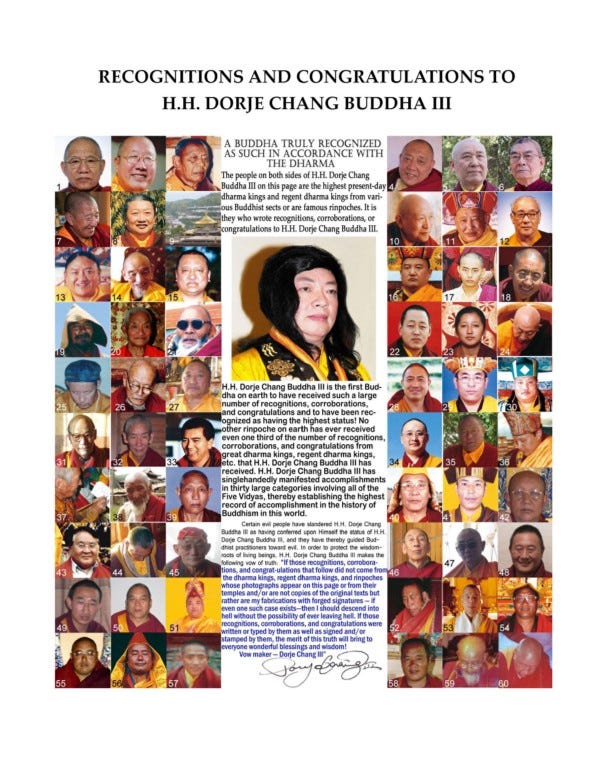
Worldwide Recognition of H.H. Dorje Chang Buddha III by Eminent Buddhist Leaders

Recognitions and Congratulations to H.H. Dorje Chang Buddha III

When over a hundred great Dharma Kings, Regents, and Rinpoches from various Buddhist traditions throughout the world lawfully recognized, in accordance with Buddhist precepts, that Namo H.H. Dorje Chang Buddha III is the reincarnation of the ancient Buddha, Buddhist disciples around the globe rejoiced in celebration. The descent of Namo H.H. Dorje Chang Buddha III brings to the beings of this Dharma-ending age the correct and unerring True Dharma of the Tathagata that leads to liberation from the cycle of birth and death. How fortunate living beings are to personally hear the teachings of the Buddha — there is now hope for attaining enlightenment in this very lifetime!

Online Slander and Misunderstanding of H.H. Dorje Chang Buddha III’s Holy State

However, some people on the internet refuse to face the legitimate recognitions, the holy realization, and the perfect mastery of the Five Vidyās and teachings of H.H. Dorje Chang Buddha III with reason or correct understanding. Instead, they fabricate rumors, spread insults, slander, defamation, and false accusations — maliciously twisting facts, inventing lies, and making baseless claims. They use vulgar words, forge fake documents, false notices, and false statements, and even create distorted images and mocking content — doing everything they can to attack H.H. Dorje Chang Buddha III. Through their own words and actions, they merely expose their ignorance and lack of virtue.

Some say, “A Buddha or Bodhisattva is realized through practice, not by ‘recognition.’” “Shakyamuni Buddha didn’t need a certificate of recognition.” But their purpose is clear — to stop more people from learning the true Buddha Dharma and attaining liberation!

So, does a Buddha need recognition when descending into the world?

A Practice for the Benefit of Sentient Beings.

A Buddha is one of unsurpassed, perfect enlightenment and complete wisdom. The reason one is a Buddha lies in their realization and enlightenment — not because of any recognition by others. No matter how great a Dharma King, Regent, or Rinpoche may be, their level of realization is far inferior to that of a Buddha; thus, any recognition they offer to a Buddha would be, in essence, just a piece of paper of no value to the Buddha.

However, because sentient beings in this world often lack the wisdom to discern between true and false saints, between genuine Buddha Dharma and false teachings that imitate Buddhism, they may easily be misled by superficial appearances and deviant views. Therefore, for the benefit of sentient beings, by following the Buddhist tradition of formal recognition, those virtuous masters issued such recognitions that help people give rise to faith and thus be saved. This is an act of right knowledge and right view.

The Example of Master Padmasambhava and the Importance of Recognition

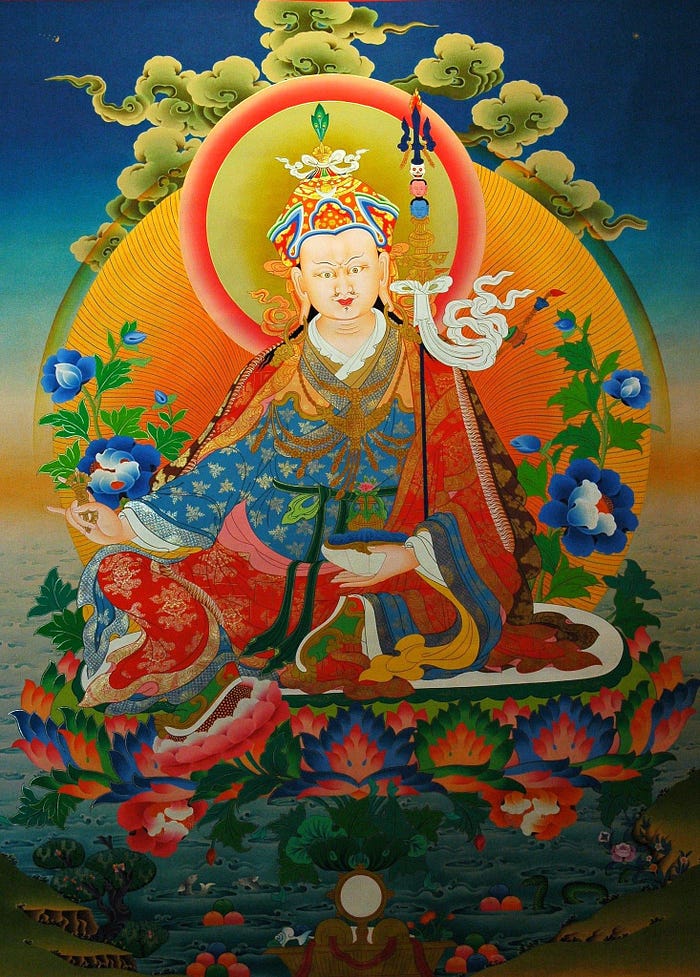
Master Padmasambhava

When Master Padmasambhava first went to Tibet to propagate the Dharma, he was not greeted with respectful welcoming crowds. Instead, the Tibetan people were terrified and shouted, “Quick! Drive out this sorcerer who performs strange magic without lineage transmission! Do not let him deceive us with his witchcraft!” They even lifted him up and threw him into a muddy pit. Later, Master Padmasambhava returned to India and asked two renowned masters to write letters of recognition. Only then did Buddhism begin to flourish in Tibet. In fact, those two masters later became Master Padmasambhava’s disciples.

Therefore, when Buddhas or Bodhisattvas reincarnate and manifest again in this world, undergoing recognition according to Buddhist rules is not for their own sake, but for the sake of helping sentient beings generate faith and thereby be liberated.

The Supreme Conduct and Realization of H.H. Dorje Chang Buddha III

Indeed, the realization and attainment of a Buddha or Bodhisattva come from their own cultivation and enlightenment. The realization, virtue, and attainment of all Buddhas and Bodhisattvas are the manifestation of their supreme enlightenment. The pure and flawless conduct of Namo H.H. Dorje Chang Buddha III, His mastery of both exoteric and esoteric teachings, His perfect command of the Five Vidyās, and His countless acts of liberating sentient beings — all fully demonstrate the enlightenment and realization of a true Buddha!

Therefore, I sincerely advise those who slander: repent sincerely before the Buddhas and Bodhisattvas, or karmic retribution will not spare you! At the same time, I compassionately remind all who truly wish to learn and practice Buddhism: we live in the Dharma ending age, when confusion prevails, and the nature of the demonic offspring is to destroy the Dharma and obstruct sentient beings from learning the true path. Kind-hearted beings, please open your eyes of wisdom, discern the true from the false, and do not be deceived by demonic forces — lest you miss the supreme Dharma opportunity that can bring you liberation from birth and death in this very lifetime!

Source: https://dharma-hhdorjechangbuddhaiii.org/the-recognition-of-h-h-dorje-chang-buddha-iii-does-a-buddha-need-to-be-recognized/

Link: https://hhdorjechangbuddhaiiidharma.com/2025/11/17/the-recognition-of-h-h-dorje-chang-buddha-iii-does-a-buddha-need-to-be-recognized/

#DorjeChangBuddhaIII #HHDorjeChangBuddhaIII #DorjeChangBuddha #TrueDharma #Buddhism #Vajradhara #LivingBuddha #BuddhistWisdom #BuddhaRecognition #ModernBuddhism