My Buddhist name is Bodi Wentu Rinpoche. I became a disciple of H.H. Dorje Chang Buddha III Wan Ko Yeshe Norbu Holiest Tathagata in Sichuan, China in late 1995. I would like to relate two examples that reflect H.H. Dorje Chang Buddha III’s highest mastery of the Five Vidyas.
After I returned to the United States from Sichuan, I began translating from Chinese into English ten discourses on the Buddha-dharma given by H.H. Dorje Chang Buddha III. A fellow disciple named Losang Gyatso Rinpoche assisted me in that translation.
One day in 1998 when H.H. Dorje Chang Buddha III was visiting the United States, Losang Gyatso Rinpoche and I went to the place where H.H. Dorje Chang Buddha III was staying to pay our respects to him and present the translation of those discourses to His Holiness for His Holiness’s review. The translation was put in sealed envelopes. Right after we prostrated to H.H. Dorje Chang Buddha III but before we presented the translation to His Holiness, H.H. Dorje Chang Buddha III said, “You have earned great merit and made a great contribution to living beings. Although the translation that you brought today contains some minor mistakes, it will still be of great benefit to westerners.” Before we even reported anything to H.H. Dorje Chang Buddha III, His Holiness already knew what we wanted to report. This moved me very much. Losang Gyatso Rinpoche and I then presented to H.H. Dorje Chang Buddha III the sealed envelopes containing the translation.
The second example occurred in 1999. I and other fellow disciples accompanied H.H. Dorje Chang Buddha III to Missouri, where H.H. Dorje Chang Buddha III received an honorary doctorate degree in Buddhism, Art, and Religious Studies from the American League of Colleges and Universities. After the presentation ceremony, all of us sat down to eat dinner. There were a number of college and university deans, presidents, and professors in attendance. The president of a religious college asked whether questions could be posed to His Holiness. H.H. Dorje Chang Buddha III responded, “Ask whatever questions you would like to ask. All of my answers will satisfy you.” H.H. Dorje Chang Buddha III answered all of the questions posed with total ease, which evoked great admiration. The president of that religious college asked the most difficult question, which H.H. Dorje Chang Buddha III easily answered, causing the president to blush with embarrassment. When there were no more questions, the chairman of the American League of Colleges and Universities expressed how awestruck he was with the answers of H.H. Dorje Chang Buddha III by suddenly slapping himself once on each cheek. He then excitedly and loudly stated that he has lived in vain for all of these years and that the answers of H.H. Dorje Chang Buddha III had truly opened his eyes. The president of the religious university also marveled at the wisdom that H.H. Dorje Chang Buddha III displayed that evening. One can see from this how complete the wisdom of H.H. Dorje Chang Buddha III is.
There are many other examples I could relate concerning H.H. Dorje Chang Buddha III’s highest mastery of the Five Vidyas and His Holiness’s great compassion toward living beings. However, due to limited space, I will stop here. May this book be a blessing for all living beings, and may it aid in liberating them from the sufferings of reincarnation.
In response to the request of Dorje Chang Buddha III’s students, His Holiness’s photographs have been added to the category of Technological Art. H.H. Dorje Chang Buddha III said, “I do not have any photographs that I have taken. Give me a camera and in only one day I will have them.” The Buddha Master then exited his place of solitary retreat. His Holiness quickly led more than ten people up a mountain ridge. The clicking sound of His Holiness’s camera could be heard capturing the scene of an ancient stratified cliff that resembled a fortress.
During the time His Holiness was taking photographs, extraordinary phenomena appeared. The sky was like a square mirror that reflected on the cliff in the photo area. Behind the mountain, blue light was being emitted from the earth. From a distance, these two scenes acted in coordination with each other. This sharp contrast of light caused the left mountain ridge to become pitch black. However, where there was light, the light was dazzling and extremely wonderful. The fact that there was such a magnificent and a holy site in this photograph shows the greatness of H.H. Dorje Chang Buddha III’s Buddha-dharma. We who accompanied His Holiness were deeply moved by this and felt an obligation to tell people of the world what actually happened. Therefore, we came to a true consensus that we would take a vow of truth in order to confirm that H.H. Dorje Chang Buddha III’s holy virtue moves and inspires.
The text of the vow is as follows. “This photograph was truly taken by the Buddha Master after His Holiness ascended the mountain ridge accompanied by us. His Holiness casually took a couple of photos as His Holiness stood before this holy mountain scene. There has been no computer modification of this photo. It is the original photograph. If what we have just stated is in any way false, we are willing to receive karmic retribution and not attain liberation. If what we have just stated is completely factual, may the good fortune of all living beings increase, and may they experience good luck and happiness.”
The disciples who together made the above vow have personally signed their names in the Chinese section.
(The text was translated from the Chinese text that follows.)
The sky was totally clear for miles on end that day. When H.H.Dorje Chang Buddha III was photographing scenery, a heavenly window above suddenly opened. From that heavenly window, an extremely strong beam of light in the shape of a square shined upon the place where H.H. Dorje Chang Buddha III stood. At this time, the strong light from the sun became dark in contrast. A square blue light arose from the mountaintop shining upon both sides of the mountain. This was truly miraculous. Although all of this happened in an instant, H.H. Dorje Chang Buddha III used his camera to capture this holy sight. The sky then returned to its original open, clear, cloudless condition. 這一天萬里晴空,三世多杰羌佛在攝影風景時,天頂的天窗突然打開,從天窗中射下一道強力無比的方形光幕照在三世多杰羌佛所站的位置,這時強烈的陽光竟然被對比成一片黑暗,山頂升起了方塊藍光,兩相映照,成了奇蹟。雖然只有那麼剎那,三世多杰羌佛的相機捉住了這一聖景,萬里晴空又依然如故。
This is a photograph of that same mountain scene that a disciple took at that time from a lower and farther place. 弟子當時在較低的遠距離所拍攝之同一山景
That was a very solemn and magnificent dharma assembly. Venerable Akou Lamo Rinpoche, who came to the United States from Tibet, and I, Long Hui, personally arrived at the Altar Hall of His Holiness Dorje Chang Buddha III Wan Ko Yeshe Norbu Holiest Tathagata and respectfully requested that Dorje Chang Buddha III give a discourse for our group on the rituals of the Green Tara Dharma.
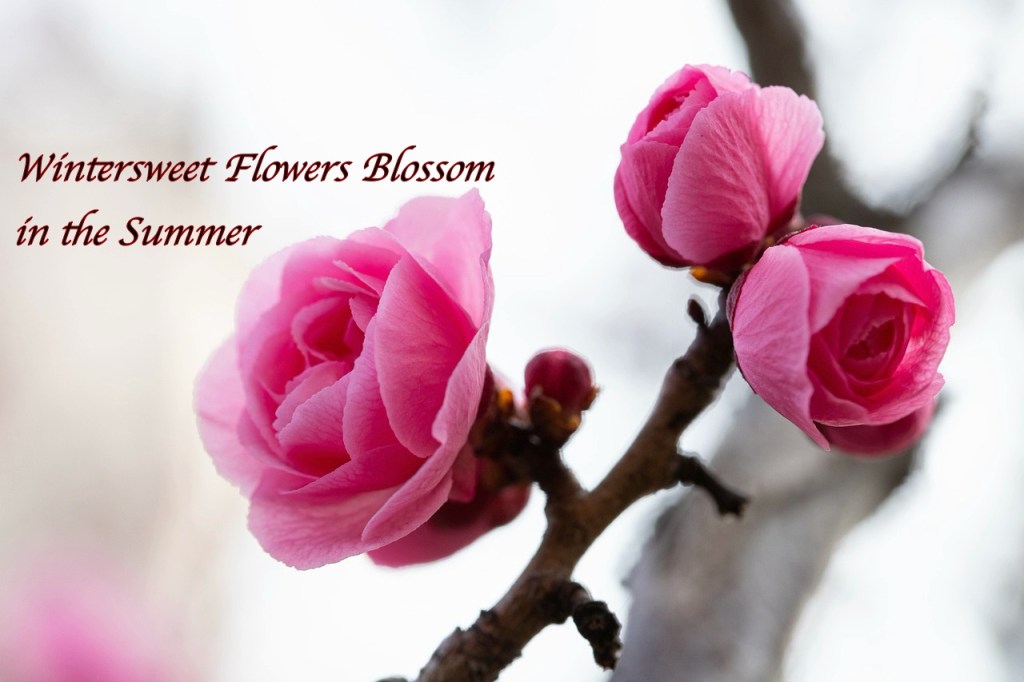
When the discourse was concluded, a pot of wintersweet (a kind of plum blossom tree that only blooms in the winter) in front of the altar unexpectedly started budding. That day was the 4th of August, 2001, in midsummer. The wintersweet suddenly blossomed forth red plum flowers. I had bought this plant and humbly offered it to my magnificent Buddha Master, His Holiness Dorje Chang Buddha III, in December of 2000. When I bought it, the plum flowers were red and white. After about one month, all of the flowers withered and fell. Although new leaves grew, no flowers ever blossomed after that.
However, on that August day of the dharma assembly in the height of summer, that pot of wintersweet suddenly started to bloom right after His Holiness finished the discourse. All the flowers were a brilliant red. Even more amazingly, the shape of some of the flowers resembled lotus flowers and emitted a heavenly fragrance. It was quite incredible. The disciples attending this special dharma assembly were all stunned as they gathered around to look at the pot. Afterward, the plant was placed in the Dharma Bowl Altar Hall of H.H. Dorje Chang Buddha III to be guarded at all times by about ten disciples. The blossoming lasted fifteen months, with the flowers retaining a fresh color until November of the following year. How extraordinary!
Certainly, such a holy and auspicious phenomenon could only have happened because of the great merits of the exquisite discourse that H. H. Wan Ko Yeshe Norbu Holiest Tathagata had given. We had heard of the miracles of old, such as self-turning Buddhist umbrellas above statues, or the sudden blossoming of withered plum blossom trees, or even a rock nodding upon hearing the discourse of a great master. And now we witness the miracle of a winter flowering plant blossoming in the hot summer, and the blossoming lasted fifteen months! We were able to film this wonderful occasion. Just when everyone was marveling and praising, H.H. Dorje Chang Buddha III said lightly, “The true meaning of the Buddha-dharma is not illustrated by whether wintersweet plum flowers blossom or not, or whether such an occurrence is auspicious or not. Do not be attached to these phenomena. The most important thing is how to carry out all good deeds and gain wisdom. We must fully understand the true dharma teachings and act accordingly. This is how we should practice. We are here to cultivate ourselves, not to look at wintersweet plum flowers. That is what we should devote ourselves to.”
We are grateful for the Buddha Master’s teaching, which we shall keep firmly in mind. But we also know that these continual miraculous phenomena could only be manifested because H.H. Wan Ko Yeshe Norbu Holiest Tathagata is truly an ancient Buddha who is praised and supported by the Buddhas and Bodhisatvas. Yet, H.H. Dorje Chang Buddha III always presents himself as a humble practitioner. His Holiness’s pure, noble, and holy morality sets the highest example for his disciples. His Holiness’s profound Buddha realization brings the greatest blessings and teachings to all sentient beings.
Chairperson of the International Buddhism Sangha Association
Long Hui Shih
(This is a complete translation of the Chinese text that follows originally written and signed by Long Hui Shih.)
The Virtue of H.H. Dorje Chang Buddha III and Holy Occurrences: Wintersweet Flowers Blossom in the Summer 臘梅花綻放了十五個月並開出形如蓮花的花朵,異香撲鼻
Spa still life with water lily and zen stone in a serenity pool
The moment I heard that I would be going with Venerable Dharma Teacher Long Hui to Los Angeles, unspeakable joy arose in my heart. On the way to Los Angeles, a rainbow suddenly emerged from the drizzling sky, emitting beautiful lights of various colors. A white celestial crane seen in the distance flew near and landed at the side of the freeway gazing at us, as if paying us respect. All of these signs expressed auspicious blessings. I strongly sensed that what I had wished for so long was about to come true.
A notice arrived in the afternoon of December 28th. From Venerable Dharma Teacher Long Hui’s somewhat tense facial expression, I could tell this must be the time for me to pay my respects and visit the Buddha Master. Just as expected, when we stepped into the mandala, I saw H.H. Dorje Chang Buddha III Wan Ko Yeshe Norbu Holiest Tathagata sitting upright on the dharma platform. His Holiness appeared so dignified and had an expression of loving-kindness. As I sincerely prostrated myself to H.H. Dorje Chang Buddha III, all I heard was the cordial voice of His Holiness telling everyone to come sit toward the front. I sat beside Venerable Dharma Teacher Long Hui. Dharma Teacher Jue Hui and Dharma Teacher Ruo Hui also sat with us.
Venerable Dharma Teacher Long Hui reported to the Buddha Master regarding the Buddhist chanting work that had taken place at Hua Zang Si over the past two months. Next, the Buddha Master called my name: “Fa Hai, proceed with what you want to say.” Without knowing why, my mind went totally blank. I felt that my entire body was soaking in a kind of freshness. I remained kneeling with a very straight back, as if I had entered a state of meditation. At this time, I only heard the Buddha Master say, “It is all right. Just speak directly!” Yet, I still could not speak and was silent for another eight or nine minutes. I could sense that the Buddha Master was patiently waiting.
Finally, a sound floated out of my mouth: “My karmic affinity with the Buddha Master should have begun ten years ago. Because I could not come to America, I was not able to visit His Holiness. I finally got a visa last year. Only this year did I have the opportunity to visit Hua Zang Si, where I respectfully listened to recorded dharma teachings of the Buddha Master. For more than one straight month, I have listened to the recorded dharma discourses without the slightest sense of tiredness. This has been the most beneficial and rewarding time of my entire life. The beneficial effects I have experienced can never be expressed in words. I bring my body, speech, and mind to respectfully visit the Buddha Master at this time. Today, I would like to specially request a great dharma from H.H. Dorje Chang Buddha III. I would not hesitate to leap into boiling water or walk on fire in order to obtain this great dharma. I am willing to undergo any test in order to obtain such dharma. I am even willing to sacrifice my own life. It might sound like I am exaggerating, but I truly can do such things.”
Perhaps because I was too nervous or focused, I unexpectedly was not able to express exactly what I meant to say. However, I silently told myself that the Buddha Master definitely understands what I am trying to express and what dharma I am requesting. I still remember that I fasted for a full 21 days in the Philippines in order to obtain this great dharma. This is because I am very aware that in this world only H.H. Dorje Chang Buddha III can accomplish this task and announce to the world this great dharma in order to demonstrate the brightness of Buddha and enable the correct dharma to exist in this world forever.
At first, the Buddha Master did not answer my request directly but gave us a profound and important discourse. Only afterward did I realize that this discourse was actually the beginning of His Holiness’s response to my question. His Holiness specifically pointed out the various kinds of confusion and mistakes that have appeared within Buddhism in this current Dharma Ending Age. Some Buddhist sutras contain serious mistakes. What is even more serious is that there are some so-called eminent monks and great virtuous beings who, due to their erroneous understanding and views, seriously misguide others when giving discourses on the dharma. What is even sadder is that believers who do not understand the truth still fanatically follow them and prostrate to them in worship. H.H. Dorje Chang Buddha III does all He can to correct these heretical ideas and views. However, being limited by the karma of living beings, H.H. Dorje Chang Buddha III feels that it is very difficult to change the current situation despite His wish to do so. The Buddha Master gave some examples of these heretical ways within both esoteric Buddhism and exoteric Buddhism. These very worrisome examples left me not knowing whether to laugh or cry.
After finishing the discourse, the Buddha Master said to me directly, “Fa Hai, you did not say what great dharma you want to request. Let me say it for you. The dharma you want to request is to film a movie of the Buddha. There really is no one else besides me who can do this because I completely understand the teachings of the Buddha. I can write the script. This movie must be filmed. The only thing is that the karmic conditions this year are not quite mature enough because the script needs to be written and actors need to be found, especially actors who are qualified. As for funding, as long as there is a script, there will be people who will sponsor and invest. Besides, the movie of the Buddha will not be filmed as one undivided whole but will be divided into a series of 100 parts or episodes. Perhaps this is really the right channel. After all, the influence of a book is limited as it reaches fewer people than a movie, which has much more of an international impact. In addition, when we do this, many problems might be solved. We might even be able to build several temples this way!” At this moment, I understood that the discourse just given by H.H. Wan Ko Yeshe Norbu Holiest Tathagata on the current chaotic situation within Buddhism illustrated that it is impossible for anyone else to write in a script the authentic doctrines of the Buddha.
Listening to this point, I was really shocked in my heart. I used to pay respect and visit many eminent monks and great virtuous beings. I requested from them great dharma. None of them knew what this great dharma in my mind was that I wanted to request. H.H. Dorje Chang Buddha III is truly magnificent. I did not reveal in the slightest what great dharma I wanted to request. Nonetheless, what His Holiness stated was the exact great dharma in my mind that I wanted to request.
His Holiness then said, “Fa Hai, when you come back from mainland China, I will transmit to you dharma according to the formal rituals of Tibetan esoteric Buddhism. You still have some negative karma. At that time, I will perform an initiation for you and eliminate your karmic hindrances. You will see.” I was totally engulfed in the joy of the dharma. The Buddha Master further said, “On your way here, the rainbow and the celestial crane you saw augured that your future undertakings will be bright. However, behind the brightness lurks darkness, and there are twists and turns on the path. We will soon face some attacks and slander, although those who commit the slander will all end up losing. When A Treasury of True Buddha-Dharma is published, no force can obstruct or destroy us because what is in that book are facts.” The Buddha Master finished by saying, “The movie of the Buddha definitely has to be filmed. You see, Fa Hai, your wishes have all been fulfilled. How fortunate you are!”
Actually, there are no words that can express my happiness. There are also no words that can express my gratitude toward H.H. Dorje Chang Buddha III.
I only want to respectfully offer to the Dorje Chang Buddha III my most beautiful spirit, my most beautiful melody, my most beautiful singing voice, and my best wishes. May all those who hear this beautiful melody and singing voice be happy.
I would like to express my special thanks to an anonymous person who ten years ago sent me an express mail package in which a yellow silk scarf was wrapped around the book The Fruits of Pious Devotion and CD’s that had a picture of H.H. Dorje Chang Buddha III on their covers. It is because of this present that seeds planted ten years ago have borne fruit in the form of my taking refuge in the His Holiness as my Buddha Master and in the form of my witnessing the magnificence of the Buddha-dharma.
Everything I described above is true. I am a Buddhist nun. I accept the karmic responsibility for my words. If what I have stated is false, I will descend into the Vajra Hell. If what I have stated is true, I would like to dedicate the resulting merit to all living beings in the dharma realm so that they will soon realize enlightenment.
Respectfully written by disciple Fa Hai Shi
December 30, 2006
The above account was written by Fa Hai Shi. We three humble Buddhist nuns provide the following testimonials.
Encountering an Unusual Occurrence
Basically, whenever people pay their respects and visit H.H. Dorje Chang Buddha III Wan Ko Yeshe Norbu Holiest Tathagata, they make good use of their short meeting time by posing prepared questions or by requesting the transmission of dharma. Some groups have really made the best use of their time by requesting answers to problems that have arisen.
From left to right: Rui Hui Shih, Long Hui Shih, and Jue Hui Shih
However, there was one particular occasion in the afternoon of December 28, 2006 when a dharma teacher from the Philippines, Fa Hai, came to the mandala from thousands of miles away. This was the first time she was granted an audience with H.H. Dorje Chang Buddha III. When H.H. Dorje Chang Buddha III asked her what question she had, I saw that Buddhist nun take a deep breath. She then unexpectedly remained silent as she stared at the Buddha Master with open eyes, sometimes lowering her head. Perhaps all of this was due to nervousness or other factors. At this time, the Buddha Master also did not speak. Seconds and then minutes passed by in silence. Then, that dharma teacher sighed once more and straightened her back, still looking at the Great Dharma King without uttering a sound. Strangely, Dorje Chang Buddha III also remained silent. A moment later, she sighed for the third time but still did not reply to the Buddha Master. The duration of this silence lasted more than eight minutes. This kind of situation had never happened before.
Finally, the dharma teacher spoke. She said she had come with a wish to request a great dharma. If her wish to obtain this great dharma were fulfilled, she said she would dedicate her life to the Buddha-dharma and living beings, even if it meant sacrificing her life. After uttering such words, she again fell into silence without mentioning what dharma she wished to request.
At this time, Dorje Chang Buddha III said, “Do not say anymore. I will give you a discourse.” The Buddha Master pointed out what request was in the mind of this Buddhist nun. That discourse not only enabled us disciples who were there to once again witness the supernatural powers of H.H. Dorje Chang Buddha III, it also enabled us to understand precious dharma principles.
Because I took Dharma Teacher Fa Hai to pay her respects to H.H. Wan Ko Yeshe Norbu Holiest Tathagata, I was there and personally witnessed everything that happened. Everything I described above is true. If what I have stated above contains false words, may I never become accomplished in the dharma. If what I have stated above is true, I dedicate the resulting merit to all living beings so that they may soon hear the correct dharma and soon attain liberation and accomplishment.
Buddhist disciple Long Hui Shih
I was present at the time. I hereby confirm that what is stated above is true. If what is stated above is false, I am willing to descend into hell and experience negative karmic retribution. If everything stated above is true, I dedicate the resulting merit to all living beings so that they may soon hear the correct dharma and soon realize enlightenment.
Buddhist disciple, Jue Hui Shih
Everything stated above is true. If what is stated above contains false words, I will not become accomplished in the dharma and will become impoverished and miserable. If what is stated above is true, I wish to dedicate the resulting merit to all living beings so that they may always see Buddha and attain liberation.
Buddhist disciple, Ruo Hui Shih
(This is a complete translation of the Chinese text that follows originally written and signed by Fa Hai Shih, Long Hui Shih, Jue Hui Shih, and Ruo Hui Shih.)
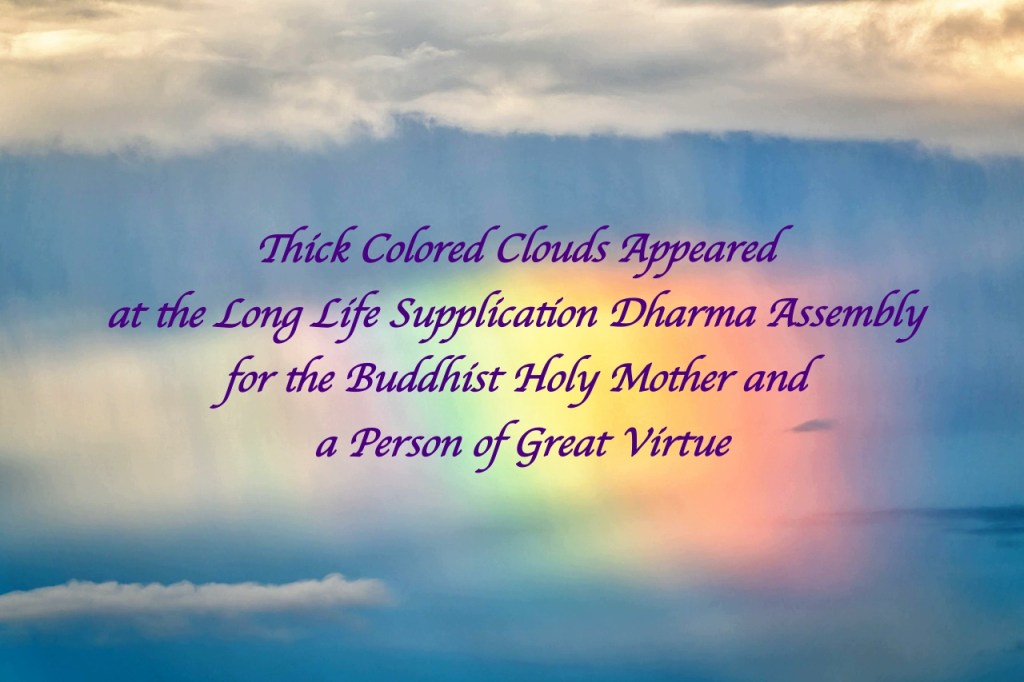
On August 19, 2007, H.H. Dorje Chang Buddha III practiced the Long Life Supplication Dharma for the Buddhist Holy Mother and a person of great virtue. At that time, a dazzling cloud with the multiple colors like a rainbow suddenly appeared amid the white clouds that filled the sky. After a ten minute period during which it changed colors and shape, it slowly dissipated. Clouds with color that people normally see are white clouds refracting sunlight. However, what is amazing about this holy scene is the fact that this cloud was colorful in and of itself and was totally surrounded by white clouds. More than ten people personally saw that holy scene and took photographs. The bottom of the photo which printed on the following page is the signatures of those who witnessed the holy scene that day.
People often say that helping others is the source of happiness. It rings especially true for me as I grew up in a Buddhist family. I feel very happy if others are happy. When I saw a small dead animal by the street, I would find a place to bury it and chant mantras for its well-being in the afterlife. When I had extra household items, I would donate them to help those in need. When I met homeless people on the street, I always helped them as much as I could. At the time of my graduation from college, my goal was to make a lot of money so I could help even more people.
I feel very happy when I can help others.
One day, I met a Buddhist sister who is one of good knowledge in Buddhism. She invited me to her home altar. I prostrated to the Buddha and listened to the recorded dharma expounded by H.H. Dorje Chang Buddha III. Because His Holiness the Buddha’s voice had a Sichuan dialect accent, I found it hard to understand. However, I was determined to concentrate and give my best effort. In the end, with the Buddha’s blessings, I was able to grasp part of the meaning of the dharma.
Through the years, with my Buddhist family background, I have learned a variety of Buddhist rituals and formalities and attended a lot of Buddhist classes for beginners and youth, and dharma assemblies, etc. However, none of these can be compared to the Dharma of H.H. Dorje Chang Buddha III, which is truly the greatest I have ever encountered in my life. H.H. Dorje Chang Buddha III pointed out to us the proper ways to cultivate oneself (in What is Cultivation? as contained in the dharma transmitted by H.H. Dorje Chang Buddha III) and how to master the dharma with step-by-step instructions how to walk on the path to liberation. I instinctively realized right then that I had found the true Buddha Dharma. I felt like I have found a treasure and was very grateful for H.H. Dorje Chang Buddha III. I was also very thankful to the Buddhist sister.
Afterward I learned that many disciples of H.H. Dorje Chang Buddha III had already achieved great accomplishments, for example, H.E. Dharma King Ciren Gyatso Venerable Gar Tongstan IV,H.E. Kai Chu Rinpoche, Jian Hui Dharma Master who can fly in high speed, Hui Xiu Liu who passed away in a sitting position and had attained liberation from the cycle of birth and death, and layperson Yu Shan Ho who gained rebirth in the Western Paradise of the Ultimate Bliss, etc. (They are just a few examples out of many.)
I was very excited for a long time. I want to thank H.H. Dorje Chang Buddha III and all Bodhisattvas, who made it possible for me to meet the true ancient Buddha in real life and learn correct Buddha-dharma. I realized that the way I was helping others before was so superficial compared to the true Buddha-dharma. If everyone could listen to the Dharma of H.H. Dorje Chang Buddha III, cultivate according to the correct dharma, start on personal improvement, do all good deeds and eradicate all evil thoughts, deeds or words, then, the cause and effect would be changed for the better and lead us to liberation from reincarnation and true happiness! I would like to work even harder to help others to get to know and listen to the recorded dharma expounded by H.H. Dorje Chang Buddha III. Only then, will they get on the path to true happiness and liberation.
I established a Buddhist altar at my home in Thailand on January 16, 2005. On that day, a fellow-disciple brought me a small glass bottle containing several individual strands of the hair sariras of my Buddha Master, Dorje Chang Buddha III Wan Ko Yeshe Norbu Holiest Tathagata. Each hair was roughly one centimeter long. I respectfully placed a blue semi-precious stone inside the bottle and set the bottle onto my altar.
A few months later, I decided to replace the glass bottle with a Venetian crystal bottle. When I opened the glass bottle, I noticed that the originally short hairs were longer than before. Although I was taken aback, I did not think much of it at first. However, the hairs continued to grow, and recently the difference has become unmistakable. Some of the hairs have grown as much as five or six times their original length and now are five or six centimeters long. Some hairs were pinned down on both ends by the stone, and their middle section had grown into a loop. How truly amazing!
From a scientific point of view, hair cells die upon being cut. How could short severed hairs continue to grow? Let the continuing growth of the hairs strengthen our conviction. This is a genuine manifestation of the power of the Buddha-dharma!
Buddhist disciple,
Shu-Hui Chen
(This is a complete translation of the Chinese text that follows originally written and signed by Shu-Hui Chen.)
Traditionally, the vidyas are divided into the five major vidyas and the five minor vidyas. The five major vidyas are the silpakarmasthanavidya (craftsmanship vidya), the cikitsvidya (healing vidya), the sabdavidya (sound vidya), the hetuvidya (causality or Buddhist logic vidya), and the adhyatmavidya (inner realization vidya). The five minor vidyas are rhetoric, ornate diction, prosody, dramaturgy, and astronomy. Actually, the Five Vidyas are not that narrow. Everything in the universe can be classified into five aspects of brightness and darkness. To develop everything that is good in the universe and that benefits living beings is classified as “bright.” That which confuses and is bad is classified as “dark.” This is the real meaning of the Five Vidyas (Five Bright) of which the Buddha spoke.
Venerable Akou Lamo Rinpoche
(This text was translated from the Chinese text that follows.)
Wearing a dharma hat, Venerable Akou Lamo Rinpoche conducts a Dharma Assembly for rinpoches, dharma teachers, and laypersons. 戴法帽的阿寇拉摩仁波且在為活佛、法師們和居士們舉行法會
H.H. Dorje Chang Buddha III Wan Ko Yeshe Norbu Holiest Tathagata usually cuts His own hair. However, there have been several times when I respectfully accompanied His Holiness to a barber shop. Each time, out of respect, after other people’s hair on the floor was swept away and the floor was cleaned, the haircut began. When the cut was finished, I would respectfully gather the Buddha Master’s hair from the floor and wrap it carefully with paper. I would then place it on my Buddhist altar when I got back home. Gradually, I have been collecting and keeping some of the hair.
I still remember what happened on June 1, 2003. On that day, I took out several unopened paper packs and organized them, intending to wash the hair. Because the individual hairs were very fine, I had paid special attention and placed them on a screen. While soaking them in water, I saw three small round red beads among the hair. The entire cleaning process was handled by me, and I did not touch anything else during that time. I felt this to be very strange and wondered where those red beads came from. I intended to press them with my finger to see if they were hard or soft and even took a magnifying glass to carefully exam them. Suddenly, a thought occurred to me. Could they be sariras? I realized if I did this, it would be too disrespectful.
Hurriedly, I placed the three small beads in a small white box and took them to H.H. Dorje Chang Buddha III to inquire of their origin. I asked, “May I know what these things are?” The Buddha Master said, “Where did you get these? These are sariras!” Afterwards, the Buddha Master practiced dharma and chanted mantras to prove the authenticity of those sariras. I reported to the Buddha Master that they were wrapped in paper and appeared from the cut hair of His Holiness.
Later, the Buddha Master gave us a special discourse in which His Holiness stated, “This has happened because of conditions and the level of fortune of all sentient beings. It does not matter where they come from. Perhaps they originated from the empowerment of the Buddhas and Bodhisattvas. It actually does not matter what the disciples think concerning how or where they come from. If they can appear out of nothing, then they can disappear out of nothing. The important thing is the cultivation of each one of us and the need to live in accordance with the teachings and abide by the principles of Buddhism.”
That night, I carefully placed those three red sariras in a small tightly covered Tibetan box and cushioned them with white cotton. The next day, a fellow disciple requested to view them. I thought about placing the sariras in a crystal bottle that I had just bought. When I opened the small box and looked inside–how could it be that there were only two sariras left? I did not touch any other things anymore! I shredded and tore the cotton, but could only find two sariras. It was really upsetting! This proves and corresponds to what H.H. Dorje Chang Buddha III previously expounded: “If they can appear out of nothing, then they can disappear out of nothing.” I once heard a sister personally attested to the fact that sariras fell off of the Buddha Master. This time, I personally witnessed such an occurrence myself. It is truly an extremely wonderful and auspicious sign.
All that I have said above is true and authentic. If there are any false statements, may I suffer all evil retribution. If they are real facts, may living beings be able to receive the dharma teachings of H.H. Dorje Chang Buddha III Wan Ko Yeshe Norbu Holiest Tathagata, be liberated from the cycle of life and death, and gain wisdom and good fortune.
Buddhist disciple,
Hsuan Hui
(This is a complete translation of the Chinese text that follows originally written and signed by Hsuan Hui.)
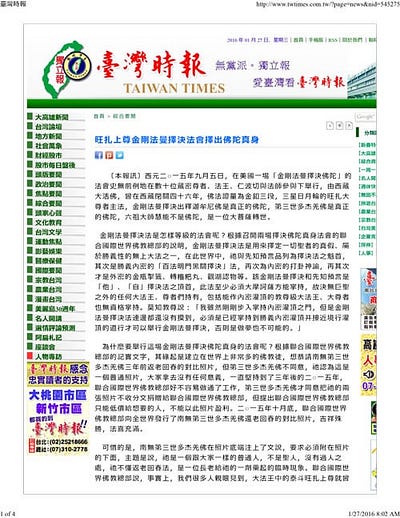
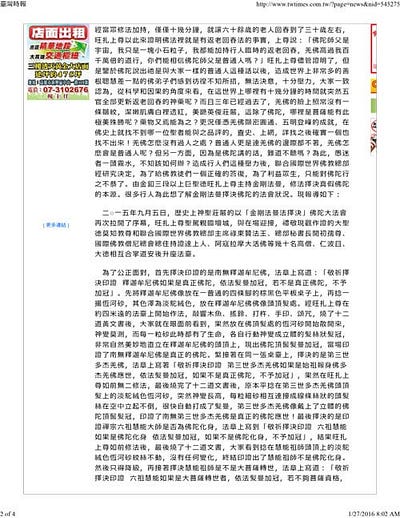
(Reported by the Taiwan Times) On September 5, 2015, an unprecedented dharma assembly of “Determining the Status of a Buddha by the Dharma of Jin Gang Fa Man Ze Jue (Jin Gang Fa Man Ze Jue is a dharma in Tibetan Esoteric Buddhism for determining the result sought through selection)” was held in the United States of America with the attendance of several dozens of venerable ones, dharma kings and rinpoches, who are from Tibetan Esoteric Buddhism, and dharma masters. The dharma practice was led by Great Rinpoche Wang Zha from Tibet, who once practiced in solitary retreat for 46 years in Tibet and has the realization of Golden Button Grade 3 (having three Sun-Moon wheels) in Buddha-dharma. The decisions by the Dharma of Jin Gang Fa Man Ze Jue determined that Sakyamuni Buddha is a true Buddha, H.H. Dorje Chang Buddha III is a true Buddha, and Master Hui Neng, the sixth patriarch of the Ch’an (Zen) School, was not a Buddha but was the incarnation of a great Bodhisattva.
At what level is a dharma assembly of determination by the Dharma of Jin Gang Fa Man Ze Jue? According to the explanation provided by the United International World Buddhism Association Headquarters (UIWBAH) who sponsored the two sessions of the dharma assembly to determine the status of a Buddha, the Dharma of Jin Gang Fa Man Ze Jue is one of the holy supreme great dharmas and can be used to determine the true or false status of any holy being. In this world, this dharma and the Dharma of Forecasting the Future (announcing events that will happen in the future ahead of time) are the co-champions among the dharmas of decision by selection. The dharma ranked next is the holy inner-tantric dharma of “Bai Fa Ming Men Hei Guan Ze Jue (a dharma specifically used to determine the correct or wrong result).” The next lower dharma is the dharma of dropping divine pieces to receive divine instruction, which is at the inner-tantric level. Then, there are lower, outer-tantric dharmas of lot-drawing from a golden vase, rotating a tsampa ball, watching a sacred lake to see the result, and others. This Dharma of Jin Gang Fa Man Ze Jue and the Dharma of Forecasting the Future are the highest dharmas among dharmas of decision by selection to determine the status of either “another person” or “self.” This dharma can only be possessed and commanded by holy ones at the level of great Mahasattvas or higher. Therefore, no great dharma king or venerable one who is not an extremely great holy one can hold and practice this dharma. Even great dharma kings and great venerable ones at the level of Jiao Zun who have the ability of performing inner-tantric initiations do not have the qualification to hold and practice this dharma. Mo Zhi Jiao Zun said, “Although I have just entered the door of holding and performing inner-tantric initiations, I have not touched even the edge of the Dharma of Jin Gang Fa Man Ze Jue. Only a holy one who has the realization of performing holy inner-tantric initiations that are close to the level of state practice can perform the Dharma of Jin Gang Fa Man Ze Jue. Otherwise, one is merely dreaming and far away from doing it.”
Why was this dharma assembly held to determine the status of a Buddha by the Dharma of Jin Gang Fa Man Ze Jue? According to a writing describing the fact by the UIWBAH, the karmic condition rose from the fact that many Buddhists in the world wished to respectfully beseech the contrasting photos of H.H. Dorje Chang Buddha III showing His returning from an aged appearance to a youthful person three years ago. However, H.H. Dorje Chang Buddha III did not agree to that. He thought that these were just ordinary photos and were meaningless for people to have. The discussion lasted three years to 2015. The UIWBAH finally got the agreement from H.H. Dorje Chang Buddha III. His Holiness the Buddha donated the two photos of His to the UIWBAH free of charge with a requirement that the UIWBAH can only sell the photo at a low price to those who wish to get it and must not profit from selling the photo. At the end of October of 2015, the UIWBAH published the contrasting photos of H.H. Dorje Chang Buddha III showing His returning from an aged appearance to a youthful person to the world. This provided people with auspicious and magnificent feelings and abundant joy of Buddha-dharma.
Unfortunately, H.H. Dorje Chang Buddha III wrote a note for the photos and demanded it to be printed at the lower part of the photo sheet. The note mainly stated that He is an ordinary person like everyone else, He is not a holy person, He has no advantage over other people, He does not know the dharma of returning from an aged appearance to a youthful person, and what people saw was a temporary phenomenon due to a medicine given by an elder virtuous one. On the other hand, UIWBAH stated that many people witnessed the real fact that Wang Zha Shang Zun, who is an outstanding one among great dharma kings, publicly practiced a dharma of empowerment. After a short period of a little over 10 minutes, an elder person whose age was over 60 changed into an appearance of a person who was about 30 years old. Wang Zha Shang Zun used this demonstration to show the fact that the dharma of returning from an aged appearance to a youthful person does exist within the realm of Buddha-dharma. Wang Zha Shang Zun said, “My Buddha Master is the universe. I am only a small piece of stone. Even I can empower a cultivator to return from an aged appearance to a youthful person temporarily. H.H. Dorje Chang Buddha III’s realization is millions of times higher than mine. Can you believe that the Buddha Master is an ordinary person?”
Although Wang Zha Shang Zun made the above proof, the speech by His Holiness the Buddha saying that He is an ordinary person just like everyone else made many Buddhist disciples in the world, whose good roots and intelligence are not strong enough, hesitate and be at a loss. They are unsure, with pressure on their mind. All can tell that, in terms of science and causality, how can there exists any miraculous medicine that can completely change a person’s facial features in a short period of a little over 10 minutes? Furthermore, three years have already passed and there is still not even one winkle in H.H. Dorje Chang Buddha III’s face. The skin and flesh on His face are clean and tender with a light ruddy complexion. His appearance is extremely beautiful, handsome, and majestic. Other than a Buddha, how can a Bodhisattva have such extremely beautiful magnificence and how can any medicine create such an effect? Additionally, H.H. Dorje Chang Buddha III’s accomplishments of perfect mastery in both exoteric Buddhism and esoteric Buddhism and at the acme of the Five Vidyasare unmatched and incomparable by any holy one throughout the history of Buddhism. Not even one can be found from looking through history, searching the internet, and exhaustive investigations! How could H.H. Dorje Chang Buddha III not have advantage over others? Ordinary people do not bear any remote resemblance to H.H. Dorje Chang Buddha III. Then, how could H.H. Dorje Chang Buddha III be an ordinary person? On the other hand, should we not listen to His Holiness the Buddha’s speech? Therefore, unintelligent and deluded people feel muddle-headed and do not know what is right.
Considering this situation of cultivators being pressured, the UIWBAH had discussions and decided to provide Buddhists a correct conclusion. For the sake of benefiting living beings, an action that may not respect His Holiness the Buddha has to be taken. Wang Zha Shang Zun, an extremely great holy one at the level of Golden Button Grade 3 or higher, took the lead to practice the Dharma of Jin Gang Fa Man Ze Jue to determine fundamentally whether the Buddha’s status is true or false. Many cultivators wish to know the situation of the dharma assembly that determined the Buddha’s status by the Dharma of Jin Gang Fa Man Ze Jue. The following is a report on that dharma assembly:
On September 5, 2015, the historic grand dharma assembly to determine the status of the Buddha using the Dharma of Jin Gang Fa Man Ze Jue began in a solemn and majestic scene. Wang Zha Shang Zun’s holy arrival was welcomed by Great Holy and Virtuous One Mo Zhi Jiao Zun, Chairman of the UIWBAH Dharma King Gar Tongstan, UIWBAH’s Secretary General Kai Chu Ru Zun, Chief Abbot of the International Buddhism Sangha Association Dharma Master Zhengda, Great Rinpoche Akou Lamo, and several dozens of eminent monks, rinpoches, and dharma masters who were to serve as observing witnesses. They held palms together to greet each other and were seated on the dharma rostrum.
To be fair, the decision by selection was first conducted to verify the status of Sakyamuni Buddha. The beseeching dharma document wrote, “We respectfully beseech a verification from the decision by selection. If Sakyamuni Buddha is truly a Buddha, a crown made by strands of hair will be put on the head. If not, there will be no crown.” First, a portrait of Sakyamuni Buddha was laid on an ordinary four-legged flat table of dark-brown color. Then, a pinch of sand from the Ganges River with the color of light camel wool was picked up and put on the portrait at a spot of hair at the top of the Buddha’s head. Wang Zha Shang Zun began to practice the dharma at a dharma rostrum which was about 13 feet away from the table. After the ritual of knocking the wood fish, ringing the bell, waving the Vajra, performing mudras, and chanting mantras, twelve documents written on yellow papers were burnt. All observing witnesses saw with their own eyes that the sand placed at the spot of hair at the top of the Buddha’s head began to disperse with inconceivable changes. Every grain of sand seemed to be alive. All sand grains moved individually with miraculous transformations to form a crown made of strands of hair, which very naturally and wonderfully stood up above the top of Sakyamuni Buddha’s head. A scene of adding a crown of strands of hair to the Buddha’s top-knot was manifested, proving that Sakyamuni Buddha is a true Buddha.
Immediately after and on the same table, the decision by selection was conducted for H.H. Dorje Chang Buddha III. The beseeching dharma document wrote, “We respectfully beseech a verification from the decision by selection. If H.H. Dorje Chang Buddha III is the incarnation of the primordial Sambhogakaya-Buddha Dorje Chang Buddha, a crown made by strands of hair will be put on the head. If not, there will be no crown.” Wang Zha Shang Zun practiced the dharma following exactly the same ritual as before. After the twelve documents were burnt, the sand of the Ganges River with the color of light camel wool that had been flatly put on the spot of hair at the top of H.H. Dorje Chang Buddha III’s head suddenly had the miraculous transformation of being elevated upward. Sand grains connected with each other to form strands of hair standing in the air. The strands of hair then automatically formed a crown of hair. A 3-dimensional crown was put on the head of H.H. Dorje Chang Buddha III in the portrait, proving that H.H. Dorje Chang Buddha III is a true Buddha coming to the world!
The last decision by selection was to verify whether the Sixth Patriarch Master Hui Neng was a Buddha’s nirmanakaya (meaning emanated body). The beseeching dharma document wrote, “We respectfully beseech a verification from the decision by selection. If the Sixth Patriarch Master Hui Neng is a Buddha’s nirmanakaya, a crown made by strands of hair will be put on the head. If not, there will be no crown.” As before, Wang Zha Shang Zun practiced the dharma following the same ritual and the twelve documents were burnt. Everyone saw that the sand of the Ganges River with the color of light camel wool placed at the top of Patriarch Master Hui Neng’s head had no movement or change at all. Therefore, the conclusion was that Patriarch Master Hui Neng was not a Buddha’s nirmanakaya. So a lower-level status had to be verified by the decision by selection, i.e. to determine whether Patriarch Master Hui Neng was an incarnation of a great Bodhisattva or not. The beseeching dharma document wrote, “We respectfully beseech a verification from the decision by selection. If the Sixth Patriarch Master Hui Neng is an incarnation of a great Bodhisattva, a crown made by strands of hair will be put on the head. If he was not at the level of a Bodhisattva, there will be no crown.” After Wang Zha Shang Zun practiced the dharma, a dharma crown was put on Master Hui Neng’s head. Sand grains formed a crown of hair. However, because Patriarch Master Hui Neng was not a Buddha or a Bodhisattva with universal or wonderful enlightenment, as stipulated by the dharma, the crown of hair did not stand up into the air and become a 3-dimensional crown, but was formed on a flat plane. However, it was very naturally structured and absolutely not something that can be made by humans.
The two sessions of the dharma assembly lasted more than five hours. To show the magnificence and extremely truthful nature of the crowning process through determination by the Dharma of Jin Gang Fa Man Ze Jue, each of the venerable ones, dharma kings, rinpoches, great dharma masters, dharma masters, great laypersons, and others attending the dharma assembly took a test to crown the visage using the sand from the Ganges River. As it turned out, none of the holy and virtuous ones present who are at the levels of Golden Button Grade 2, Golden Button Grade 1, and Blue Button Grade 3 were able to crown the Buddha’s portrait with sand from the Ganges River. There was no manifestation of power of Buddha-dharma to cause miraculous changes. This proved that the great dharma of Jin Gang Fa Man Ze Jue can only be practiced by extremely great holy and virtuous ones at the level of Golden Button Grade 3 or higher. No one else possesses the realization to practice the dharma successfully.
Wang Zha Shang Zun was very dissatisfied with himself for the first session. He said that his cultivationwas shallow and lacked merit and virtue and that his own karmic forces caused him not to practice this dharma of decision by selection perfectly. The reality was that a few people in the observing crowd had their karmic forces become visible during the dharma assembly. They caused disturbance in the Buddha hall when they could not control their excitement upon seeing holy states. They shouted loudly and pushed others. Such disrespect toward the holy dharma kept the outcome from being completely perfect. For this reason, Wang Zha Shang Zun decided to hold a second session of the dharma assembly. Before the second dharma assembly started, Dharma King Gar Tongstan made the rules on behalf of Wang Zha Shang Zun. He announced that onlookers could get closer to watch but no one was allowed to speak loudly or push others. All must have the mind focusing on being respectful before moving closer. Then Wang Zha Shang Zun practiced the dharma. The second dharma assembly had a perfect success with extremely magnificent manifestations, proving again that Sakyamuni Buddha is a true Buddha and H.H. Dorje Chang Buddha III is the incarnation of the primordial Sambhogakaya-Buddha Dorje Chang Buddha. In the process, the sand of the Ganges River of the light camel wool color placed at the top of the head exhibited unimaginably miraculous transformation. A lose-hair crown changed into a head-covering crown and a thick-hair crown changed into a thin-hair crown. The strands of hair gathered or separated as required at different places to knit into a naturally perfect crown. Every sand grain had its own independent life. Some walked extremely fast; some wandered around casually; some followed twisted paths; some traveled past the boundary and then came back; and some climbed from the bottom to the top. The sand grains followed each other one by one to form strands of hair that stood into the air without falling. Eventually, a knot was formed to create a perfect crown for the Sambhogakaya-Buddha. Then, Wang Zha Shang Zun snapped a finger to perform a mudra and the strands of hair fell into a pile of sand with no trace left of the crown. Wang Zha Shang Zun issued a dharma decree to distribute the sand of the Ganges River (which became Vajra Sand after the dharma was performed) to all who were present. Every attendee received a share of the Vajra Sand that manifested the holy crown worn by the genuine incarnation of the Buddha.
The situation at the time was that the dharma was practiced with the same table, at the same position, following the same ritual, and using the same sand of the Ganges River. However, the three hair crowns created were completely different. There was one Bodhisattva two-dimensional crown and there were two Buddha hair crowns that were three-dimensional and stood into the air. The latter two were also different from each other in terms of shape and structure.
All attendees on the dharma assembly on that day took an oath to testify for the above reported true facts, “We all attended the dharma assembly for determining the status of the Buddha by the Dharma of Jin Gang Fa Man Ze Jue as practiced by Wang Zha Shang Zun. We clearly understand and believe in the law of cause and effect. What was stated above is true and without any false statement. If we lied to deceive people, we not only will not become accomplished but also will descend into the three lower realms to undergo extremely miserable suffering. If what was stated above is all true, we wish and pray that all living beings be able to learn the true dharma of the Tathagata from H.H. Dorje Chang Buddha III and Sakyamuni Buddha, attain perfect good fortune and wisdom, and become accomplished and liberated to benefit countless living beings.”
(Translated from a news report in Chinese published by Taiwan Times)












 頂禮 H.H.第三世多杰羌佛-- 正法