It Is Time to Truly Wake Up

It Is Time to Truly Wake Up

It Is Time to Truly Wake Up

After respectfully listening to the Dharma discourse “Focusing Primarily on Cultivating One’s Own Dharma and Conduct” imparted by Namo H.H. Dorje Chang Buddha III, I came to a profound realization: It is time to truly wake up!

I am deeply grateful for the blessings of all Buddhas and Bodhisattvas!

Although I had listened to this Dharma discourse before, it seemed to have left almost no impression on me. Just as my Buddha Master said, it went in one ear and out the other. As soon as I finished listening, I forgot what I had heard. The teachings neither entered my mind nor touched my heart. I am truly ashamed of myself.

After listening to this Dharma discourse again, I came to understand more deeply the preciousness of Buddha Dharma, the true meaning of liberation, and how I should make use of my limited lifetime.

First, we must understand that Buddha Dharma is extremely precious and difficult to encounter. Why? Because only Buddha Dharma can enable us to end the cycle of birth and death and transcend the six realms of samsara in which we now exist.

In the past, when Dharma Master Nenghai listened to Geshe Jangba expound the Dharma, he could hear only one sentence each day and had to make a round trip of about 25 miles. It took him half a year to finish listening to that Dharma teaching.

There are also many people who learn Buddhism by studying Buddhist scriptures. Because many scriptures are written in classical Chinese, their meanings can be very difficult to understand. Even when someone can understand the words, the scriptures were compiled by the Five Hundred Arhats based on their recollections of the Dharma expounded by Namo Shakyamuni Buddha. Therefore, deviations in the meaning of the Dharma could inevitably have occurred, and what was recorded may not fully convey the perfect Dharma meaning spoken by the Buddha.

Today, we are able to listen directly to the perfect Dharma teachings of unsurpassed, complete enlightenment expounded by my Buddha Master(H.H. Dorje Chang Buddha III). This is truly rare, precious, and extraordinarily auspicious!

When my Buddha Master (H.H. Dorje Chang Buddha III)expounds the Dharma, profound principles are explained in simple and accessible language, almost like having an everyday conversation. Deep principles of Buddha Dharma are presented to us clearly and understandably, enabling people of different levels of good roots to gain understanding according to their capacities.

Therefore, we must cherish every opportunity to listen to the Dharma!

Second, we must understand how swiftly impermanence can arrive. How much time do I really have left to waste? Impermanence can take my life at any moment, for death makes no distinction between the young and the old.

Since I have already encountered the true Dharma of H.H. Dorje Chang Buddha III, I must make good use of my time and genuinely cultivate myself according to the Dharma principles taught by my Buddha Master. I must integrate Buddha Dharma into my everyday life.

At every moment, I should recall the Dharma principles taught by H.H. Dorje Chang Buddha III and use them to examine my every word, action, and thought:

Do I truly have compassion?

Have I practiced patience and forbearance?

Have I let go of greed, anger, and ignorance?

Am I still entangled in worldly grievances and disputes over right and wrong?

Are the things I am doing bringing me step by step closer to accomplishment and liberation?

A human existence endowed with the freedoms and favorable conditions for learning the Dharma is difficult to obtain. Even more difficult is the opportunity to hear directly from H.H. Dorje Chang Buddha III the perfect Dharma teachings that enable living beings to end the cycle of birth and death!

All worldly phenomena are illusory and ultimately unreal. What, then, is there to cling to?

Isn’t that true?

The people and possessions I cherish most, everything I have worked so hard to obtain—I carefully protect them, constantly afraid that I might lose them. Joy, worry, and anxiety accompany me all the time.

But has this attachment really brought me happiness?

Is this truly the happiness I have always longed for?

Have I actually obtained it?

At the very moment I take my last breath, will any of these things still belong to me?

Therefore, I must clearly establish the true goal of my life: to end the cycle of birth and death and attain liberation.

On the path toward liberation, I must not keep looking around—admiring the scenery here one moment and envying someone else’s treasures the next. Doing so only delays my journey and wastes my precious life and time.

Cultivation means cultivating oneself.

I must listen to the Dharma teachings frequently, and whenever I understand even one principle, I should put it into practice through my actions, speech, and thoughts—the three karmas.

I must constantly examine myself:

Have I let go of greed, anger, and ignorance?

Am I practicing the Six Paramitas and the myriad Bodhisattva practices?

I should begin with the people closest to me. It is in front of those closest to us that we remove our disguises and reveal our true selves. In those relationships, all our shortcomings are exposed most clearly.

I asked myself sincerely: Am I truly compassionate toward my family?

Suppose I have just finished mopping the floor, and suddenly a large footprint appears on the spotless surface. At that very instant, anger and irritation arise within me. I glare angrily at the person responsible, only to receive a casual response:

“Just wipe it again. What’s the big deal?”

Not only was my effort unappreciated, but I also felt that it had been disrespected. My anger immediately intensified, and I raised my voice:

“Why don’t you clean it yourself?”

Such a trivial incident exposed the selfishness within me.

First, my effort was not truly selfless. I expected praise and respect in return. Second, I lacked tolerance and understanding. When someone failed to respect the results of my labor, instead of responding with compassion and patience, I gave rise to anger and resentment.

At the root of the problem was my failure to truly understand the impermanence of all phenomena. I had failed to realize that I should be selfless, compassionate, and forbearing, and that I should do only those things that benefit others.

Instead, I had neglected what was truly important while clinging to things that offered no help whatsoever toward my accomplishment and liberation—my pride, my dignity, my boundaries, and so on.

It is truly time for me to wake up completely.

I must make full use of this limited lifetime, take my Buddha Master (H.H. Dorje Chang Buddha III) as my role model, establish unwavering faith, rely upon correct understanding and correct views, and diligently cultivate my own conduct and practice my own Dharma.

I will strive to end the cycle of birth and death and attain liberation as soon as possible.

Written by: Qingxin
Edited by: Sayi

Learn more about H.H. Dorje Chang Buddha III

Link: https://hhdorjechangbuddhaiiidharma.com/2026/09/20/it-is-time-to-truly-wake-up/

#DorjeChangBuddhaIII #MasterWanKoYee #BuddhaDharma #BuddhistTeachings #Buddhism #BuddhistCultivation #DharmaTeachings #BuddhistPractice #SpiritualAwakening #BuddhistWisdom

An Awakening While Stopped at a Red Light

An Awakening While Stopped at a Red Light

An Awakening While Stopped at a Red Light

Sometimes, what suddenly wakes us up and brings clarity to our minds is not the sound of a temple bell. It can be something as ordinary as watching the countdown on a traffic light at an intersection.

That day, I was riding my scooter and stopped at a red light. I found myself staring at the numbers as they counted down, one second at a time…

Normally, those numbers simply tell us how many seconds we have to wait before moving on. But for some reason, at that moment, something gently struck me deep inside.

I suddenly realized: It wasn’t just the traffic light that was counting down. Our lives are counting down too.

Every time another second disappears from the display, one second of our own lives is gone as well.

We often talk about the Buddhist teaching of “impermanence.” We have heard countless times how swiftly life passes and how quickly circumstances can change. In His Dharma discourses, Namo H.H. Dorje Chang Buddha III has also compassionately reminded us time and again of how frightening impermanence can be and how it is constantly unfolding right before our eyes.

Yet this is simply how we human beings are. We may understand these teachings intellectually, but somehow they never seem to truly frighten us deep down.

We continue drifting through our days in a haze. We still lose our temper. We still tightly hold on to attachments, grudges, and conflicts that we cannot seem to let go of. We always think there is still plenty of time. We simply assume that when the sun rises tomorrow, we will still be here.

It often takes an ordinary, seemingly insignificant moment to suddenly wake us up:

From the day we were born, our lives have already been counting down.

Older generations often say that the frightening thing is not that we are slowly growing old, but that we do not even realize we are growing older day by day.

When today passes, one more day of our life is gone. When this second slips away, we will never be able to get it back again.

The Verse of Admonition by Samantabhadra Bodhisattva says:

“This day has already passed, and our lives have likewise diminished. Like fish in a shrinking pool of water, what joy can there be? We should diligently and vigorously cultivate ourselves, as urgently as if extinguishing a fire upon our heads. Be ever mindful of impermanence, and never give way to negligence.”

Every time I read this verse, it strikes me deeply.

Aren’t we just like fish in a pond whose water is slowly drying up? The water decreases day by day, yet we are still fighting fiercely with one another over a few pieces of fish food, completely forgetting that before long, when the water dries up, none of us can escape what follows.

When we look back carefully at all the noise and turmoil of this world—the pursuit of fame and personal gain, who wins and who loses—the things that once seemed unbearable, the things we thought we could never let go of, what do they amount to when we look back several years later?

They were little more than a dream from which we eventually awakened.

What truly matters in life has never been whether everything goes our way at this particular moment. What really matters is whether, during this lifetime, we have sincerely followed the Buddha’s teachings, whether we have earnestly cultivated ourselves, and whether we have worked toward freeing ourselves from the suffering of reincarnation.

If we can show others a little more compassion, then let us do so.

If we can lessen our attachments even a little, then let us loosen our grip.

If there is a good deed we can do today or a kind thought we can give rise to today, we should not put it off until tomorrow.

Because none of us knows what awaits us after the light turns green and we pass through this intersection.

At the next crossroads, will we simply continue along the familiar road we have traveled so many times before—or will we have reached the end of our journey in this life?

While we still have the strength, and while we still possess this precious human body, let us remind ourselves of this at every moment.

Do not wait until the light has gone out to regret having let this precious life pass by in vain.

—Buddhist disciple Gao Qiyuan
August 6, 2026

Learn more about H.H. Dorje Chang Buddha III

Link: https://hhdorjechangbuddhaiiidharma.com/2026/08/23/an-awakening-while-stopped-at-a-red-light/

#DorjeChangBuddhaIII #MasterWanKoYee #BuddhistTeachings #BuddhaDharma #BuddhistWisdom #Impermanence #Mindfulness #BuddhistPractice #SpiritualAwakening #Buddhism

Disciples of H.H. Dorje Chang Buddha III Wan Ko Yeshe Norbu Holiest Tathagata Can Be Divided into Twelve Levels

Disciples of H.H. Dorje Chang Buddha III Wan Ko Yeshe Norbu Holiest Tathagata Can Be Divided into Twelve Levels

Disciples of H.H. Dorje Chang Buddha III Wan Ko Yeshe Norbu Holiest Tathagata Can Be Divided into Twelve Levels

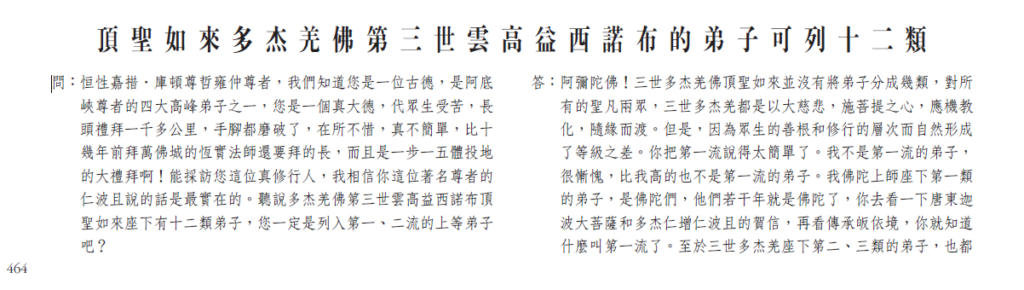
Question: Venerable Henghsing Gyatso Khu-ston brTson-‘grus g. yung-drung, we know that you are the incarnation of an ancient virtuous being and that in a prior life you were one of the four most outstanding disciples of Venerable Atisha. You truly are a person of great virtue. You have suffered on behalf of living beings by prostrating more than 1,000 kilometers. Your hands and feet are scraped all over, yet you do not mind at all. You are truly remarkable. You have prostrated a longer distance than that traversed by Dharma Master Heng Sure when he performed kneeling prostrations all the way to the Temple of Ten Thousand Buddhas over ten years ago. Moreover, you made full prostrations after each step! I know that what you say during this interview will be truthful and dependable since you are a true cultivator, a famous and venerable rinpoche. I heard that there are twelve levels of disciples under H.H. Dorje Chang Buddha III Wan Ko Yeshe Norbu Holiest Tathagata. You must be in the upper tier of disciples at the first or second level.

Answer: Amitabha! H.H. Dorje Chang Buddha III Holiest Tathagata does not classify disciples into various levels or categories. Whether the disciple is holy or ordinary, H.H. Dorje Chang Buddha III will use great compassion and bodhicitta to save the disciple by teaching according to the particular circumstances and karmic conditions of the disciple. However, different grades of disciples have naturally formed as a result of their different levels of goodness and cultivation. You have referred to the first level too casually. I do not belong to the first level since I am quite ordinary. There are those who are higher than I am who are also not within the first level. The first level of disciples under my Buddha Master is composed of Buddhas. They have been Buddhas for years and years. Take a look at the congratulatory letters sent by the great Bodhisattva H.E. Tangtong Gyalpo and H.E. Dorje Rinzin Rinpoche. Then take a look at the lineage refuge tree. You will then know what is meant by the first level. Even disciples of H.H. Dorje Chang Buddha III on the second and third level are all holy beings on the level of a great Bodhisattva. Each and every one of them is the incarnation of a famous ancient being of great holiness. Everyone would know who they are if their names were mentioned. We who live in this contemporary era cannot pretend to be them.

Question: That is wonderful! Can you tell us who they are?

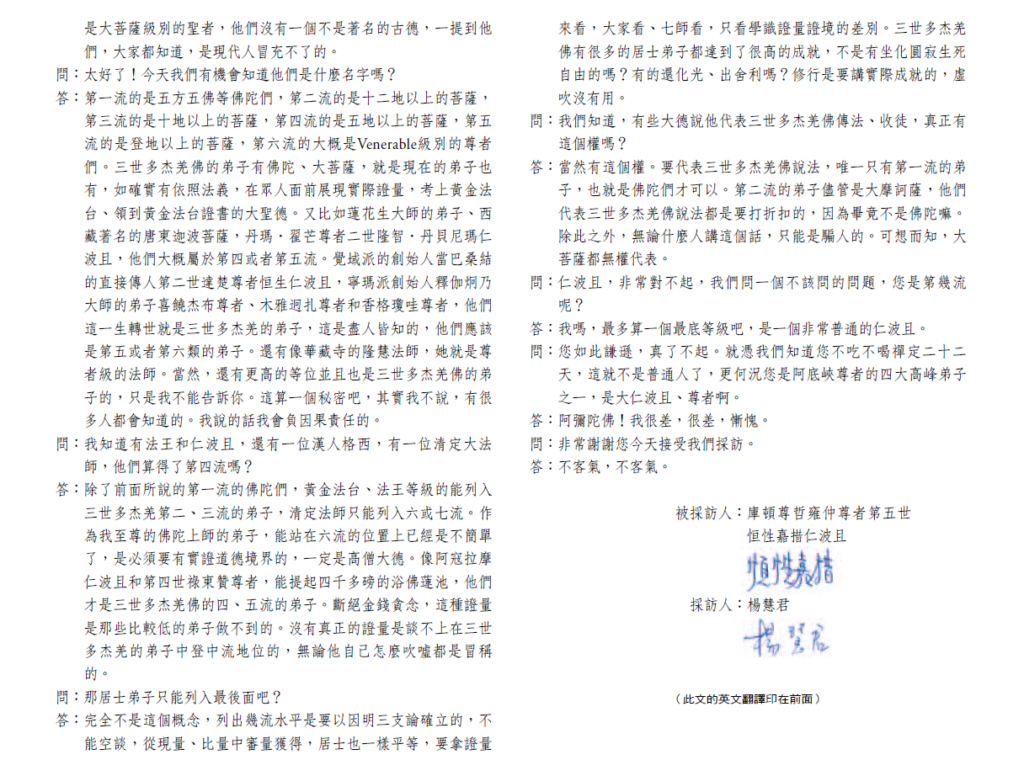
Answer: The first level is composed of the five Buddhas in the five directions as well as other Buddhas. The second level is composed of twelfth-stage Bodhisattvas and higher. The third level is composed of tenth-stage Bodhisattvas and higher. The fourth level is composed of fifth-stage Bodhisattvas and higher. The fifth level is composed of first through the fourth-stage Bodhisattvas. The sixth level is generally composed of those on the level of venerable ones. There are Buddhas and great Bodhisattvas among the current disciples of H.H. Dorje Chang Buddha III. For example, there are disciples of great holiness and virtue who passed the test to become a Golden Throne Holder. During those tests, which were held completely in accordance with the dharma rules, those disciples manifested true realization in front of many people. Having passed the test, they received a Golden Throne Holder certificate. Other examples of disciples are H.E. Tangtong Gyalpo Bodhisattva, who is famous in Tibet, and H.E. Denma Tsemang II Longzhi Tanpe Nyima Rinpoche, both of whom were disciples of Guru Padmasambhava. Those two are probably on the fourth or fifth level. Other people who in this lifetime have become disciples of H.H. Dorje Chang Buddha III include Venerable Dachu II Hengsheng Rinpoche, who in a prior lifetime received teachings directly from the founder of the Jueyu sect, Dangba Sangjie; Venerable Xirao Jiebu, Venerable Muya Jiongzha, and Venerable Xiangge Qiongwa, all of whom in a prior lifetime were  disciples of the founder of the Nyingma sect, Master Shantaraksita. Everyone knows that they are disciples of H.H. Dorje Chang Buddha III. They should be at the fifth or sixth level of disciples. There is also Venerable Dharma Teacher Long Hui of the temple called Hua Zang Si, who is a dharma teacher on the level of a venerable one. Of course, there are other disciples of H.H. Dorje Chang Buddha III whose status is even higher. However, I cannot tell you who they are because that is a secret. Actually, many people know about this without me having to say anything. I bear responsibility for what I say based on the law of cause and effect.

Question: As far as I know, among the disciples of H.H. Dorje Chang Buddha III are dharma kings and rinpoches. There is also a non-Tibetan Chinese Geshe. Great Dharma Teacher Qingding was also a disciple. Can they be called fourth-level disciples?

Answer: As I just said, the first level is composed of Buddhas. Those on the level of a Golden Throne Holder or dharma king belong to the second or third level of disciples under H.H. Dorje Chang Buddha III. Dharma Teacher Qing Ding only belongs to the sixth or seventh level. To be within the sixth level of disciples under my most venerable Buddha Master is something remarkable. One must have true realization and high morals. Such a person is surely an eminent monastic or a greatly virtuous practitioner. Take, for example, Venerable Akou Lamo Rinpoche and H.E. Gar Tongstan IV.

They were able to lift an over 4,000-pound lotus tub used to bathe the Buddha. Still, they are only on the fourth or fifth level of disciples under H.H. Dorje Chang Buddha III. Those disciples who are relatively low have not attained the realization in which all greed for money is cut off. It is out of the question for those who do not have true realization to rise to the mid-level of disciples under H.H. Dorje Chang Buddha III. No matter how much such a person may brag of himself, without true realization he is just making false claims.

Question: Then, should all the lay disciples be classified as belonging to the lowest levels?

Answer: That is not the concept at all. Their level will be determined by the Three Branches of Yinming (Logical Reasoning). It is not a matter of empty talk. Their level is determined by examining their direct awareness and their reasoning. Lay disciples are equal to everyone else in that they must show their realization for all to see and for seven witnessing masters to see. Their different levels result from differences in knowledge and realization. Many lay disciples of H.H. Dorje Chang Buddha III have attained very high accomplishment in the dharma. Aren’t there lay disciples who have passed away in the cross-legged posture while in total control over their own death? Aren’t there lay disciples whose body emitted light after their death? Aren’t there lay disciples who left behind sariras (holy relics) after their cremation? Cultivation emphasizes real accomplishment. Boasting about oneself is of no use.

Question: We heard that there are some persons of great virtue who claim that they represent H.H. Dorje Chang Buddha III in transmitting dharma and accepting disciples. Do they truly have such rights?

Answer: Of course, there is such a right. If you want to represent H.H. Dorje Chang Buddha III in expounding the dharma, you must be on the first level of disciples. That is, only a Buddha has that right. Even Mahasattvas on the second level of disciples fall short of the right to represent H.H. Dorje Chang Buddha III in expounding dharma. That is because they are not Buddhas. Thus, no matter who the person is, if that person is not a Buddha yet claims the right to represent H.H. Dorje Chang Buddha III, then that person is a fraud. You can see that even great Bodhisattvas do not have the right to represent H.H. Dorje Chang Buddha III.

Question: Rinpoche, forgive me for asking a question I should not ask, but to which level do you belong?

Answer: Me? At most I belong to one of the lowest levels. I am a very ordinary rinpoche.

Question: Being so modest, you are truly amazing. We know that you sat in meditation for twenty-two days without eating and drinking–that was not something an ordinary person can do. Moreover, you are the incarnation of one of the four most outstanding disciples of Venerable Atisha. You are a great rinpoche, a venerable one.

Answer: Amitabha! I am quite lacking. I am an ordinary person.

Question: Thank you very much for accepting this interview.

Answer: You are welcome, you are welcome.

Interviewee: Venerable Khu-ston brTson-‘grus g. yung-drung V

Henghsing Gyatso Rinpoche

Interviewer: Huei-Chin Yang

(This text was translated from the Chinese text that follows.)

Learn more about H.H. Dorje Chang Buddha III

Link: https://hhdorjechangbuddhaiiidharma.com/2026/08/02/disciples-of-h-h-dorje-chang-buddha-iii-wan-ko-yeshe-norbu-holiest-tathagata-can-be-divided-into-twelve-levels/

#DorjeChangBuddhaIII #MasterWanKoYee #TwelveLevelsOfDisciples #BuddhistDisciples #BuddhaDharma #BuddhistTeachings #BuddhistPractice #DharmaCultivation #LearningBuddhism #AuthenticBuddhaDharma

Praying for a Child — Gratitude to Namo Dorje Chang Buddha III

Praying for a Child — Gratitude to Namo Dorje Chang Buddha III

Praying for a Child — Gratitude to Namo Dorje Chang Buddha III

I would like to share with every mother who is hoping to conceive that there is an incredibly effective way to pray for a child—the Buddha Dharma.

My precious little one was born safely in December 2016, filling my heart with immense gratitude and happiness. I have always been in poor health. Before becoming pregnant with my daughter, I had experienced the heartbreaking loss of a child. At that time, I believed I might never be able to have children again.

Fortunately, I had already begun studying the Buddha Dharma about a year before that happened. During that period, I diligently listened to the Dharma discourses of Namo Dorje Chang Buddha III and sincerely recited the Universal Gateway of Guanyin Bodhisattva. I dedicated the merits to the child with whom I no longer had the karmic affinity, while also praying that all Buddhas and Bodhisattvas would bless me with a healthy child.

Then something truly miraculous happened. Just two months later, I became pregnant again.

During my pregnancy, I became even more diligent in listening to the Dharma and reciting the Universal Gateway of Guanyin Bodhisattva. Before each session, I would lovingly say to my baby:

“My dear little one, Mommy is about to listen to the Dharma and recite the Universal Gateway of Guanyin Bodhisattva. I invite you to join me so that we can learn together. May you grow up healthy, wise, and well-behaved. May all Buddhas and Bodhisattvas bless us.”

Truly, my child has grown up to be exceptionally intelligent.

While she was still in my womb, I would often communicate with her, saying:

“My little one, when it’s time for you to be born, please don’t let Mommy panic. Give Mommy enough time to prepare mentally. Also, please be born weighing between 2,900 and 3,200 grams—a healthy weight that will make delivery easier for Mommy.”

I have always been someone who is very afraid of pain. Although I eagerly looked forward to my baby’s arrival, I was also extremely anxious about childbirth. After every Dharma-listening session, I would dedicate the merits and pray that all Buddhas and Bodhisattvas would bless me, because I knew the pain of childbirth was beyond what most people could imagine. I also worried that labor might begin unexpectedly before I was prepared.

Even though I had made every preparation, I still felt somewhat nervous.

On my due date, I went directly to the hospital to be induced. That day, I arrived at the hospital calmly and without panic to give birth—an experience I will never forget.

The labor ward was filled with the anguished cries of other mothers in labor. Hearing their suffering brought tears to my eyes. My husband, who was by my side, could hardly eat a bite and quietly fought back tears himself. Their cries were so heart-rending that even those nearby could deeply feel the tremendous pain these mothers were enduring.

During the induction process, I felt only mild discomfort. After receiving the epidural anesthesia, I experienced almost no pain at all. Eventually, the nurse said to me:

“You’re fully dilated and ready to deliver! It’s time to go into the delivery room. Don’t you feel anything?”

I replied,

“Honestly, I don’t feel much at all—just a little pressure.”

At that moment, however, I became afraid that because I couldn’t really feel the contractions, I wouldn’t know how to push. I worried that I might not be able to deliver naturally and would end up needing a cesarean section. The fear I felt was difficult to describe.

Even so, I was probably the quietest mother in the entire labor ward.

Then, in the midst of my fear, I suddenly seemed to hear a voice saying:

“The more fearful you are, the more important it is to remain calm.”

I closed my eyes, visualized the compassionate holy image of the Buddha Master, and continuously recited:

“Namo Dorje Chang Buddha III.”

As I was wheeled into the delivery room, another miracle occurred.

Less than ten minutes after entering the delivery room, my baby was born.

Throughout the entire delivery, I felt virtually no pain at all. It was nothing like the agonizing, hellish pain that many people describe.

Even one of the nurses assisting me remarked,

“How did she do that? Just a moment ago she didn’t even know how to push…”

(To this day, I still find it astonishing myself.)

Even more amazingly, my baby’s birth weight was exactly 3,000 grams—precisely what I had hoped for. She was born healthy and safe.

I am profoundly grateful for the compassionate blessings of the Buddha Master and all Buddhas and Bodhisattvas. The entire childbirth process went remarkably smoothly, and my daughter has grown up to be an easygoing and well-behaved child.

I deeply understand that everything I experienced was made possible through the compassionate blessings of the Buddha Master and all Buddhas and Bodhisattvas. The empowering strength of the Buddha Dharma was something I experienced personally—it was real, tangible, and unmistakable.

With the deepest gratitude to Namo Dorje Chang Buddha III and to all Buddhas and Bodhisattvas throughout the ten directions.

Gratitude to Namo Dorje Chang Buddha III!

Gratitude to Namo Dorje Chang Buddha III!

Gratitude to Namo Dorje Chang Buddha III!

Humbly written by the remorseful disciple,

TINGYUN

Learn more about H.H. Dorje Chang Buddha III

Link: https://hhdorjechangbuddhaiiidharma.com/2026/07/20/praying-for-a-child-gratitude-to-namo-dorje-chang-buddha-iii/

#DorjeChangBuddhaIII #MasterWanKoYee #BuddhaDharma #BuddhistTeachings #Gratitude #DharmaExperience #SpiritualTransformation #BuddhistPractice #Cultivation #Compassion